Story code: ST-000369
Part 3: The Tin Box Under the Shelf
I slid the postcard closer to the edge of the basement lab table and watched what the room did with it. Evan did not relax. He shifted his weight once, then reached toward the old tin box under the shelf as if he had only just remembered it was there. June saw the movement and got there first. She knelt, pulled the box out by the rim, and set it on the concrete between the storage shelves and the cart of coiled cords.
The lid was dented on one side. The marker label on top had faded down to two names and a year. June opened it without asking anyone for permission. Inside was a stack of folded index cards, three thrift-store ribbons, and a key wrapped in masking tape. Dr. Lila stepped closer, hands still on the cart handle, and looked down at the contents without touching them. Evan made a short sound in his throat and stopped.
June lifted the top card first. It had Noah Bell’s handwriting. Not a note for the whole room. A list. One line had been crossed out and rewritten beneath it. Mara’s name was on the newer line, beside the same chair number written on the postcard. Under that, in smaller writing, was the date from the postcard. June held the card up so the others could see the ink without taking it from her.
Evan said the card was old. He said anyone could write a name on anything. He said it did not prove the family line. He said it did not prove the room. But he kept looking at the key in the box, and then at the basement door, and then back at the box. Dr. Lila asked him what the key opened. He did not answer right away. He took one step toward June, then stopped when she closed the box lid halfway over the cards and kept her hand on it.
The key had a tag on it, written in the same slanted hand as the postcard. NOT THE MAIN LOCK. That was all. No explanation. Just enough to send every eye in the room to the small side door near the utility sink, the one that had been painted over so many times the frame looked swollen. I had seen that door before when someone needed a spare outlet or a roll of tape, but no one had used it during the reunion.
June stood up with the card still in her hand. She did not hand it to Evan. She did not hand it to me either. She set it on top of the box and kept the lid from closing all the way. That was a new shape in the room. Before, Evan had been the one moving objects. Now June was.
Dr. Lila crossed to the side door and checked the old brass lock without opening it. It clicked under her thumb. She looked back at the key, then at Evan, then at the postcard in my hand. Evan said the room was getting out of control. He said the event was supposed to stay simple. He said the family did not need a scene. But he was no longer speaking for the whole basement. He was speaking into it.
I turned the postcard over and saw what the crease had been holding. Tucked into the fold, flattened against the paper long enough to leave a mark, was a second strip of cardstock. It had been cut from something larger. On it was the same chair number as the card in the box, and under that, in Noah’s handwriting again, one sentence: If they say she does not count, use the side door.
No one moved for a beat. Then June looked at the side door. Dr. Lila looked at the key. Evan looked at both of them and said, too fast, that he did not know what that meant. The speed of the answer did more than the words.
June did not argue about the meaning. She only asked him who had the spare key. Evan did not answer that either. He reached once toward the box, then stopped when I folded the postcard closed around the strip and kept it in my palm. The card was no longer just paper now. It had weight from the folded insert, from the box, from the dates and names all lining up in the same room.
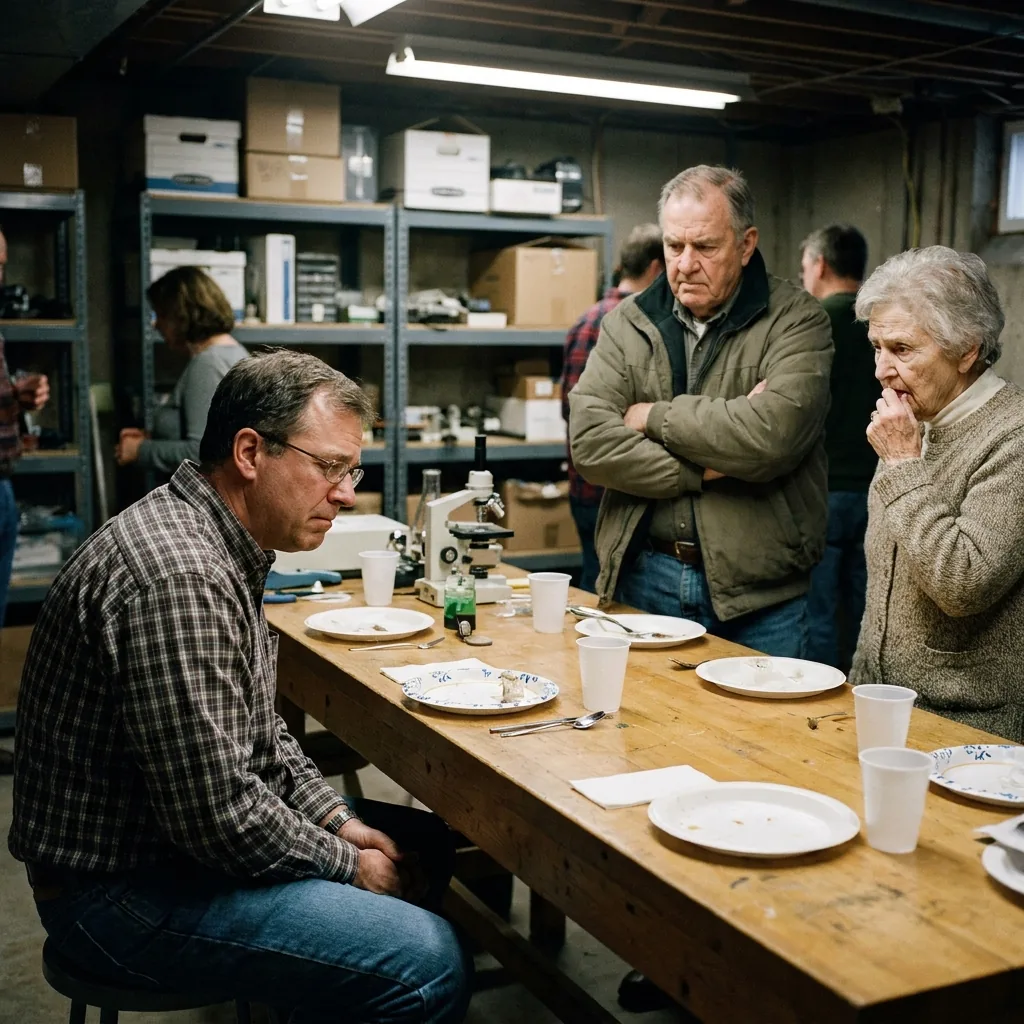
Dr. Lila took the box from June and set it on the lab table beside the empty cake knife and the stack of paper plates. Then she said the event could keep going after a repair. Not a reset. A repair. She looked at the side door when she said it, and then at Evan. Evan’s hand was still half-raised, empty.
That was the point where the story changed shape. The proof was not in the room as a speech. It was in the box, the key, and the door that had been waiting for the right hand. Evan could still talk, but he could not make the objects line up differently. And if the side door opened for Mara, then the room had already admitted she belonged to the part of the house he had tried to keep off the record.