Story code: ST-000386
Part 2: Every Basic Question Made It Worse
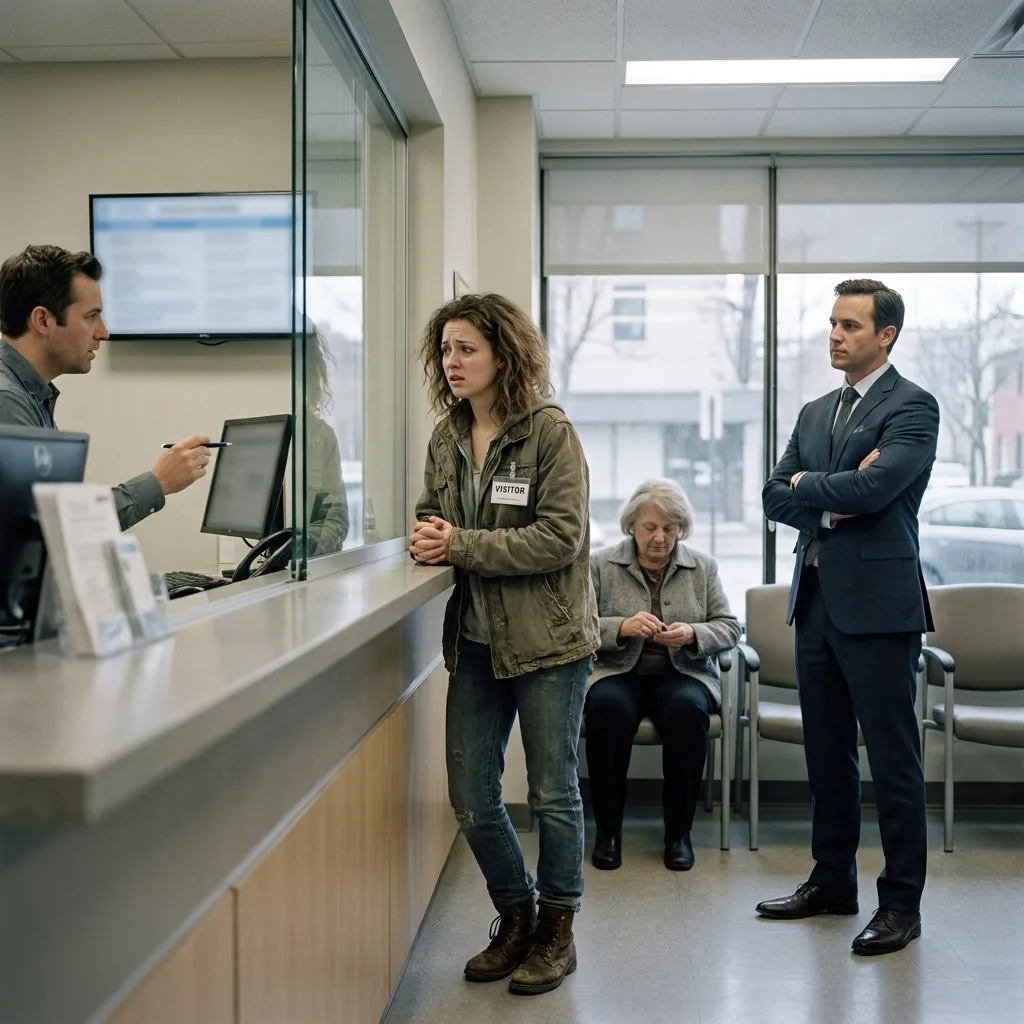
I stepped away from the counter before Damon could call security over a daughter reading labels too closely, but I stayed where I could still see his monitor through the reflection in the glass. Luis disappeared back toward the scanner bays with the black case. Damon lifted his desk phone, listened for a second, then set it down without speaking. He smoothed the aftercare sheet with his palm like it had become the important thing.
I texted Nina again. What happened before 10:50? Was Mom here earlier?
The three dots flashed, vanished, came back, vanished again.
Then: I told you I was on my way.
Not an answer.
I walked to the consultation corridor and stood near the frosted panels where family members were supposed to wait for guided access. A woman in clinic gray offered me water and asked me to stay behind the line until my case advocate returned. She never used my mother’s name. Through the glass I could see movement in pieces: a rolling stool, a sleeve, the edge of a scanner arch glowing white. Every few seconds a badge reader chirped.
When Luis came back through with empty hands, I stopped him.
“Was that my mother’s drive?”
He shifted the cart handle from one hand to the other. “You need to talk to your advocate.”
“I did. He keeps saying the system record is complete. I’m asking a plain question. Was that Marla Walsh’s case?”
Luis looked past me toward the counter first, then back at the hall. “I move what I’m assigned to move.”
“Did you scan it at intake?”
“There are multiple scan points.”
“Was it already tagged before you touched it?”
He tightened his mouth. “Everything is tagged before bay processing.”
“At what time?”
He did not answer that one. Instead he said, “If a family member is disputing sequence order, they usually ask for audit escalation.”
“Damon told me I can’t see anything raw.”
Luis gave one quick shrug that didn’t reach his shoulders. “That’s above me.”
He moved on, but not before I caught one more thing. He reached the scanner threshold, tapped his badge, then doubled back to swap out the drive cradle on his cart for one with a red stripe. He had corrected a label earlier. Now he was changing hardware after Damon had just said bay transfer only. I put that in the same mental pile as the backward timestamps.
When I returned to the counter, Damon already had my file up again, or at least a screen with my name on one corner. He stood when he saw me.
“If you continue bypassing guidance,” he said, “I can mark this as disruptive family interference.”
“Do that after you answer two questions.”
“Ms. Walsh-”
“Two questions. First, if intake imprint was received at 10:42, why did your technician just say the drive had already been scanned at intake? Second, why does your system show duplicate continuity reconciliation at 10:17 before the drive was received?”
His expression stayed flat, but his voice changed by half a step, thinner and more exact.
“Drive receipt and imprint receipt are not identical events.”
“Great. Then tell me the event in between.”
“Summary displays do not enumerate all machine-side actions.”
“Then your summary is false as shown.”
“No. It is abbreviated.”
“Abbreviated enough to reverse time?”
The man at the next counter turned his head. Damon lowered his voice.
“If you force a public disturbance, access can be suspended pending review.”
There it was. Policy as a weapon, clean and bloodless.
I opened the photo folder on my phone and pulled up the screenshots I had taken when I parked. One was the appointment confirmation from the clinic portal. Family witness window begins 11:30. Subject pre-sequence stabilization 10:55-11:25. Another was the location ping I’d sent Nina at 10:58 when I turned into the garage. I set both in front of him.
“Your own portal had her in pre-sequence stabilization at 10:55. So either the case was active before the appointment window you gave us, or these timestamps are attached to something you are not showing me. Which is it?”
He looked at the screen of my phone this time. Not long. Long enough.
“Portal windows are estimates,” he said.
“And duplicate continuity reconciliation is what, exactly?”
“A protected technical phrase.”
“Protected from family?”
“Protected because partial language creates misunderstanding.”
“No,” I said. “Partial language creates cover.”
For the first time, he stopped answering right away.
My phone buzzed again. Nina this time, not text but a photo. It was our mother’s house key on the blue float, lying on a white counter I recognized as the clinic intake desk. The time stamp on the image was 9:48 a.m.
Under it she wrote: Stop doing this in the lobby.
I stared at the picture, then at the time.
9:48. My mother’s key at intake more than an hour before Nina had texted me that Mom was just checking in for prep.
I lifted the phone toward Damon. “Why was my mother’s property logged here at 9:48 if you told me she didn’t move into intake sequence until after 10:42?”
He did not look at the photo first. He looked past me.
I turned. Nina had come through the sliding doors and stopped dead three steps inside, still holding her own visitor badge strip in one hand. She wouldn’t look at me. She wouldn’t look at the picture either.
That was when I knew the clinic wasn’t the only place where part of this day had been left off the official story.