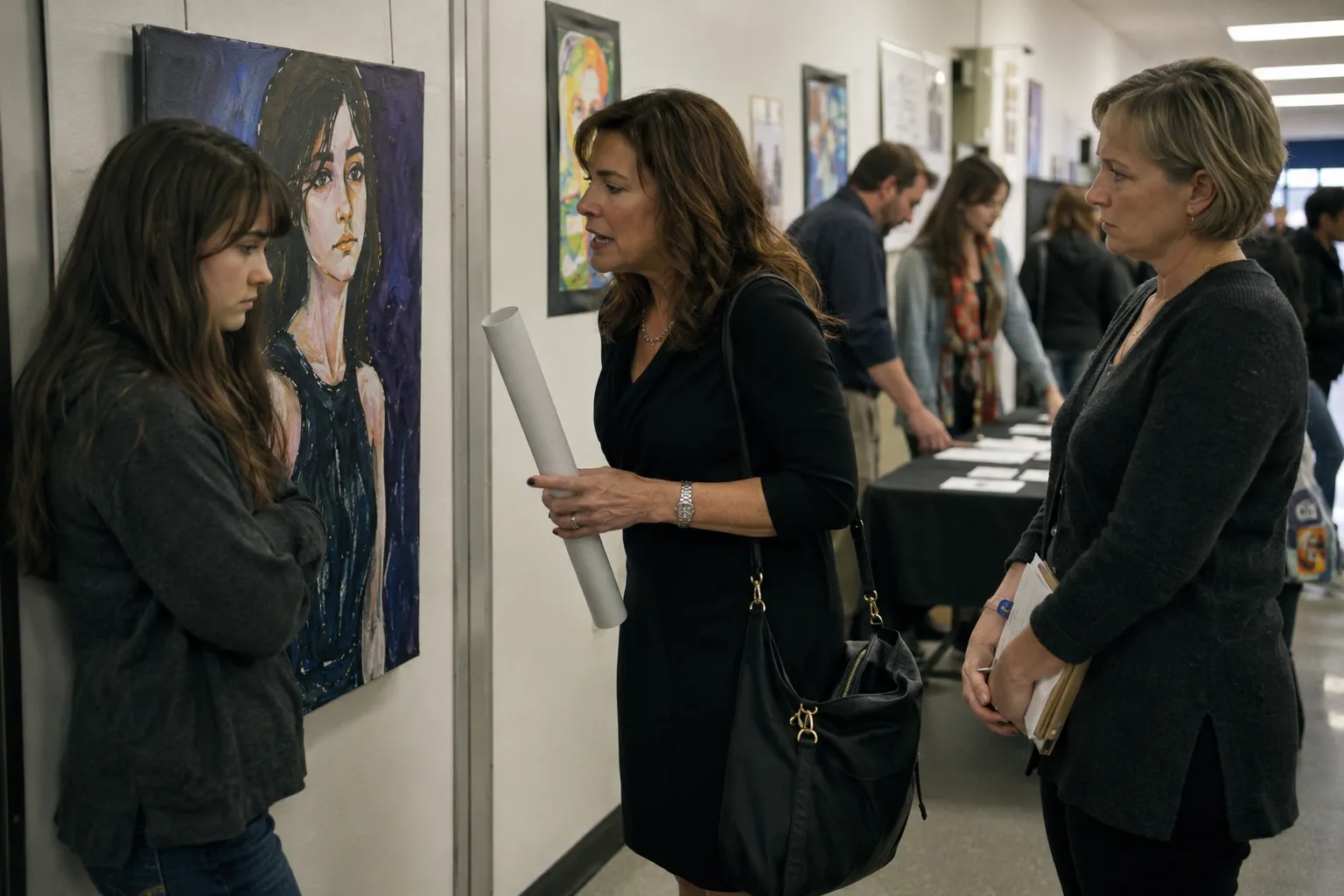
Story code: ST-000040
Part 4: I Left With What Was Mine
I turned away from my mother and answered the man before she could do it for me.
“I’m the artist,” I said.
He nodded once and asked if the price on the card was firm. My voice felt strange at first, like I was borrowing it from someone calmer than I was, but once I started talking about the painting, the words came back to me. I told him the size, the varnish finish, the wire on the back, and when it could be picked up after the show. He listened to me, not to her.
My mother stood beside us for the first few seconds, then tried to slide in.
“We can work out payment,” she said.
I looked at the buyer and kept my tone even. “Payment goes through the school sale sheet with my name on it. Mr. Alvarez handles pickup.”
That was enough. It was not dramatic. It was just clear.
Mr. Alvarez stepped in with the clipboard. “That’s right. Student work sales are logged to the student artist, and released after display closes.” He held out the form to the man in the vest. “If you’d like, I can write it up now.”
My mother started to say something, then stopped when she saw both of them looking past her instead of at her. The buyer filled out the line. Mr. Alvarez took a deposit envelope from the check-in volunteer and wrote my painting number across the front. I watched the cash disappear into school paperwork with my own eyes. Not her wallet. Not her hand. Not a promise I would have to fight about later.
When it was done, the buyer smiled at me and said he hoped I kept painting after graduation. Then he moved on.
My mother waited until he was out of earshot.
“So that’s what this is,” she said. “You embarrass me and cut me out after I carry you all the way here.”
“No,” I said. “I stopped you from taking my sale money.”
She gave a short laugh that didn’t sound amused. “From your sale money. Right. Because who paid for the canvas? The paint? The gas?”
There it was again, the same recital, the same list. This time it didn’t land the same way. She had used it so many times in one night that it had worn thin in public and private both.
I held out my hand. “Give Mr. Alvarez the roll back.”
“It’s not his.”
He didn’t argue. He just waited, clipboard tucked under one arm. Tessa stood near the side wall with her box of labels, watching. Evan had drifted into view by the refreshments table, not close enough to be in it, close enough to see.
I could have pushed harder. I could have said the word switch, or sleeve, or Aunt Celine’s office, or read the messages aloud. I could have made every nearby parent hear exactly how the story had been built. Instead I looked straight at my mother and chose the smallest door out.
“I’m not going home with you,” I said.
That got her attention faster than any accusation.
“Don’t be ridiculous.”
“Mr. Alvarez already said he can lock senior work in the supply room until Monday. Tessa’s brother is still here and can drop me at my dad’s apartment after breakdown.” I kept my voice level. “You are not taking the painting. You are not taking the deposit. And you do not get to call this support and hand me a bill for it again.”
Her face changed in tiny ways I knew well: the blink that came too slow, the chin lifting, the mouth flattening when she wanted control back and couldn’t get it with volume alone.
“If you walk out on me over this,” she said, “don’t expect me to keep funding your little projects.”
It hurt because I believed her. Not as a dramatic line. As logistics. Rides. Store runs. Emergency twenty-dollar bills. Last-minute things that become impossible when one person controls the car keys and decides that help has a price.
“I know,” I said.
That was the cost, sitting right there between us. Not abstract. Not later. Paint, transport, access. Everything she had always been able to turn into leverage if I let her.
She looked at Mr. Alvarez, then at the roll in her hand. For a second I thought she might keep arguing. Instead she shoved the tube against his clipboard hard enough that the papers slid crooked.
“Keep your precious school supplies,” she said.
He steadied the stack and said, “Thank you.”
She grabbed her wallet from the check-in table, called for Evan, and started toward the doors. He hesitated, looked at me, then hurried after her. She did not look back.
The hallway never stopped being a school art show. Someone laughed at the ceramics table. A little kid asked if one of the abstract pieces was upside down. The fluorescent lights kept humming over everything like none of it mattered.
But my hands shook once the doors closed behind her.
Tessa touched my sleeve. “My brother can take you,” she said.
“Thanks.”
Mr. Alvarez wrote my name on a storage tag and clipped it to the back of the painting. Then he sealed the deposit envelope and placed it in the cash box under the volunteer table. I watched him lock the box with a small brass key and put that key on the ring at his belt.
That click was the first thing all night that sounded like relief.
I helped break down my section after the crowd thinned. When it was time to leave, my painting stayed in the supply room instead of going into my mother’s car. I walked out to the parking lot carrying my tool pouch, my phone, and nothing else.
I lost the ride home, the easy supply money, and whatever version of peace depended on pretending her favors were love without a price tag. I kept my painting, my name on the sale sheet, and the truth quiet enough to get out with them.
The night air outside the art building was cold. It smelled like wet pavement and tempera from the classroom vents. Tessa’s brother flashed his headlights once from the curb, and I got in before I could second-guess myself.