Story code: ST-000058
Part 3: So We Measured It in the Garage
I did not argue with the next word she picked. I just went to the shelf, got the measuring cup we used for oil changes, and set it beside the bin on the rubber mat.
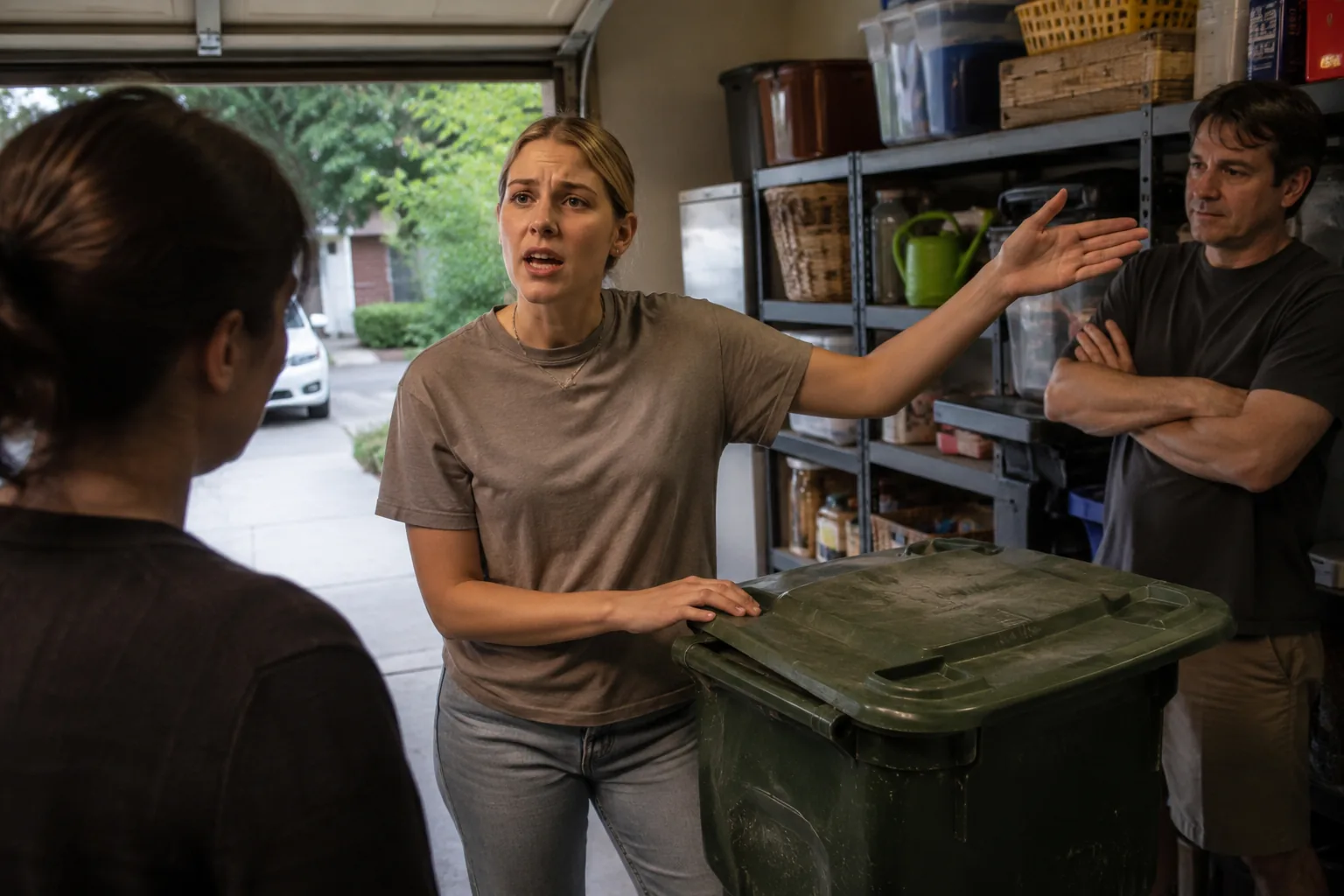
Megan watched me from the other side of the lid. Her jaw stayed still, but her hand kept moving, two fingers tapping the rim like she was keeping time for a class no one else had signed up for. Linda stayed by the workbench, quiet and upright, her eyes on the cup and the seam and my hand.
I said, “We do this simple. Water in, see what comes out.”
Megan gave a short, thin laugh. “That is not how you evaluate a mature compost interface.”
“It is how I evaluate a crack,” I said.
She looked at the bin, then back at me. “You are forcing a linear test onto a dynamic system. The bleed cycle is not visible to the naked eye until the matrix settles.”
There was the voice again, steady as a sales pitch. She said matrix like it had been in the garage all along. She said bleed cycle like it belonged on the side of the bin. Linda did not move, but her eyes dropped to the wet ring under the corner I had already wiped once.
I lifted the lid, set the cup under the opening, and poured half a cup of water over the top layer. The material inside was dark and clumpy, with bits of onion skin and coffee grounds and one bright strip of celery leaf stuck to the side. It did not look like science. It looked like kitchen scraps trying to pretend they had a job.
The water disappeared for a second. Megan nodded, quick and sharp.
“There,” she said. “It is absorbing. That is the point.”
Then it started running down the inside wall.
Not vapor. Not a gradual exchange. A thin brown line broke free at the seam and slid under the bin, then out onto the cardboard, then across the concrete in a crooked little stream. The old freezer hummed. Nobody said anything for a beat.
Megan stepped forward and pointed at the stream like it had offended her. “That is pre-equilibrium runoff.”
I looked at her. “You made that up too?”
She did not answer that. She bent over the bin, pressed the side panel with her palm, and kept talking. “The microflora are reorienting. You are seeing surface lag.”
I crouched and put two fingers under the edge where the liquid had come through. It was wet all the way across the seam now. The cardboard had a dark stain growing fast enough that I could watch it spread.
Linda said, very low, “It is coming through the bottom.”
Megan turned to her. “Because the load is uneven. You cannot shock the system and then blame the response.”
I set the cup down, pulled the bin toward me by the rim, and the whole thing shifted with a scrape that made everyone go still. On the side closest to the floor, a second split opened wider when the weight changed. The plastic flexed, then gave a little more, and a line of brown liquid gathered under it.
That was the part I had been waiting for. Not the words. The movement.
I tipped the bin onto the mat just enough to see underneath. The bottom panel was bowed and the seam had a long hairline crack running into the center, hidden by a strip of green tape that had gone loose at one end. Megan had called it a bleed cycle. What I was looking at was a bin that had been patched and overfilled until it started letting go.
I said, “That tape has been there the whole time.”
Megan looked at the loose strip, then at the wet floor, then back at me. She still did not raise her voice. “The patch is to guide airflow.”
I held the bin up long enough for Linda to see the crack from where she stood. She did not say anything. She just reached for the roll of blue painter’s tape on the bench, tore off a strip, and slapped it across the lid latch so it could not be snapped shut again.
Then she stuck a second strip to the front of the bin and wrote one word on it with a black marker: BROKEN.
Megan went still for the first time since I had opened the garage door.
The marker squeaked once as Linda pressed the tape down. She did not look at Megan when she finished. She just set the marker back on the bench, picked up the wet cardboard, and carried it to the trash can by the side door.
The bin sat there on the mat with water running out of it, and nobody in the garage said another word for a while.