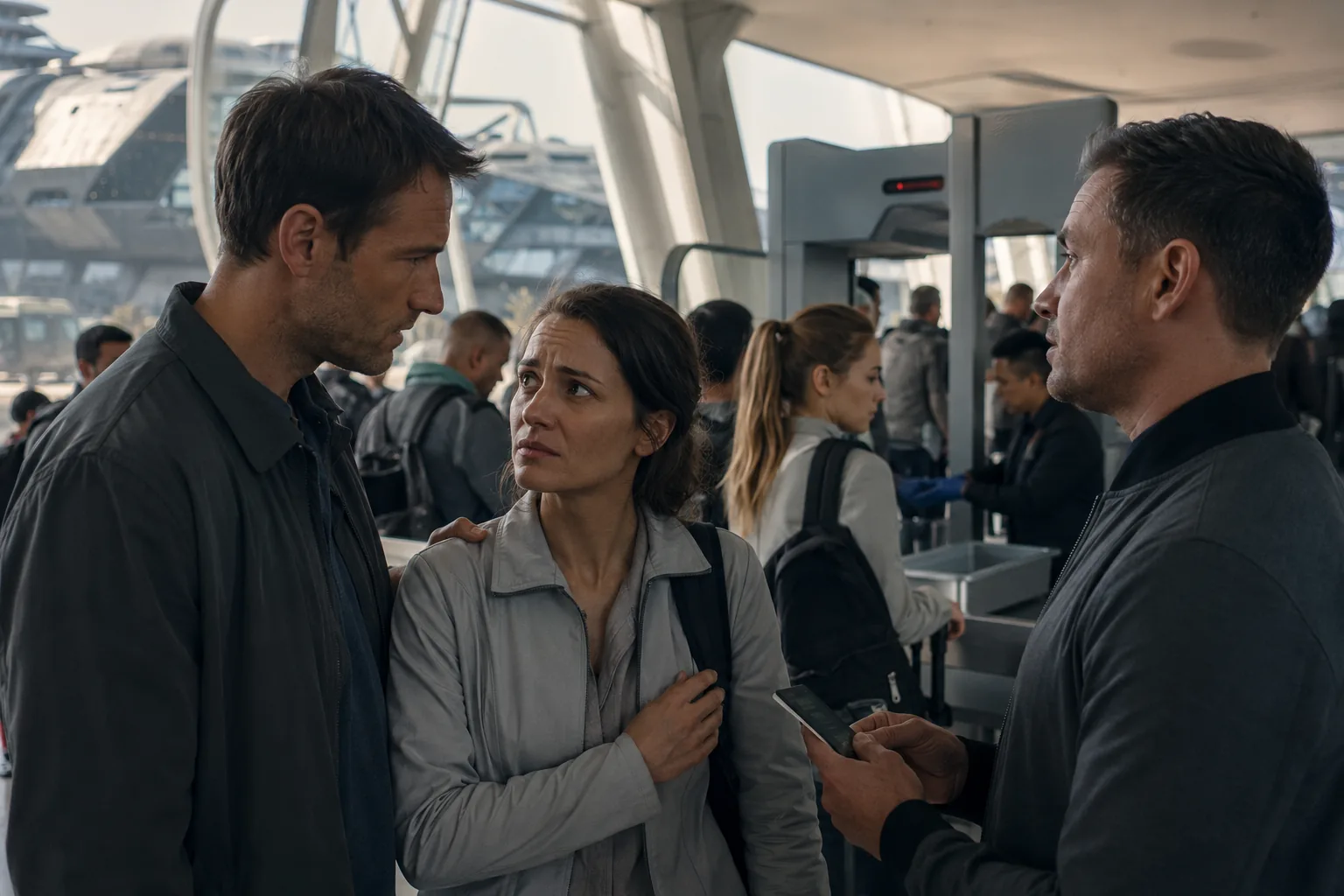
Story code: ST-000054
Part 3: The Missing Line Item
I held my pass where all three of them could see it and said, “Then tell me the amount.”
Cal blinked once, like he had heard me wrong. Dane’s hand stayed on his bag strap. Tessa looked from my face to the pass and back again.
“Mara,” Cal said, “that’s not the point.”
“It is to me.”
A woman in a navy transit blazer rolled a suitcase past us and glanced over the top of her glasses. The moving walkway kept carrying people toward security in a steady hiss. Nobody stopped for us. The terminal was all bright floor and rolling bags and departure screens that kept changing before I could finish reading them.
Dane folded his lips together for a second, then opened them again. “We are not discussing private sponsor accounting in the middle of the concourse.”
“You brought it into the concourse,” I said. “You brought it into my hand.”
Cal made a short, hard sound. “You want everybody to hear this?”
“No,” I said. “I want you to say it once without hiding behind a story. What did I owe, exactly?”
He looked at Dane again. This time the glance lasted longer. Not long enough to tell me anything hidden, just long enough to show me who he kept checking with.
Dane stepped a half pace forward and lowered his voice, still smooth enough for strangers. “We covered your placement after the list shifted. The family could not absorb the full change. We bridged the gap.”
“With what?”
He gave me a patient look that did not answer anything. “With sponsor support. With timing. With flexibility.”
“No,” I said. “Numbers.”
Tessa sucked in a breath and let it out through her nose. Cal rubbed the side of his thumb against his palm. Dane’s jaw tightened once, then settled again.
I noticed the edge of the white paper in his inner pocket still. It was folded into a sharp square now, like he had pressed it flat on purpose. I pointed at it with the pass.
“What’s that?”
“Routine materials,” he said again.
“Then take them out.”
He did not move.
The gate screen overhead changed to final boarding for another flight. People around us shifted position in little waves. A child started crying near the snack stand. The sound cut through the air and made Cal flinch.
I looked at the scanner at the nearest kiosk across the lane. It was unattended. The screen kept cycling through welcome prompts and reservation options. My pass was warm in my hand. My name was on it. Not theirs.
“I’m not handing this over,” I said.
Cal’s face went red at the edges. “You think this is about the paper?”
“Right now, yes.”
Dane’s voice flattened. “If you walk away from the sponsor arrangement, you understand what that means for your access.”
There it was again. Access. Opportunity. Flexibility. Every clean word they used felt like a cover pulled over something sharp.
I turned before any of them could stop me and walked the six steps to the kiosk. The line was empty. A maintenance worker was wiping fingerprints off the glass partition nearby and not looking at us. I held my pass under the scanner.
The machine beeped once.
A screen came up with my flight and a sponsor-linked note beneath it. Not a private thought, not a hidden motive, just words on a public display where I could read them: sponsorship contact on file, traveler confirmation required.
Cal came up behind me and stopped short. I could hear him breathing. “Mara. Don’t.”
“This is my boarding pass,” I said.
The screen asked for a traveler confirmation code. I entered the one in my phone without looking at either of them.
Dane said, “Wait.”
The screen paused, then refreshed.
Sponsor contact removed.
I stared at the words for one second, maybe two. Then the kiosk printed a fresh strip and slid it into the tray with a dry mechanical sound. I picked it up. The new pass had my name, my flight number, and nothing else attached to anybody else’s story.
Behind me, Cal said my name like he was about to argue with the machine. Tessa had gone quiet. Dane finally moved, but only enough to reach for the inner pocket where the folded paper had been. He took it out and looked down at it once. I did not go over there. I did not ask for it. I had seen enough to know the paper mattered to him, even if I still did not know every line on it.
I folded the old pass in half and kept the new one open in my palm.
“You can keep the story,” I said. “You do not keep my seat.”
Cal started to speak, then stopped. Dane pressed the folded paper flat against his own badge and said nothing at all. The kiosk screen behind me reset to the welcome page, bright and blank.
When I turned back toward the walkway, they were still there, but the pressure had changed shape. It was no longer reaching for my hand. It was looking for another place to land.