Story code: ST-000633
Part 2: The Drive Stayed In
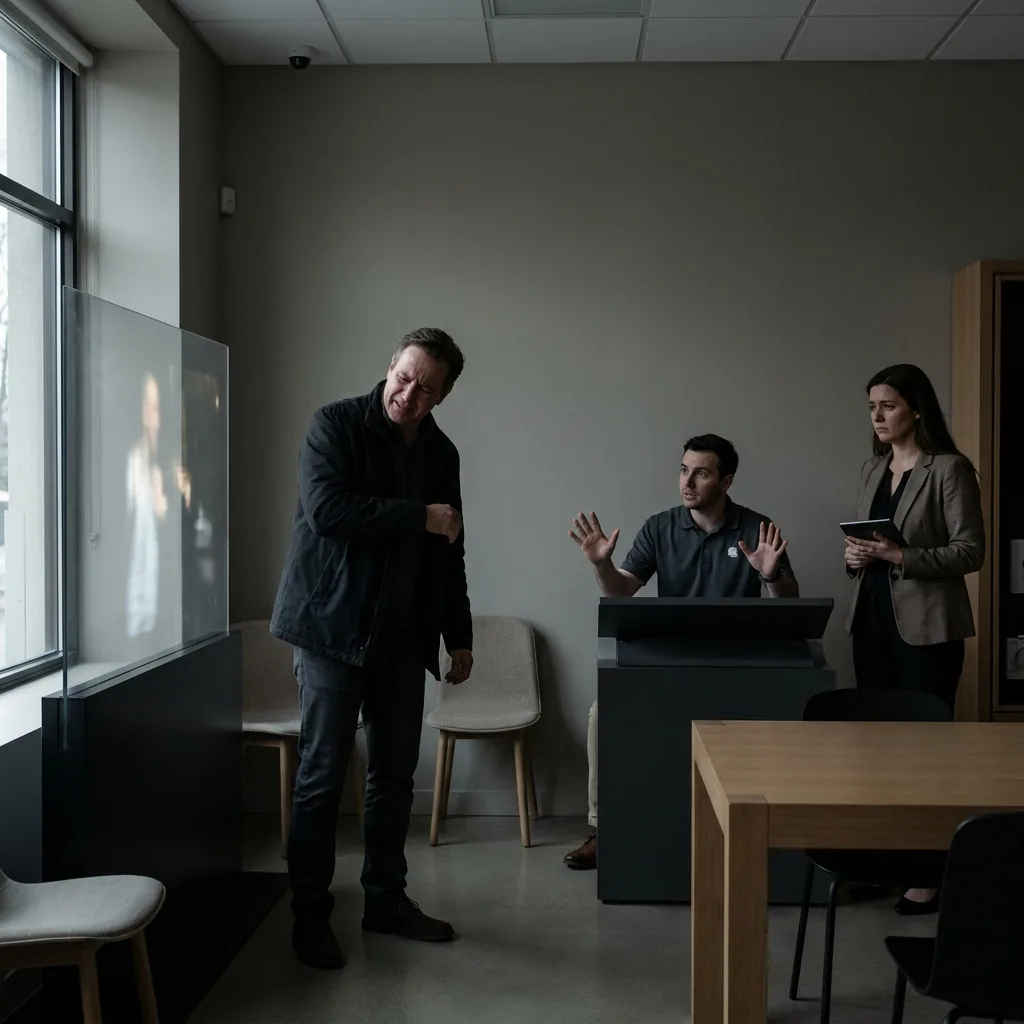
Nobody in the presentation bay moved after Dana said it. The hologram of Ruth Mercer stayed standing on the lit platform with its fixed showroom calm, and the smallest sound in the room came from Marisol Reed’s tablet as the appointment screen timed into a dimmer display.
Evan Mercer recovered first. He kept one hand near the console and gave Dana a careful look that would have sounded gentle to anyone who had just walked in. “That isn’t how the system works,” he said. “Removing active media in the middle of a memorial session can corrupt the rendering state.”
Dana answered before Thomas Hale or Marisol could fill the silence. “You just said it was standard authentication.”
Evan’s fingers tapped once on the counter. “It is. That doesn’t mean you hot-swap storage during live projection.”
Marisol looked from his hand to the screen on her tablet again. She had hosted enough previews to know the ordinary sequence: intake, family note confirmation, likeness render, then either a generic memorial script or a voice-enabled session if a family-specific model had been prepared. The docked drive mattered when a family voice build was actually being called. Her tablet did not show every operator detail, but it did show session type codes. Ruth Mercer’s code line included VM-ACTIVE.
Dana took one step closer to the console, not enough to crowd him, just enough that Thomas shifted in his chair. “Then answer the same question another way. If no custom voice was ever promised, why did you build this session as voice active?”
Evan did not answer that one directly. He reached to the console and muted the projection. Ruth’s moving image remained, but the room lost the soft synthetic voice that had been floating over everything. “Because all premium memorial previews are built on the same framework.”
Marisol’s eyes moved back to her tablet. Premium memorial previews were not all voice active. The standard visual package used a different display marker. She had checked in three families that month under the visual-only path.
Thomas cleared his throat. “Maybe he means the same software,” he said, more to the room than to Dana.
Dana nodded once without looking at him. “Fine. Same software. Then why did he say the drive could corrupt the rendering state if the drive isn’t carrying anything the session needs?”
Evan spread his free hand, a small professional gesture. “Because some files are cached, some are referenced live, and some are part of system integrity. These aren’t distinctions clients usually need.”
The sentence hung there with too many parts in it. Marisol noticed that he had started using more technical terms each time Dana narrowed the question. He had also not removed the drive.
She stepped nearer to the end of the console, still outside his reach space. “Evan,” she said, and kept her tone plain, “do you want me to pull up the intake summary on the bay display?”
He looked at her fast enough for Thomas to see it. “No, that won’t help.”
Marisol did not move back. “It would show whether this preview was entered as visual-only or voice-enabled.”
Evan gave a short smile that did not settle anywhere. “It would show package shorthand without explaining the family conversation.”
Dana turned to Marisol then, not pleading, just precise. “Please show the session type.”
Marisol glanced once at Evan. He was still touching the edge of the console. The dock light under Ruth’s drive was green. On the angled operator display, the top bar showed LIVE VOICE SESSION in small white text. She could only see part of it from where she stood, but enough to read the middle word clearly.
“I can show the intake summary,” Marisol said.
Evan’s answer came over hers. “And then what? We confuse a grieving family with backend labels?”
Dana’s head turned back toward him. “No. You already tried confusing the room by calling me confused. I’m asking the same thing I asked before.” She lifted one hand and pointed, not at the hologram, but at the drive. “If that device is only sitting there for a generic memorial rendering, say what it is actively doing right now.”
Thomas looked at the drive again and this time did not look away when Evan stayed silent.
Marisol set her tablet on the side ledge and woke the appointment note screen there instead. The mirrored host view was limited, but the family-facing intake summary could still be sent to the wall display with one tap. Her finger hovered for a second.
Evan turned toward her fully now. “Don’t,” he said, still in the same low tone.
It was the first outright instruction he had given her since the session began. Marisol stopped with her finger above the glass. She did not tap. She looked instead at the status ribbon across her tablet, then at the operator screen, then at the docked drive. The labels did not line up with the explanation he had repeated.
Dana did not fill the silence right away. When she did, her voice was even quieter. “One question, Evan. If this was never meant to be my mother’s reconstructed voice, why is the bay tagged for live voice session before a single line is spoken?”
The waiting area printer started again. Someone at reception laughed softly at something out of earshot, then stopped. In the bay, Evan faced the console without touching the command Marisol knew would put the intake summary onto the wall. He did not remove the drive. He did not unmute the projection. He only said, after a pause that lasted long enough for the room to count it, “Session tags don’t always reflect final output.”
Marisol looked at the green dock light, then at the header still visible on his screen, and saw one ordinary next step that would prove whether that sentence was true or not. Evan saw where she was looking.
He moved his hand toward the verification menu before anyone asked him to.