Story code: ST-000635
Part 3: The Test He Tried to Shrink Became a Record
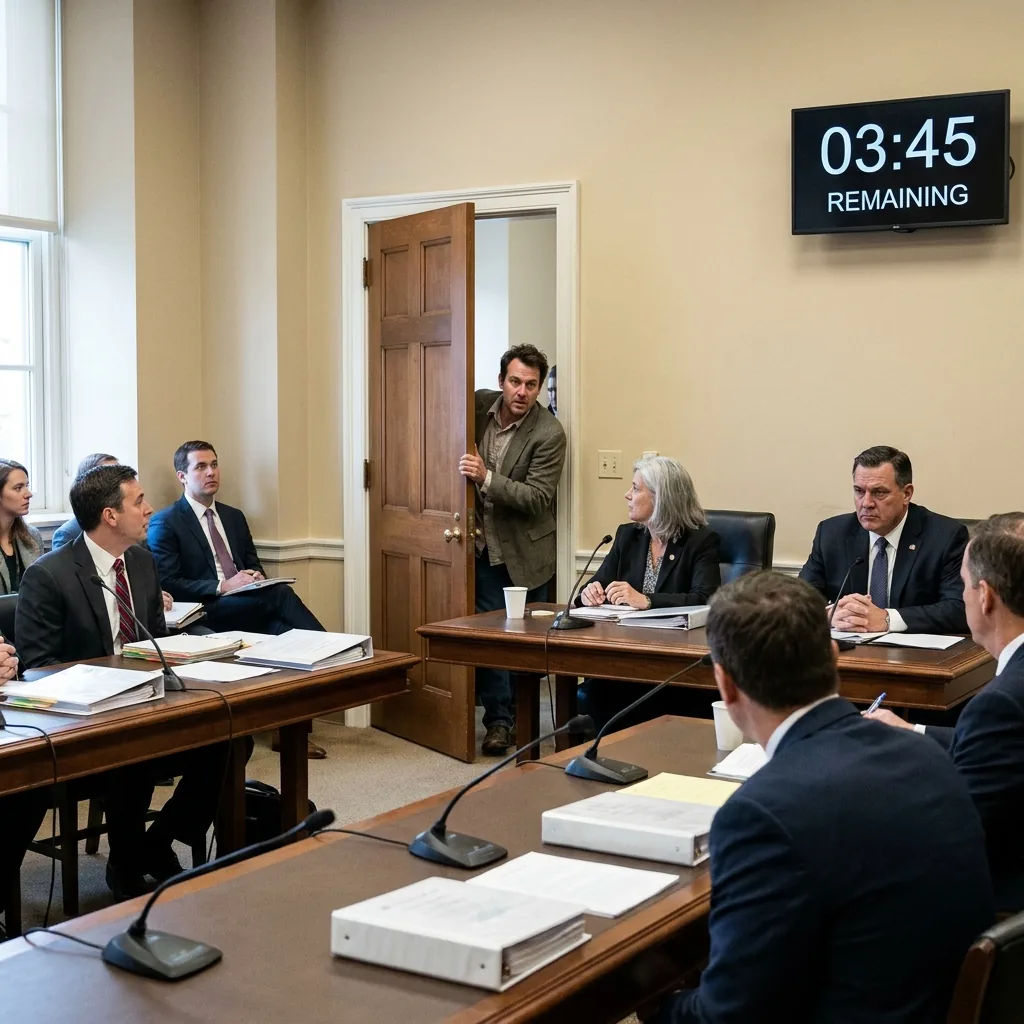
Asha Reed capped her pen and set it beside the pad like she had decided on an order of operations. Then she pressed her mic. “Mr. Kessler, before this committee returns to testimony, I want your request narrowed one last time. On the record, are you alleging an active freezer malfunction, or are you withdrawing the emergency claim?”
Evan Kessler did not answer right away. He kept one hand on his water cup and looked through the glass toward the sample freezer zone instead of at the dais.
“I am stating,” he said finally, “that sponsor materials face sensitivity risk and public overhandling is not acceptable.”
Asha did not move. “That is not one of the two options I gave you.”
Miguel Hart was still standing by my table with the gray case closed. He had not taken a step toward the freezer. The whole problem was now only a few feet wide: one glass partition, one locked unit, one sponsor who had burst in calling it a minutes-left emergency and now would not say the words again.
Dr. Lena Park said, “Answer counsel’s question.”
Kessler cleared his throat into his fist. “I am not withdrawing concern.”
“Concern is noted,” Asha said. “Emergency?”
He looked down at his phone, tapped the screen once, and locked it without showing anyone. “I cannot verify emergency status from here.”
That changed the air more than if he had raised his voice. Twenty minutes earlier he had been the one insisting there was no time to verify anything.
Dr. Park turned slightly toward Miguel. “Officer Hart, what is the least invasive verification step available from inside the room?”
Miguel answered in the same tone he had used since he arrived. “Visible panel confirmation, chain log review, and if authorized, external diagnostic handshake without opening the freezer or disturbing custody seals.”
Asha said, “Does that create a handling event?”
“Not unless access is attempted,” Miguel said. “Diagnostic read only. Logged automatically.”
Kessler moved at that. “No. I object to any handshake before sponsor technical staff are present.”
“You object to a read-only diagnostic,” Asha said.
“I object to committee interference with proprietary preservation systems.”
Dr. Park folded her hands. “You asked this committee for immediate intervention.”
He spoke over her. “I asked for cooperation.”
She waited until he stopped. “And the room heard you ask staff to bypass protocol. We are now at a narrower step than that. If your claim is real, this confirms it. If your claim is not active, this confirms that too.”
Nobody else spoke. The hearing microphones carried every little sound: a chair settling, the soft hum from the freezer side, the tap of my thumbnail against the edge of the console before I made myself stop.
Dr. Park said, “Staff, display the current access log on the room monitor. Officer Hart, describe the read-only step before it is initiated.”
I routed the console output to the side screen used for exhibits. The monitor lit with a plain table: freezer ID, lock status, last authorized maintenance date, no active access entry, and the hearing timestamp attached to Kessler’s objection to technical verification. It looked boring, which made it worse for him. There was nowhere for urgency to hide inside neat rows.
Miguel opened the gray case. Inside was a tablet, a short cable, and a sealed adapter pouch. He held up the pouch without breaking it. “This remains sealed unless chair authorizes port connection. Read-only diagnostic checks unit alarm history, sensor status, and temperature stability record. It does not unlock the freezer.”
Kessler pointed at the pouch. “That connection itself alters system state.”
Miguel looked at him, then at Dr. Park. “Not on this model.”
Asha’s eyes stayed on Kessler. “You knew the model well enough to claim compressor trouble. Do you disagree with the officer’s statement?”
Kessler’s answer came slower now. “I disagree with doing this in a hearing room like theater.”
“Then the room was only urgent when you wanted a rule broken,” Asha said.
He opened his mouth, shut it, then pulled his hand back from the water cup and flattened both palms on the table.
Dr. Park did not look at him again. “Authorized. Read-only diagnostic only. No opening, no sample movement, full log capture.”
Miguel broke the pouch seal where everyone could see it. He crossed to the glass-partitioned freezer zone with me beside him to witness the console link. The freezer door stayed shut. He crouched at the external access port, connected the adapter, and waited while the tablet screen populated. I could see the reflected glow in the glass.
“Diagnostic live,” Miguel said.
No one in the room moved.
Then Miguel straightened just enough to read from the tablet. “No active alarm. No compressor fault in current cycle. No temperature excursion beyond threshold in the last twenty-four hours. Last flagged event was a brief door-open notification yesterday at 18:14, resolved in twelve seconds.”
Asha did not take her eyes off Kessler. “Yesterday. Not today.”
Miguel scrolled once. “Current internal temperature stable. Trend line flat.”
Kessler spoke before anyone asked him anything. “That log is incomplete unless sponsor calibration overlays are loaded.”
Miguel turned the tablet so the timestamp could be seen on the room camera and the side monitor. “The base unit reports no emergency condition.”
Dr. Park’s voice came through the speaker clean and cold. “Staff, mark the live diagnostic result and Mr. Kessler’s repeated objections to verification as a separate administrative item for immediate note.”
That was the moment the problem stopped being his claim and became its own entry in the record.