Story code: ST-000635
Part 2: The Emergency Started Shrinking on the Record
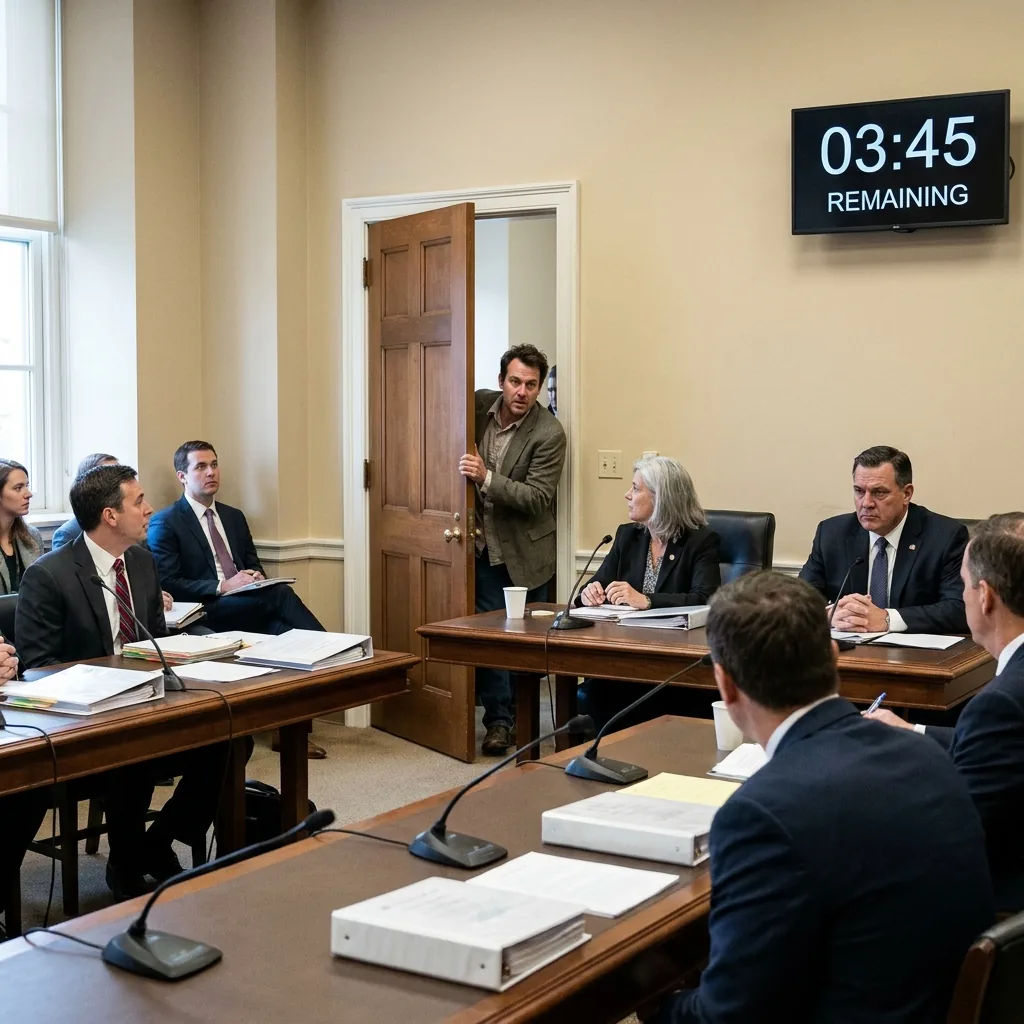
By the time the call to Miguel Hart was logged, the room had gone quiet in that hard, listening way that is louder than shouting. Evan Kessler stayed standing instead of taking his table seat, one hand flat on the wood, the other still near his phone. The sample freezer sat behind the glass partition off the hearing space with its display strip glowing blue, visible enough that everyone kept glancing at it like it might start proving somebody right by itself. Dr. Lena Park spoke first. “The page stands.” Kessler gave a short laugh with no smile in it. “Chair, that is not what I requested.” Asha Reed answered before Dr. Park did. “You requested immediate action tied to an alleged freezer emergency. Technical verification is immediate action.” He pointed toward the freezer zone. “I requested preservation, not a compliance spectacle.” That word hung in the room. Spectacle. Like the problem was not the freezer anymore but the fact that other people would see what happened when the right person touched it. I kept the access screen open and my hands folded beside the keyboard. The hearing timer ticked in the upper corner of my monitor. Nobody asked me to move, but I could feel every eye cutting back to the console when the page status changed from sent to acknowledged. I said, “Miguel Hart acknowledged. Estimated arrival six minutes.” Kessler turned toward me at once. “Cancel it.” Dr. Park’s mic light came on. “Do not address staff directly.” He corrected toward the dais without softening his voice. “Then I am directing my objection to the chair. The samples are sponsor property under active preservation concern. Additional handling expands risk.” Asha said, “A moment ago you argued delay itself would destroy them. Which risk are you asking us to prioritize now?” He pulled his phone back into his hand, unlocked it, looked at the screen, then locked it again without showing anyone. “You are turning this into a trap.” No one answered that. We all just sat with it. Dr. Park said, “Mr. Kessler, the committee is not ordering a transfer. The officer will verify status and, if needed, initiate protocol. That is the narrowest available response.” “No,” he said. “No freezer opening. No logging event. No chain entry until my lab confirms.” Asha’s pen stopped moving. “Then explain what immediate action you are actually requesting.” He opened both hands. “Visual access. Manual correction authority. Discretion to prevent unnecessary bureaucratic damage.” That was the closest he had come to saying it plainly: he wanted the rule break itself, not the emergency response built for real emergencies. I heard movement behind the side door before I saw Miguel. He came in carrying a slim gray case and wearing his badge on a blue retractable clip, not rushing but not wasting steps either. He paused just inside the room until Dr. Park recognized him on the record. “Technical Compliance Officer Miguel Hart present,” she said. “Please approach the staff table.” Miguel nodded to the dais, then to me. “What is the reported condition?” Before I could answer, Kessler cut in. “You are not needed.” Miguel stopped. “I was paged for a temperature fault tied to clone sample custody.” “The situation is being handled internally,” Kessler said. Asha leaned toward her microphone. “By whom?” He did not answer her. He looked only at Miguel. “Stand down.” Miguel’s expression stayed flat. “I can’t stand down from a logged call without chair direction.” That was another small shift, and this one everybody in the room could hear. Kessler had come in acting like the clock was the danger. Now he was spending that same clock trying to keep the technical officer several feet from the freezer. Dr. Park asked me, “Current display status from the visible panel only.” I read exactly what I could see from the staff monitor and the panel through the glass. “Panel shows power on, lock engaged, no external audible alarm. Internal condition not verified from this position.” Kessler moved on that. “Exactly. So there is no basis to escalate further in public.” Miguel set his gray case on the corner of the staff table but did not open it. “If there is no basis, verification resolves that. If there is a fault, verification resolves that too.” Kessler shook his head once. “Your involvement creates a record event that may compromise sponsor handling.” Asha said, very clearly, “You came into a live hearing and asked us to compromise handling without a record event.” The sentence sat there untouched. Kessler’s jaw tightened. He checked the phone again. This time he turned slightly away from the room when he read whatever was on it. Then he put it down and changed direction all at once. “Fine,” he said. “The temperature fluctuation may have stabilized. My liaison may have been looking at a projected trend, not an active failure. There is no reason to dramatize a nonissue.” Nobody rushed to answer him. Miguel stayed still beside the case. Dr. Park looked at Asha. Asha looked at me. On my monitor, the freezer access log showed no emergency entry, no authorized intervention, and one recorded sponsor objection to technical verification attached to the same minute as his demand for immediate rule breaking. Dr. Park said, “Officer Hart, remain available. Staff, preserve the log and mark this sequence for the record.” Miguel gave one nod. Asha wrote something short and boxed it on her yellow pad. Kessler reached for his water, missed it by an inch, then took the cup on the second try. He had not touched the freezer. He had not named a code. He had not let the person he demanded us to get do the check. And now, in front of a room full of microphones, his emergency had shrunk from imminent loss to maybe a projected trend. When Dr. Park asked Asha what the next procedural step should be, Asha did not answer right away. She looked at the objection.