Story code: ST-000654
Part 4: I Stopped Letting Her Use My Mother as Her Stage
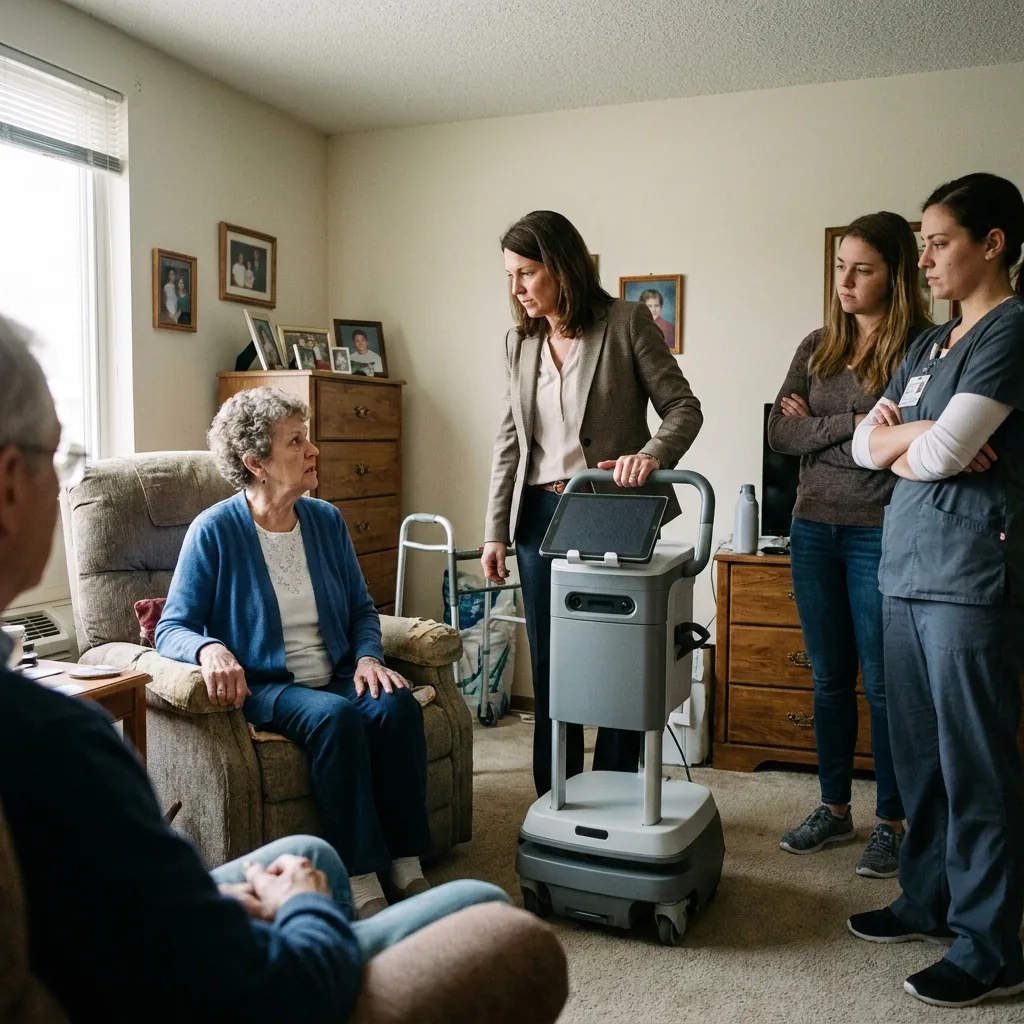
The room changed the second Dana told Nina, “No one touches its settings until I say so.”
Not because she got louder. Because she said the quiet part in a sentence nobody could sand down. She had started the afternoon talking about sacrifice and gratitude. Now she was giving orders in my mother’s room as if the care robot, the dock, and the routine belonged to her voice.
Nina did not answer right away. She looked at me, then at my mother. That was all the opening I needed.
I stepped to the doorway threshold, not to trap Dana, just to mark the line in a place everyone in the room could see.
“No,” I said. “Here’s what happens now. You are done directing anything in this room today. You can send any necessary technical notes to your office. From this moment on, you do not visit my mother without approval from me or Maya, and you do not speak to staff here like you outrank the family or the resident. Nina, please note that exactly.”
Nina gave one short nod. “I will note vendor visits by prior family approval only.”
Dana stared at her. “This is absurd.”
“It’s clear,” I said.
Maya came around the visitor chair and stood beside my mother’s recliner. Not in front of me. Beside our mother. It was the first useful side she had taken all afternoon.
“Mom doesn’t need surprise drop-ins,” she said. “And she doesn’t need speeches about what she owes you.”
Dana spread her hands. “I never said she owed me.”
I almost laughed at that, but I was too tired. “You said gratitude mattered when I wouldn’t obey you in front of staff. You said direct access changed service priority. You just told the aide not to touch settings until you say so. You don’t have to call it a debt for everyone to hear what it is.”
She opened her mouth, then shut it again.
My mother saved us from one more loop. She set her paper cup on the side table and said, very clearly for someone who had been quiet most of the afternoon, “Dana, leave the room now.”
Nobody moved for half a second. Then Dana put on a smile that looked painful around the edges and turned it toward my mother.
“Evelyn, I think Lauren is upsetting you.”
That did it for me. Not because it surprised me. Because it landed exactly where I could finally stop accommodating it.
“No,” I said. “You are upsetting her. And this is over.”
I pressed the call button myself, not as an alarm, just as a clean way to bring the facility into the boundary without turning it into a spectacle. The light over the door blinked. Dana looked at the button, then at me, then at Nina, calculating whether to keep pushing now that the room had stopped yielding.
Within seconds another aide appeared in the hallway and paused at the open door. Nina handled it in her calm work voice. “We’re fine. Family is setting a vendor access note for future visits.”
That was all. No speech. No audience. No grand exposure. Just the room reorganizing around a rule.
Dana picked up her bag from beside the family photo shelf. “You are making a mistake you’ll regret,” she said.
“Then we’ll regret it through the proper office,” I said.
She looked at the robot one more time before stepping into the hall. I moved just enough to let her pass, then stayed at the threshold while Nina followed her out to repeat the desk process. I heard only fragments from the hallway. “family approval,” “visitor note,” “front desk.” Routine words. Beautiful words.
When Nina came back, she held a small notepad in one hand. “I’ve asked the desk to add it now,” she said. “No unscheduled vendor access. If there are service needs, they’ll call family first.”
There was the cost and the relief together. More steps. More watching. More handling ourselves. But the chain was broken.
The robot gave another soft chime and repeated, “Reminder available: afternoon medication in twenty minutes.” This time it sounded like what it had been all along: a machine in a room, not a trophy in somebody else’s morality play.
Maya let out a long breath and sat on the arm of the visitor chair. “I should have backed you sooner,” she said.
“You did now,” I told her.
My mother looked at the doorway, then at the robot, then at me. The tightness around her mouth had eased. “Close the door,” she said. “And hand me my water before your helpful friend comes back through it on a white horse.”
I closed the door. I handed her the cup. The ice clicked softly again, but this time the sound did not feel like a warning.
Nina adjusted the towel stack on the counter and asked my mother if she wanted her medication now or after two more minutes. Normal question. Normal tone. My mother answered without glancing at anyone for permission.
I sat back down beside her recliner and looked at the charging dock, the family photos, the call button, all the ordinary things Dana had tried to wrap in obligation. They were just ours again, with one new rule attached.
Dana had not taken the burden back because the burden was never the point. The point had been staying in the room where no one was supposed to tell her no. Once that ended, everything finally got smaller in the right way.
My mother drank her water in peace, and for the first time that afternoon, the room felt like her room again.