Story code: ST-000654
Part 3: The Burden Only Counted If She Kept Her Hands on It
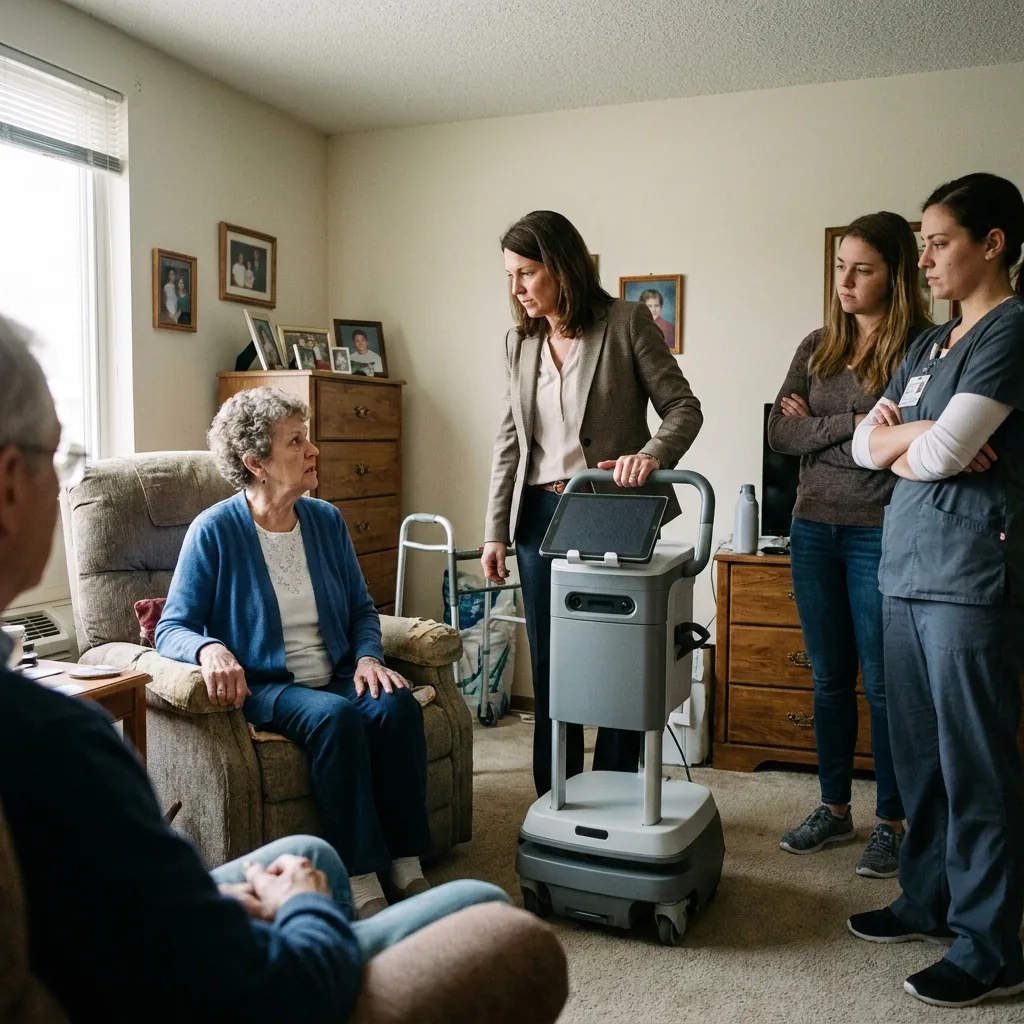
Nobody answered my mother for a second after she said, “Then maybe the support isn’t what you say it is.” Dana stood by the charging dock with one hand half raised, like she had been about to make another point and forgot the shape of it. The robot gave a soft status hum beside her calf. Nina stayed near the counter, still and practical, waiting for an instruction she could actually use.
That was when the pattern finally stopped looking messy and started looking clean.
Dana did not want thanks. She did not even want credit in the ordinary sense. Credit could be acknowledged and finished. What she kept refusing was the end of the transaction. Every time I thanked her and offered to take the burden back through proper channels, she grabbed harder for a role no one had asked her to keep. The sacrifice story only worked if we were not allowed to say, no thank you, we’ll handle it from here.
I looked at the robot, at the dock beside my mother’s recliner, at Dana’s body planted between me and both. Visible object. Visible claim. Visible refusal.
So I stopped arguing about her meaning and tested the line one more time in the plainest language I had.
“Dana,” I said, “I’m going to say this once more so there’s no confusion. Thank you for helping get the robot here. From this point on, scheduling, settings, and any follow-up go through your office and through us. Not through direct drop-ins, not through private check-ins with my mother, and not through pressure in this room. If your concern is sacrifice, we’re relieving you of the personal part.”
Maya nodded slowly this time. “That’s fair.”
Nina added, “If that’s the family direction, I can note it with the desk.”
Dana’s warm vendor voice came back, but stretched too tight. “You are making a reckless decision in the middle of an emotional scene.”
“No,” I said. “I’m ending the emotional scene.”
She gave a quick little laugh and pointed at the robot. “And when this unit starts missing details because some office queue handles everything instead of the person who actually cares, what then?”
“Then we deal with the office queue,” I said. “Like every other service issue in this building.”
Her chin lifted. “That is not how I manage my families.”
My families.
Not clients. Not residents. Not accounts. My families.
Maya heard it too. I saw it in the way she uncrossed and recrossed her arms, slower this time, like she was fitting the sentence into place with everything else Dana had said. My mother let her cup rest in her lap and looked at Dana over the rim of it.
“I am not one of your families,” she said. “I am me. In my room.”
Dana turned toward her at once. “Evelyn, you know I only mean I look after people personally.”
“No,” my mother said. “You mean you don’t like being told where the door is.”
The words sat there. Dana’s face stayed composed, but she began talking too fast.
“This is exactly what I worried about,” she said. “Lauren has always had a suspicious read on me, and now staff is being pulled into a family misunderstanding, and meanwhile the robot’s care map, reminder cadence, and preferred interactions are being treated like plug-and-play. They are not. I built a lot of this by hand. I came here on my own time. I rearranged things to make this room function. I checked on Evelyn when others were too busy. I made exceptions. I made this work.”
It was all one long defense against a door nobody had even shut yet.
Nina looked at the visitor log clipboard tucked under her arm. “For clarity,” she said, “room arrangement changes should go through resident and family approval.”
Dana’s mouth tightened. “I know protocol.”
“Then follow it,” I said.
The robot chimed once, then announced in its cheerful default voice, “Reminder available: afternoon medication in twenty minutes.” My mother gave a tired little snort at the timing. Dana reached down automatically to touch the top of the machine again, and that small move told me more than another speech. She was still claiming the object in the center of the room while calling it sacrifice.
I stood up from the chair.
Not suddenly. Not dramatically. Just enough to make it obvious I was done performing calm for her benefit.
“Nina,” I said, keeping my voice level, “please note today that no unscheduled vendor visits happen with my mother unless one of us approves it first. And if there are robot updates needed, they can be arranged through the desk when family is present.”
“I can do that,” Nina said.
Dana’s head snapped toward her. “You cannot make that kind of note based on a misunderstanding.”
“I can note family direction,” Nina said.
There it was. Not a secret file. Not a confession. Just Dana refusing release again and again, now in front of a witness who could turn a spoken line into routine. Dana took one step toward the doorway, then stopped and turned back to the dock like she could not leave the machine without taking something with her.
“If you do this,” she said, looking at me, “don’t call me when things get less simple.”
“I wasn’t planning to,” I said.
Then she said the one thing that made Part 4 unavoidable.
She pointed at the robot and told Nina, “No one touches its settings until I say so.”