Story code: ST-000657
Part 2: The Rule Started Spreading
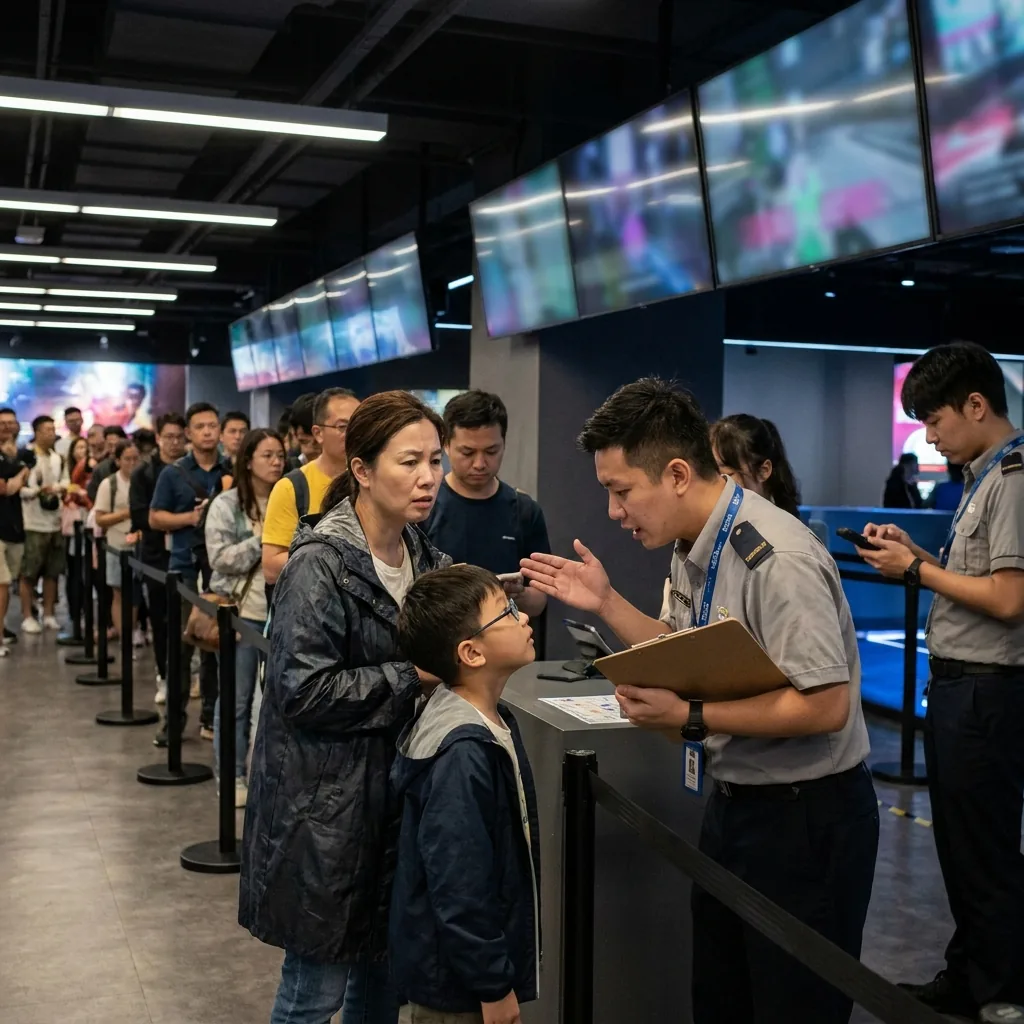
Once Nina Vale called across to the adjacent station, the whole explanation got worse, not better. Rachel Mercer was still standing at the filter control counter with Evan and his unopened wristband, and now another line had to pause because one staffer had made a rule she still could not point to on any screen.
Tori Alvarez looked up from her scanner with the quick, tight expression of somebody whose line had just been interrupted mid-flow. A father at her station already had one child wristbanded and the second child lifting a pair of AR glasses into place. Tori lowered her hand and asked, “Hold for what exactly?”
Nina answered without moving from Rachel’s counter. “External overlay filters. Check all non-plaza eyewear before activation.”
That wording had not been said a minute earlier. Rachel had heard “current visual filter compliance standard” and “live safety and filter issue.” Now it was “external overlay filters,” broad enough to catch half the room if anyone tried to use it consistently.
Tori glanced at the children in front of her, then at their father. “We haven’t been screening by that at this station.”
Nina said, “You are now.”
There was no dramatic scene. That was part of what made it so clear. Tori did not argue like a person challenging authority in public. She just stopped, repeated the instruction back in the flat voice people use when they are making sure they heard something correctly, and started asking the family in front of her to remove the glasses for inspection.
The father asked the obvious question first. “Was there a change?”
Tori said, “I’m being told to verify compatibility before activation.”
He asked where that policy was posted.
Tori gave a short glance toward Nina and said, “I’m checking on that.”
Rachel did not need to say anything for the contradiction to widen. It was happening in plain sight now. A rule that had supposedly been firm enough to block Evan at the counter had apparently not been firm enough to reach the next station until Rachel asked why other children were still getting through.
Two more families drifted their attention over. The sound from the demo wall kept running, but the check-in rhythm broke. Scanners stopped chirping. Wristbands stopped printing. Kids who had been bouncing in place a minute earlier were now holding glasses in their hands while adults asked variations of the same question.
What exactly are you checking for?
Which models?
Is this for all zones?
Nina stayed with technical language. She stepped around the end of the counter and began looking at eyewear one pair at a time. She rejected one set because the lenses were tinted. She hesitated over another and asked Tori which game lane that child had booked. She waved a third child through after asking no visible question at all beyond “standard issue?” even though the frame was obviously not plaza-issued.
Rachel saw it the same way anyone watching would have seen it: the rule was not becoming clearer as it spread. It was becoming softer at the edges and harsher in random spots.
Evan stood beside her with his glasses case pressed against his jacket. He was quiet until one younger boy from the other line got sent back to his father to remove his frames. Then Evan asked Nina, “So if his can maybe work, why can’t you even test mine?”
Nina answered him the way she had answered Rachel all along, by skipping the center of the question. “Yours present a filter conflict.”
Rachel said, “You keep naming conflicts without showing one.”
Nina turned her tablet outward for half a second, not long enough for any customer to read more than a grid of station codes and status colors. There was no visible policy text on that brief angle, no red warning attached to Evan’s reservation, nothing that settled the matter for anyone watching.
Then Tori called over from the adjacent station, not loudly, just clearly enough to carry. “Nina, are we blocking all third-party glasses, or only some?”
That question froze the lane again.
Nina answered, “Only the incompatible ones.”
Tori asked, “Based on what criteria?”
Nina said, “Lens behavior, overlay risk, and zone interaction.”
Tori looked down at the pair in her hand, then back up. “Can you define that for check-in?”
Nina did not answer immediately. She took the glasses from Tori, angled them under the counter lights, and said, “These can pass for the forest lane. Not for arena.” Then she looked at Evan’s case and added, “His still cannot.”
Rachel caught the shift right away. Ten minutes earlier, Nina had made it sound plaza-wide, fixed, and absolute. Now the supposed rule had narrowed into lane-by-lane exceptions being spoken out loud for the first time only because another staff station needed instructions that actually worked.
Rachel asked, very plainly, “If this is a zone-specific decision, why did you tell us his glasses were not allowed at all before you even checked the booking lane?”
Nina opened her mouth, closed it, and reached for the tablet again. She tapped through two screens this time. Tori waited. The father at the adjacent station waited. Rachel waited. Evan stood with the case against his chest while children with activated wristbands stared at a process that had suddenly lost its script.
When Nina finally spoke, she did not answer Rachel’s question. She said, “I need Marcus at the counter.”
And that was the moment the room stopped treating her rule like a settled policy and started treating it like something that needed to survive a test.