Story code: ST-000657
Part 3: He Had to Test the Rule in Public
Marcus Chen did not arrive with a speech. He came from the active play gate at a fast walk, badge clipped at his belt, one hand already out for Nina Vale’s tablet before he reached the filter control counter.
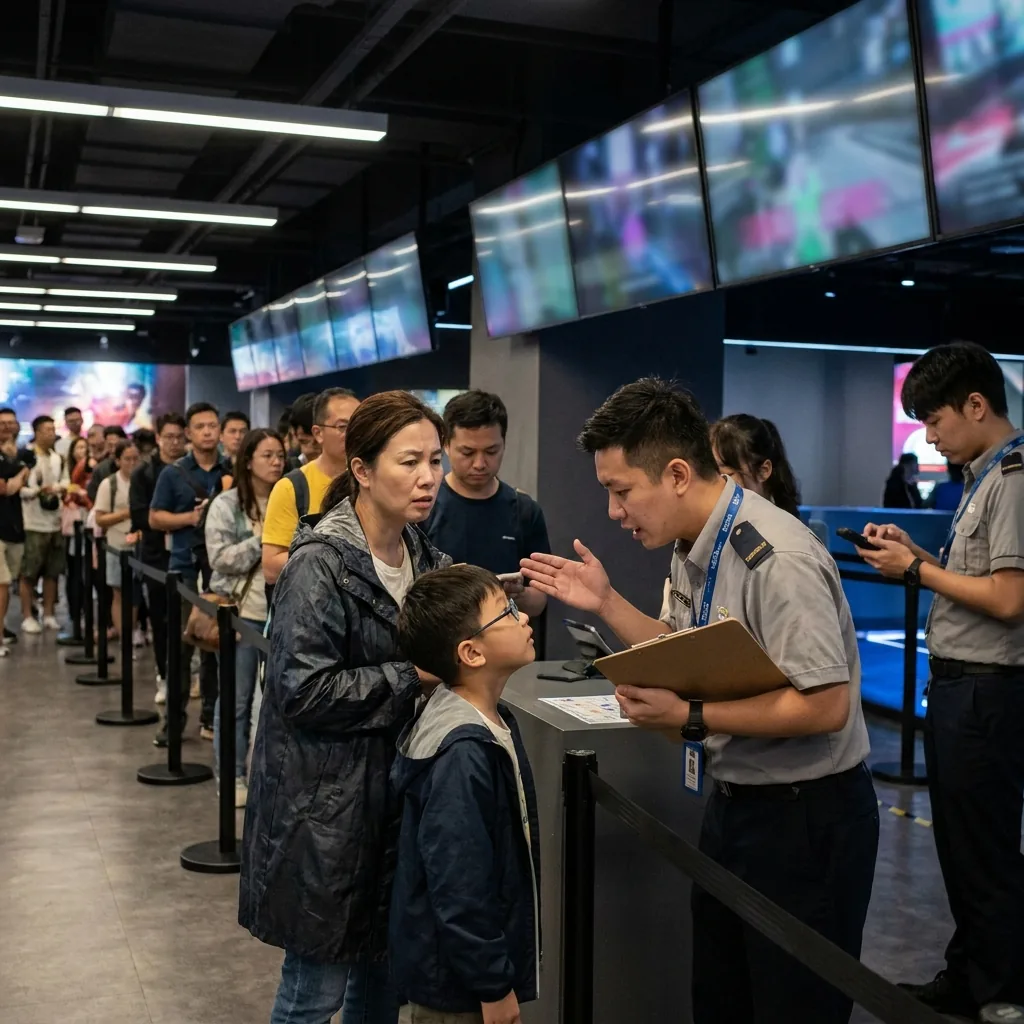
By then the plaza had split into two speeds. The demo wall still flashed forest creatures and arena scoreboards in bright loops, but the check-in lanes had gone procedural and slow. Tori Alvarez was holding two families at her station with unactivated wristbands in hand. Rachel Mercer was still at the counter with Evan beside her and the same unopened glasses case between them. Nina had enough pairs of borrowed eyewear spread across the counter to make the problem visible from several feet away.
Marcus looked first at the stopped lines, then at the glasses on the counter, then at Evan’s inactive wristband.
“Tell me the exact block,” he said.
Nina answered quickly. “External overlay filter incompatibility affecting zone visuals. I stopped one pair, then expanded screening because adjacent traffic showed comparable risk.”
Marcus held out his hand again until she passed him the tablet. “What station code flagged his reservation?”
Nina said, “It didn’t pre-flag. This was device-level review at check-in.”
Rachel spoke before the gap could slide past. “She told us his glasses weren’t allowed before she checked what lane he was booked for. Then the rule changed to lane-specific after I pointed at the other station.”
Marcus did not nod or argue. He looked at Evan’s booking on the tablet, tapped once, then asked Tori to read back the instruction she had been given.
Tori raised the scanner in one hand and said, “Check all non-plaza eyewear before activation. Then it became only incompatible ones. Then forest lane could pass while arena could not.”
Marcus asked Nina, “Is that accurate?”
Nina said, “Broadly, yes, but compatibility judgments are contextual.”
“Contextual to what?” Marcus asked.
“Lens behavior, overlay risk, and zone interaction.”
“Show me where check-in sees that criteria.”
Nina leaned toward the tablet screen. Marcus shifted it a few inches away from her and turned it toward himself. The only things visible from Rachel’s side were reservation lanes, color-coded station statuses, and a device notes field that looked blank until Marcus opened it. He scrolled once, stopped, and asked, “Why is there no compatibility note attached to this booking?”
Nina said, “Because the block is assessed live.”
“Then show me the live assessment step.”
That was the second pause that mattered. Nina reached toward Evan’s case and asked him to open it again. He did. She lifted the glasses, angled the frame under the counter lights, and said, “The overlay architecture is obvious on sight.”
Marcus said, “Obvious isn’t a check-in step. What is the step?”
The room had the stillness of people listening while pretending not to. Tori’s line stayed put. A little boy at her station was holding his glasses with both hands, waiting to hear if they had become a problem. Rachel kept one hand on Evan’s shoulder and watched the tablet, the counter display, and Marcus’s face in turn.
Marcus asked for three pairs: Evan’s, the green-framed pair from Tori’s line, and the tinted pair Nina had rejected earlier. He laid them side by side on the counter.
“Walk me through the difference as check-in would apply it,” he said.
Nina pointed at the tinted lenses first. “These interfere with visual read depth.”
Marcus asked Tori, “What lane?”
“Arena,” Tori said.
Nina pointed at the green frames. “These are lower overlay intensity.”
“What lane?” Marcus asked again.
“Forest,” Tori said.
Then Nina touched Evan’s glasses. “These create external layer competition.”
Marcus looked at his tablet. “His booking is forest lane.”
Nobody said anything for a second because the contradiction had finally landed in a form that did not need interpretation. Nina had just separated the examples by lane, accepted the green pair for forest, and then rejected Evan’s for the same lane while using a phrase no one could map to any posted standard or visible screen.
Rachel said it plainly. “So another child can enter forest with outside glasses after a hand check, but my son cannot enter forest with outside glasses because you say his lenses compete more. Where is that written?”
Nina answered, “It is part of filter judgment.”
Marcus asked, “Whose judgment is recorded where?”
Nina’s voice narrowed. “Mine at this station.”
Marcus tapped the tablet again, then held it lower, closer to the counter. “There is no recorded category for what you just said. There is no compatibility field matching your wording, and there is no active plaza notice for a glasses block at forest check-in.”
Nina started to say something about discretionary screening, but Marcus cut in with the same measured tone.
“Then we’re not dealing with a posted rule. We’re dealing with an unlogged denial.”
That changed the shape of the room. Tori stopped waiting for interpretation and set her scanner down. Rachel’s eyes went straight to Evan’s wristband. Evan looked at the glasses in Nina’s hand.
Marcus extended his palm. “Complete the action, please. Enter the denial in the system exactly as you are enforcing it, under your ID, with the lane listed and the reason field filled in.”
Nina did not move right away.
Marcus kept his hand out for the tablet and added, “If you are blocking him, log the block so I can apply it plaza-wide right now.”
That was the irreversible pressure point. Until then Nina had been speaking a rule. Now she had to either write it into the live process for every comparable child in the building or stop pretending it already existed.