Story code: ST-000720
Part 2: The Packet Told a Different Story
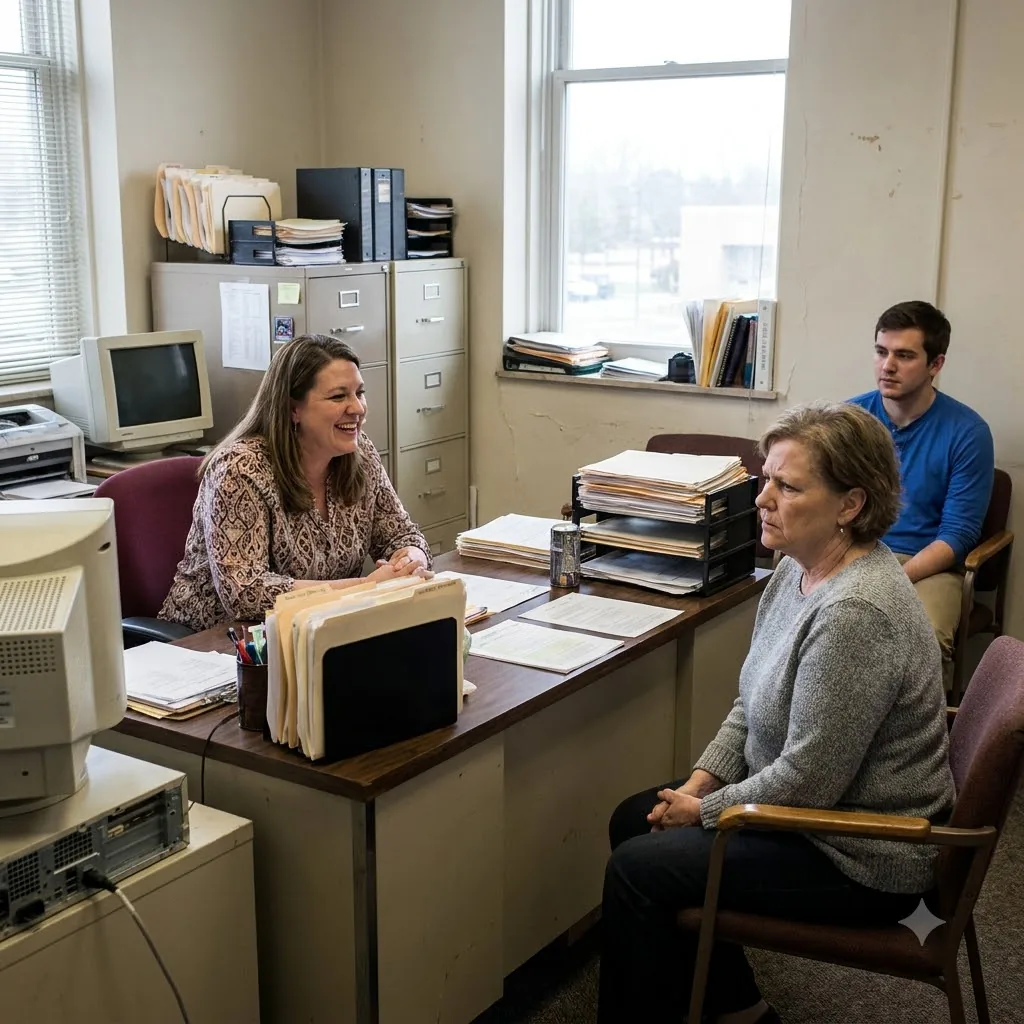
I went back to the aid office two days later because Tina’s version of events would not leave me alone, and the first thing I saw was my recommendation packet sitting on the corner of Mrs. Ellis’s desk with a yellow routing slip clipped to the front. Tina had told me she had pushed it through personally, like it moved because of her. But from where I stood, before either of them noticed me, I could see dates and initials stacked in a line that looked a lot more routine than special. Mrs. Ellis was stamping intake envelopes. Tina was at the copy machine feeding in sheets one at a time. The machine made that dragging, uneven sound old office machines make when they are about to jam. I moved closer to the desk and asked Mrs. Ellis, “Can I look at the routing slip on my packet for a second?” She adjusted her glasses and looked at the tab with my name. “If it’s yours, sure, but don’t take the clip off. Tina needs these in order.” That sentence hit me first. Tina needs these in order. Not Tina built this from scratch. Not Tina got you some private access. Just order. I picked up the packet and kept it flat on the desk. The yellow slip had boxes and initials in blue ink. Intake received. Faculty letters logged. Advisor addendum attached. Review queue. Each line had a date. One line had Mrs. Ellis’s initials beside it. Another had somebody else’s from a different office. The line Tina’s name was attached to was late in the process, and the note beside it wasn’t approved, expedited, or special handling. It said packet incomplete on arrival, corrected for missing routing code. I read it twice to make sure I wasn’t filling in words that weren’t there. Tina turned when the copy machine stopped. “What are you doing?” I looked up at her and kept one finger on the slip. “Reading my file notes.” She walked over too fast for how calm she had acted the last time. “You don’t need to do that. Give me the packet.” Mrs. Ellis glanced between us. “She was just looking at the routing slip.” Tina put out her hand. “Maya.” I didn’t hand it over yet. “You told me you made sure my packet didn’t get buried.” “And?” I looked back at the slip. “This says it came in incomplete because of a missing routing code. It says you corrected it later. That’s not the same thing.” Tina’s jaw tightened for one second, then she smoothed her face again. “Exactly. I corrected a problem that would have held you up. You’re welcome.” Her tone made the words sound prepared. I heard a chair scrape behind me as another student sat down at the waiting area. Somewhere near the front door, someone laughed at something on their phone. Ordinary office noise kept moving around us while Tina and I stood with our hands near the same packet. I said, “Who left the code off?” “That doesn’t matter,” Tina said. It mattered to me immediately, because she had spent our last conversation turning a correction into a favor and a favor into a debt. I kept my voice level. “It matters if you’re telling me I owe you because you fixed something.” Tina lowered her hand and crossed her arms. “You are being very dramatic about administrative help.” “No,” I said. “I’m asking what I actually agreed to.” Mrs. Ellis cleared her throat softly and reached for another stack of envelopes, but she answered the narrow part I had actually asked. “Routing codes usually get put on at intake or by the person assembling the recommendation materials before they come back through us. Depends where the packet starts.” Tina turned toward her. “We’ve got this.” Mrs. Ellis gave one short nod and went back to stamping, but she had already said enough for me to hear the shape of it. Tina had not described a rescue. She had described a rescue after the fact and left out the part where the packet had a problem connected to assembly and routing in the same office flow she was part of. I set the packet down carefully. “So the thing you keep calling a favor was you fixing a process issue.” Tina’s voice dropped lower. “It was me preventing harm to your future. That’s what you don’t seem to understand.” That was the phrase that shifted the whole room for me: preventing harm. Not opening doors. Not getting me extra access. Preventing harm. Fixing something that should not have been wrong in the first place. I asked, “Was my packet delayed because of your correction, or because it needed correction after it came through your hands?” She gave a quick laugh and shook her head. “You don’t know enough about this office to ask that question like that.” But she still didn’t answer it. Instead she reached for the packet again and said, very softly now, “This is why I told you not to push. I helped you, Maya. If you start picking apart every step, you can make things harder on yourself for no reason.” The words were smooth. The warning in them was not. I slid the packet back toward Mrs. Ellis and took my hand off it. “I’m not picking apart every step,” I said. “I’m trying to understand why your help only started counting once I asked for clarity.” Tina looked at me for a beat, then at Mrs. Ellis, then back at me. Her smile came back, but it sat wrong this time, like it had been placed there after the rest of her face chose something else. “You really want to do this?” she asked. I heard my phone buzz again in my bag. Probably my mother. Probably another question about costs, deadlines, next steps. But all I could see was that yellow slip and the one line attached to Tina’s name. She.