Story code: ST-000724
Part 2: The Code Linda Could Not Name
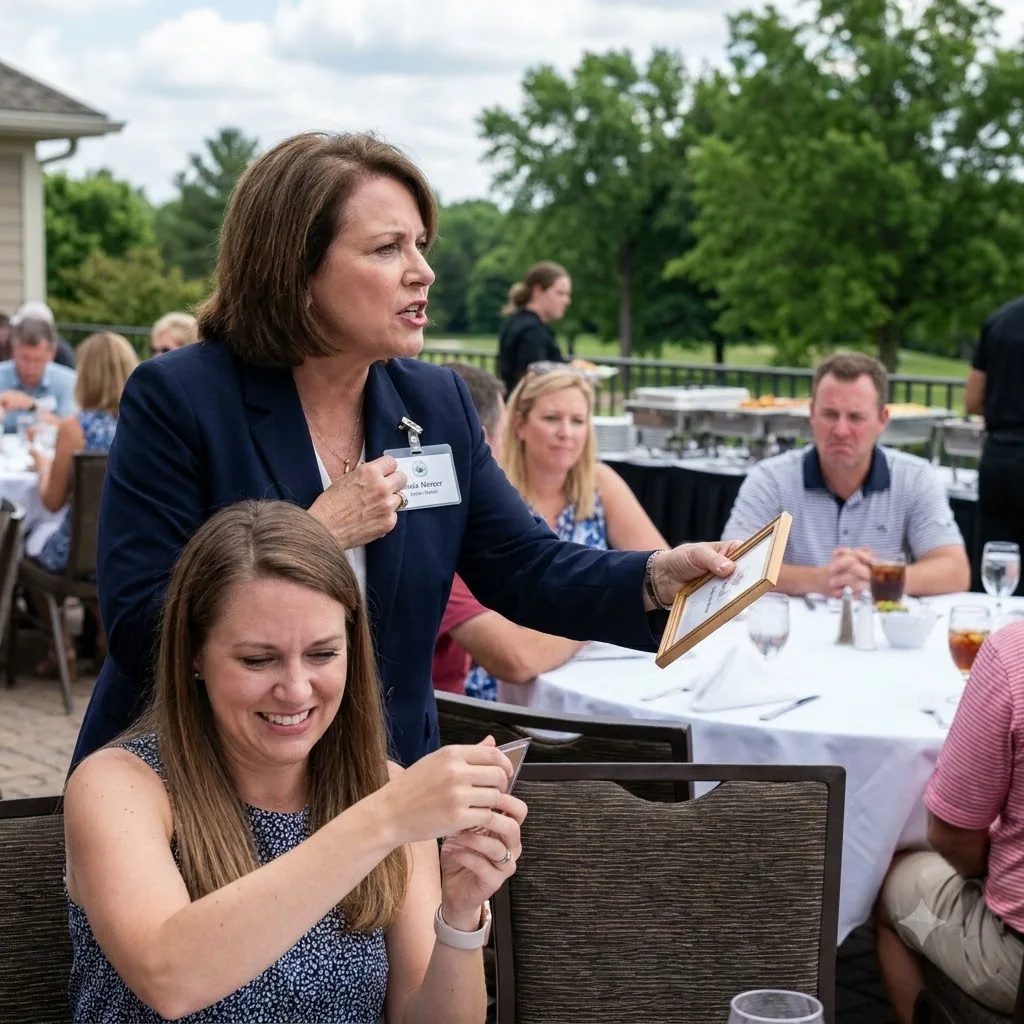
The brunch kept moving, but the story around it changed. Nina Alvarez did not announce anything to the room. She simply kept asking the next practical question in the same clean tone, and each one cut deeper into Linda Mercer’s claim. Linda had the guest badge pinned high on her blazer, but she could not give the right side-gate code, she hesitated on the table rotation, and she kept glancing at Emily Carter before she answered, as if Emily’s face could supply the missing line. That was the process gap now sitting in full view. The badge said access. The questions said knowledge. The answers did not match.
Paul Mercer tried to smooth it over. He told a server that Linda had “just stepped in to help” and then repeated to anyone who would listen that family was family. But the work counter near service traffic was already showing the difference between helping and owning. Emily was the one who knew where the extra menus were stored, which tables had changed after the late RSVP, and how the club wanted the guest badge handled when a name had to be matched to a seat. Linda knew the broad performance. She did not know the operating details. When Nina asked which folder held the updated brunch notes, Linda reached for the wrong side of the counter and stopped when she found nothing there.
That mattered because Linda could not keep the claim going without borrowing Emily’s knowledge in real time. Every time she stepped forward, she needed a correction from Emily or a prompt from Nina. Every time she talked over Emily, the next question landed on a detail she had not prepared. She could smile for the family seating cluster, but she could not fake the sequence of the setup materials, and she could not fake the club procedure that tied the guest badge to the person actually managing the room. The more she spoke, the more she needed Emily to keep the brunch from stalling.
Emily did not argue the whole case out loud. She kept working and let the observable parts line up. She answered Nina directly. She moved the setup materials where the servers needed them. She corrected the badge number when Nina checked it against the list. She opened the side tray that Linda had missed and took out the backup cards. Those were not dramatic gestures. They were the proof lane. They showed which person knew the flow and which person was leaning on borrowed access.
Linda tried once to recover by leaning into the family crowd and saying Emily was “making it awkward.” Nobody in the service lane responded to that. Nina looked at the guest badge, then at the list, then at Emily’s hands on the actual materials. She asked Emily the next question instead of Linda. Emily answered cleanly. Linda’s mouth set hard, and she reached again for the badge as if the object itself could settle the issue. It could not. The badge was supposed to support authority, but now it marked the gap between the claim and the competence behind it.
The hard part was not the noise. It was the dependence. Linda needed Emily to keep translating the brunch setup while she stood in front of other people acting like the owner of it. Without Emily’s knowledge, the claim broke down in small visible pieces: a wrong code, a missing folder, a table count that did not match, a staff question that sat unanswered a second too long. Paul noticed enough to stop repeating Linda’s line. He went quiet and watched the exchange between Emily, Nina, and the badge.
Then Nina asked for the private access key so she could reset the side door after the brunch rush. Linda reached into her purse and came up empty. She looked at Emily. Emily did not move. The brunch room stayed polite around them, but the question had landed: if Linda could not even produce the key and did not know the code, why was she wearing the guest badge and speaking as if the setup belonged to her?