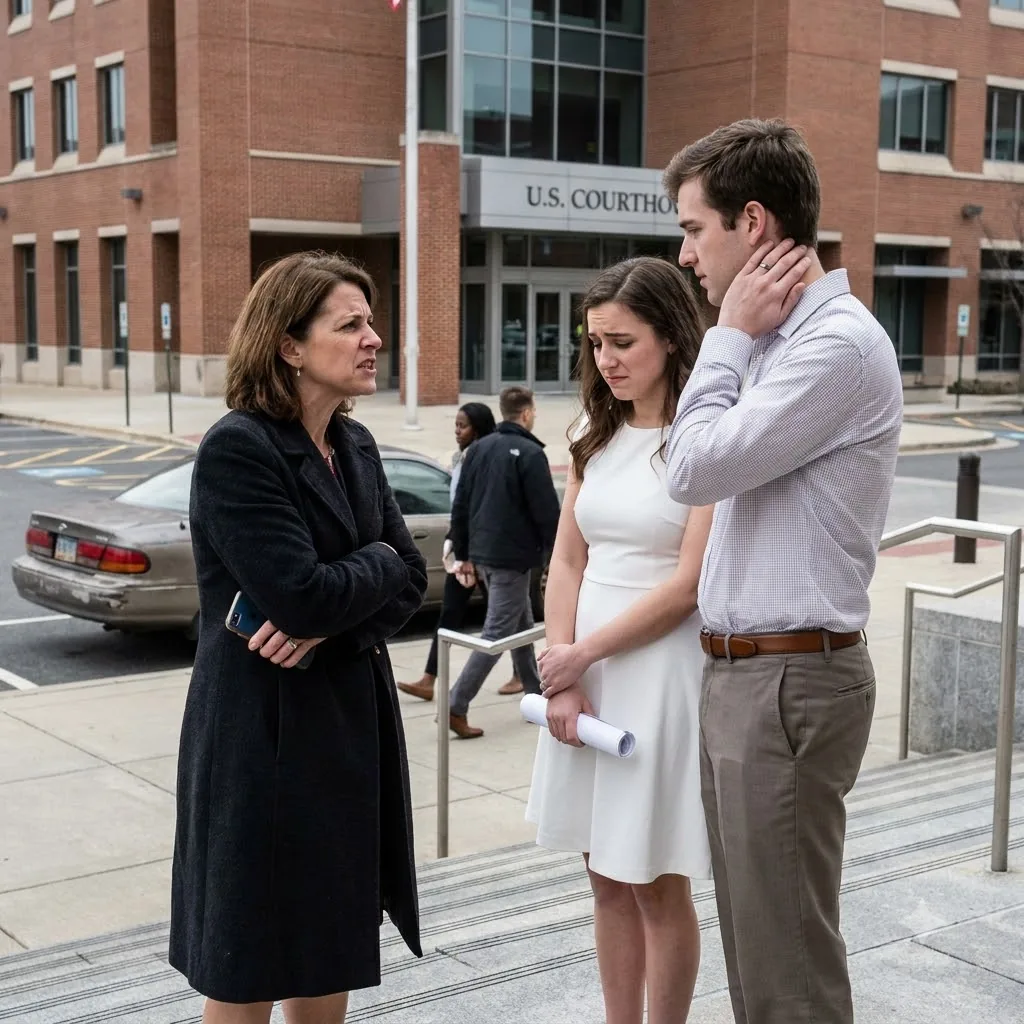
Story code: ST-000731
Part 4: The Key Stayed on the Chair
The ceremony itself took less time than Denise had spent trying to stop it.
That was not a romantic observation. It was just the visible truth of the floor schedule. The noon pair went in. The door closed. People in the hallway checked phones, adjusted jackets, opened snacks for kids, traded seats near the outlet. Denise stayed where she was, three chairs down from the key Maya had left on the vinyl seat.
She did not pick it up at first.
A minute later she did. She turned it once in her fingers, looked toward the closed door, and put it in her purse. Then she took out her phone again. Her thumb moved quickly. She paused, read, typed again, and then lowered the screen with a hard little tap that suggested the message on the other end had not gone the way she wanted.
I could not see the text. I could see the sequence. Try a contact. Wait. Try again. Stop. That same pattern had shown up downstairs after the sedan left. Whatever network of immediate control Denise expected to have, it was not answering cleanly anymore.
When the door to room 214 opened, Maya came out first holding the marriage license packet with a new folded sheet clipped inside. Eli came right behind her. The witness stayed in the doorway long enough to thank the clerk and step aside for the next couple.
Nobody made a speech. Nobody cheered.
The hallway absorbed the marriage the same way it absorbed everything else: fluorescent light, chair legs on tile, names called off a list.
Denise stood up when she saw the papers in Maya’s hand.
“So that’s it,” she said.
Maya stopped in front of her but did not offer the packet for inspection. “That’s it.”
Denise reached into her purse and brought out the brass key. For a second it looked like she might hold it just out of reach and restart the whole morning in a smaller form. Instead she put the key back in and said, “Your things need to be gone by tonight.”
The witness answered before Maya did. “The storage unit already transferred this morning.”
Again, it was not dramatic. It was logistical. And because it was logistical, it hit harder.
Denise looked at her. “Transferred where?”
The witness said, “Not your access anymore.”
The clerk at the podium called for the next names. A child started whining about the vending machine. One of the men with the bouquet laughed at something on his phone. The world around them kept refusing to become a stage.
Maya took a plain white envelope from inside the license packet and held it out. “Mail from the leasing office came to Eli’s place this morning,” she said. “They confirmed the emergency contact change and the gate code removal. You don’t need to call there again.”
That was the cold turn the whole day had been moving toward.
Not a scream. Not a scene. A notice.
Denise did not take the envelope immediately, so Maya placed it on the chair arm beside her. I was close enough then to see the block print across the top: updated authorized contacts. No flourish. No sermon. Just a process record that reduced family leverage to a line item.
Denise picked it up and scanned the page. Her face did not crack in any theatrical way. What changed was smaller. Her shoulders, which had stayed squared all morning, loosened by half an inch. She looked back toward the elevator, then to the closed ceremony door, then to Maya’s hand around the license packet.
“You had them take me off,” she said.
Maya answered, “They removed access when I changed it.”
That difference mattered. One version sounded like revenge. The other sounded like procedure. For once Denise had no louder sentence ready to lay over it.
Eli moved beside Maya, not shielding her, just matching her direction toward the elevator. The witness picked up her tote and the phone charger. Denise still held the envelope and the brass key, one old access point in each hand, and neither of them opened anything for her now.
She said one more thing before they left. “Don’t expect me to fix anything later.”
Maya pressed the clipped marriage packet flat against her side. “That was the plan.”
Then the three of them walked to the elevator without waiting for Denise to clear the path.
The doors opened. They got in. The witness hit the lobby button. Maya faced forward. Eli looked once at the envelope in Denise’s hand and then at the floor numbers over the doors. Denise stayed in the hallway.
When the elevator closed, the last clear picture was not the marriage license or the white dress somebody else down the row was carrying in a garment bag. It was Denise standing under courthouse lights with a returned key and a formal notice that her gate code and emergency contact access were gone by process, not permission.
That is why the aftermath had a colder taste than the argument downstairs. Denise had tried to make access sound personal, something she could give and take to keep herself necessary. By the end of the day, the only access that mattered had moved into systems with names on forms, and those systems did not care who had raised their voice on the courthouse steps.
The couple left married. Denise left holding paperwork that said the last practical door she could use was already closed.