Story code: ST-000795
Part 2: She Could Name the Banner Faster Than the Emergency
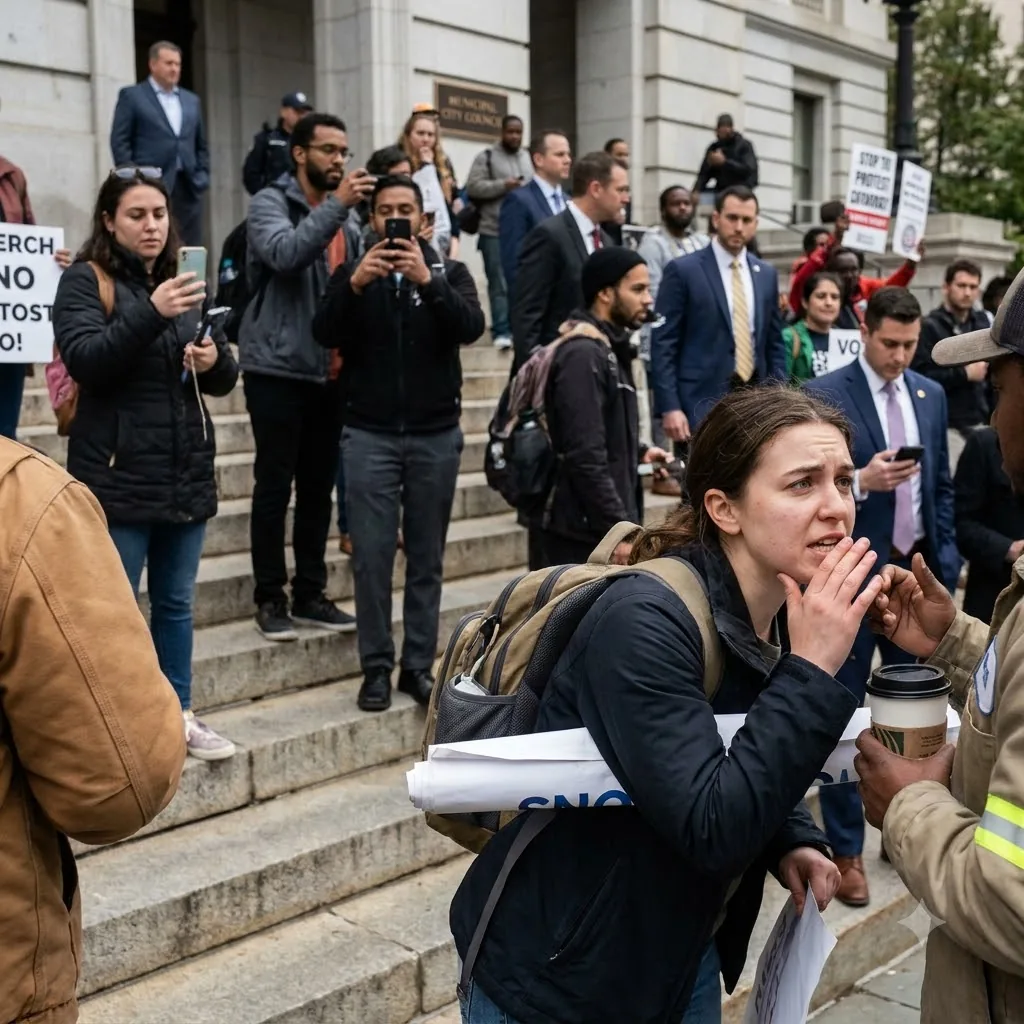
Officer Keller stood one step below Lena, looked where she pointed, and said the simplest thing in the world. “That’s not a person. Who needs medical help?” The landing got quieter after that, the bad kind of quiet, the kind where every phone stays up because the story just changed and nobody wants to miss the next sentence. Lena did not answer him directly. She kept one arm out toward the side rail and one hand open at me like I was still supposed to help her force this through. “If you move in on that side,” she said, “you’ll make it worse. We need space. We need these people off the steps.” Keller kept his voice level. “For what condition?” “For a safety condition.” “What condition?” She shifted half a step so her shoulder covered the corner of the banner nearest the rail. One of her banner holders looked down at his hands. Another let the fabric slack for a second, and I saw more of it: the lower hem looped through the side rail with zip ties, one tie cinched around a length of cord that ran behind a planter and back toward a tote bag on the stone. It was not random. It was arranged. Dana came up beside me and stopped at the edge of the pinch point. “Please keep the public path clear,” she said in her clerk voice, the same tone she used for every overflow day, every stroller, every campaign table. She glanced at the banner corner, then at Keller. “Do you need me to hold entry?” “Hold for a minute,” he said. Then to Lena: “If someone is in medical distress, identify them now. If this is an obstruction issue, step aside so I can inspect it.” That should have solved it either way. Real emergency, point to the person. No emergency, let him check the obstruction. Instead Lena started talking faster. “You don’t understand the context. We’re in the middle of an action. Council is about to go in. Cameras are here. If you start messing with our materials, you’ll escalate this for no reason.” A woman from the line said, “So there isn’t a medical emergency?” Lena snapped back, “There is a danger.” “To who?” Keller asked. She looked past him, down the steps, everywhere except at a specific person. The crowd did what crowds do on civic steps: people filled silence with body language. A man in a suit stopped pretending to text and just watched. One of the students folded her sign against her chest. The reporter nearest me lowered his camera for a second and asked, not loudly but clearly, “Can you repeat what she first reported?” I answered because he was looking at me. “She told me someone couldn’t breathe and that I had to clear the side and break normal access.” I did not raise my voice. I did not need to. Lena spun toward me. “I said there was no time.” “You said both,” I said. Keller lifted a hand, not dramatic, just enough to stop the overlap. “All right. Step back from the rail.” He looked to the two people holding the banner. “You too. Keep your hands visible and give me the corner.” That was the moment the contradiction stopped being subtle. The exact help she had wanted me to get was now three feet away, asking for a plain safety check, and Lena moved to block him again. “No,” she said. “You don’t get to touch our property because people in this building don’t like our message.” Keller did not argue the message. He did not even look at the painted words. He looked at the public stairs, the tied corner, the cord, and the foot traffic stacked behind us. “I am checking the reported hazard,” he said. “If the hazard is the banner placement, I need that corner released.” One of Lena’s people said, too softly at first, “It’s load-bearing.” Nobody moved for a beat. Keller said, “Load-bearing for what?” The young man swallowed and looked at Lena. She cut in before he could answer. “For stability,” she said. “It’s anchoring the display.” Dana’s eyes dropped to her clipboard. She wrote something down without comment. That single phrase landed harder than any shouting had. The banner was not just a sign anymore. It was part of whatever Lena had built on that rail side, tied into the exact area she had claimed was too dangerous to leave alone and too sensitive to let safety inspect. The proof lane was sitting in plain view now, zip ties bright against white canvas, cord tucked where the crowd could not see it from below. Keller held out his hand. “Cut it loose.” “No,” Lena said. “Then I cut it loose.” She looked down the steps at the phones, then back at the banner holders, then at me. Her voice changed from command to something tighter and more crowded. “Mara, tell him he can’t interfere with a peaceful demonstration.” I kept my eyes on the tied corner. “I called him because you said it was urgent.” “It is urgent.” “Then let him verify it.” Her jaw worked, but she did not give Keller a person, a symptom, or a single name. She only shifted again to keep her body between him and the rail attachment. Dana spoke without looking up from the clipboard. “Time of report logged. Time of responder arrival logged. Refusal to permit safety verification observed.” Lena stared at her. “You can’t write that like it’s decided.” Dana finally lifted her eyes. “I’m writing what happened on the steps.” Keller unhooked a small safety cutter from his belt and crouched just enough to inspect the cord path without touching it. He followed it with two fingers through the rail, behind the planter, and toward the tote bag wedged out of sight from the main approach. He looked up at Lena and asked, very evenly, “What is attached at the other end?” She.