Story code: ST-000795
Part 3: The Live Check Started at the Rail
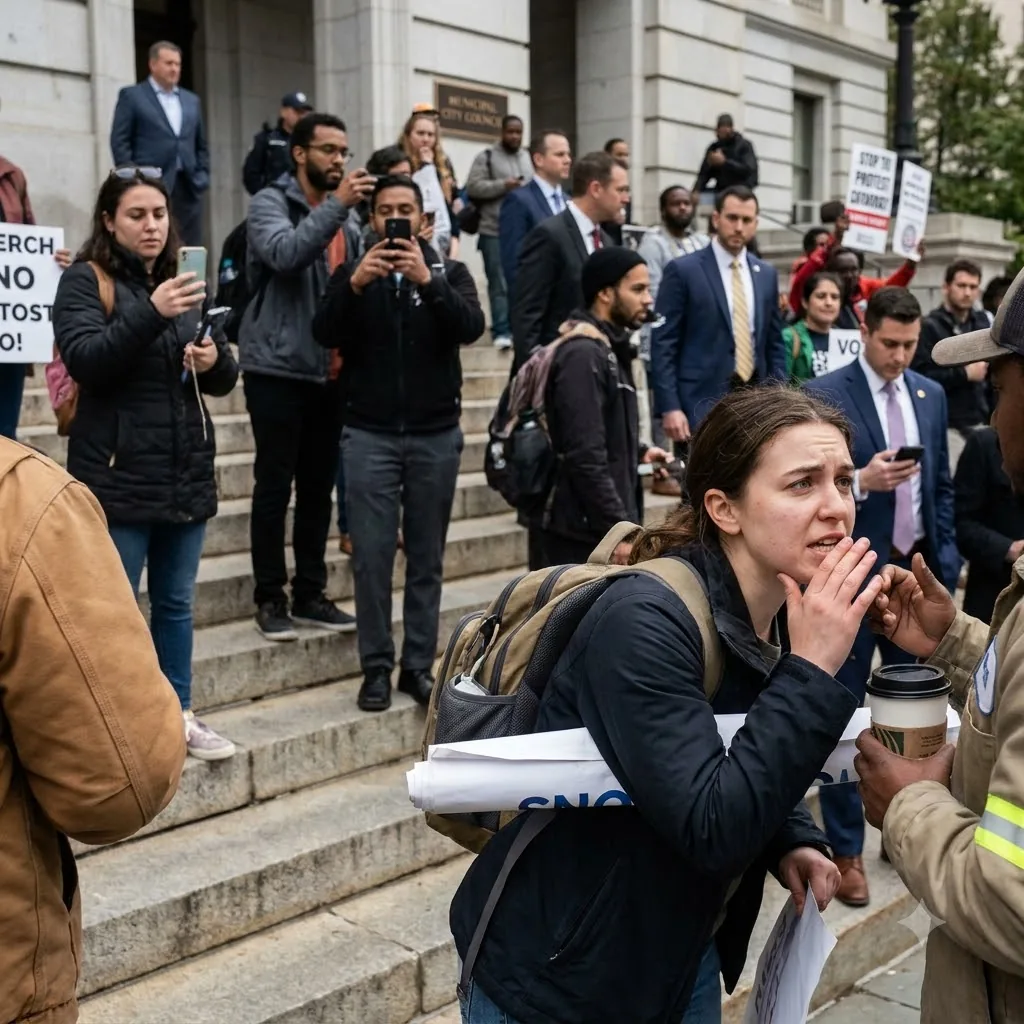
She did not answer Officer Keller right away. She looked down at the tote bag, then at the two people still holding the banner, then back at him. The whole upper landing had narrowed into that one line of sight: his hand near the cord, her body still trying to cover it, Dana’s pen resting over the clipboard.
“Supplies,” Lena said.
Keller stayed crouched. “What supplies?”
“Protest supplies. Water. Tape. Extra signs.”
“Then I need the bag moved clear of the public path.”
“No,” she said again, too quickly.
He straightened and took one small step back instead of forward, which somehow made it tighter. “All right,” he said. “If you’re refusing a safety release, we do this as a live check. Nobody touches the setup except your team. You will show me what the cord is attached to, and you will do it now.”
Lena’s mouth stayed open for a second without sound. One of the reporters said, “Please keep talking,” and his phone tilted closer.
Dana lifted her clipboard an inch. “Observed instruction given,” she said, almost to herself as she wrote.
Keller pointed with two fingers. “You. Gray jacket.” He meant the young man who had said load-bearing. “Set the banner slack on the rail and bring the bag into view. Slow. Keep your hands where I can see them.”
The young man looked at Lena first. That look did more than any speech. She cut her eyes at him, then down the stairs where the cameras were, then back to Keller.
“This is ridiculous,” she said. “We’re being singled out because council doesn’t like climate action.”
Keller did not answer that either. “Bring the bag into view.”
When the young man bent to reach behind the planter, the bottom of the banner dipped and pulled against the zip ties. A short metal clink came from behind the stone pot. Not a medical sound. Not a person in distress. Just hardware striking rail.
A woman in line let out one hard laugh through her nose and then covered her mouth.
The bag came into view by its straps first, then the rest of it, dragged over the stone. It was heavier than a tote full of flyers. The fabric sagged around a square shape inside. Keller kept his voice level.
“Open it.”
“No,” Lena said.
The young man froze with one hand on the zipper.
Keller looked at him, not at her. “Open it. If this is the hazard you reported, we verify it. If it isn’t, we clear the stairs and document obstruction.”
The zipper came down in a rough burst. Inside was a dumbbell wrapped in a sweatshirt, the black iron plate showing through one sleeve. The cord from the rail ran into the bag and around the handle with two tight knots.
Nobody on the landing said anything for a beat.
Then Dana spoke in the same dry tone she used for attendance counts. “Weighted anchor observed. Attached to rail-side banner corner. Public path narrowed by fixed display.”
Lena stepped toward the bag so fast Keller put one arm out between her and the opening, not touching her, just stopping the lane. “That is for wind,” she said. “Everybody uses weights for wind.”
“Not across a stair pinch point,” Keller said. “Not tied through a public rail after a reported medical emergency.”
I could hear the earlier words still hanging there because people repeated them under their breath: can’t breathe, no time, medical emergency. They sounded different now with a dumbbell in a tote and zip ties bright against the banner hem.
The reporter nearest me said, “Did she report a person or a hazard?”
I answered what I had heard. “She reported a person first.”
Lena turned on me. “You are twisting this in front of strangers.”
“I’m saying what you said on the steps,” I told her.
Keller nodded toward the banner corner. “Release the ties. Right now.”
“You’ll ruin it.”
“The stairs stay open,” Dana said. “That’s the rule whether the sign says trees, taxes, or football.”
That landed another kind of silence. No lecture. No argument about message. Just the flat civic fact of the space.
Lena looked around for somebody to pick a side. Her people would not meet her eyes now. The student with the chest-held sign had shifted back two steps. The contractor had ended his phone call. Even the little kid near the rail was watching the dumbbell like it had explained the whole afternoon.
“Cutting ties on my count,” Keller said. He held up the safety cutter but kept it still. “Three.”
Lena grabbed the banner edge with both hands.
“Two.”
“Don’t,” she said, but this time it was to her own team.
The young man in the gray jacket let go first. The woman at the other end released a second later. Without their weight, the stretched canvas sagged against Lena’s arms. The cord snapped taut to the tote bag and dragged it six inches over the stone with a heavy scrape everyone heard.
That was the new truth in plain sight. Not just a tied banner. A fixed weight, set low at the rail, making the exact obstruction she had tried to name as an emergency.
Dana wrote again and said, “For the log: hazard demonstrated by movement on release.”
Keller looked at me once, then back to Lena. “Now we remove it and identify who organized the setup.”