Story code: ST-000086
Part 3: The Call That Broke The Timing
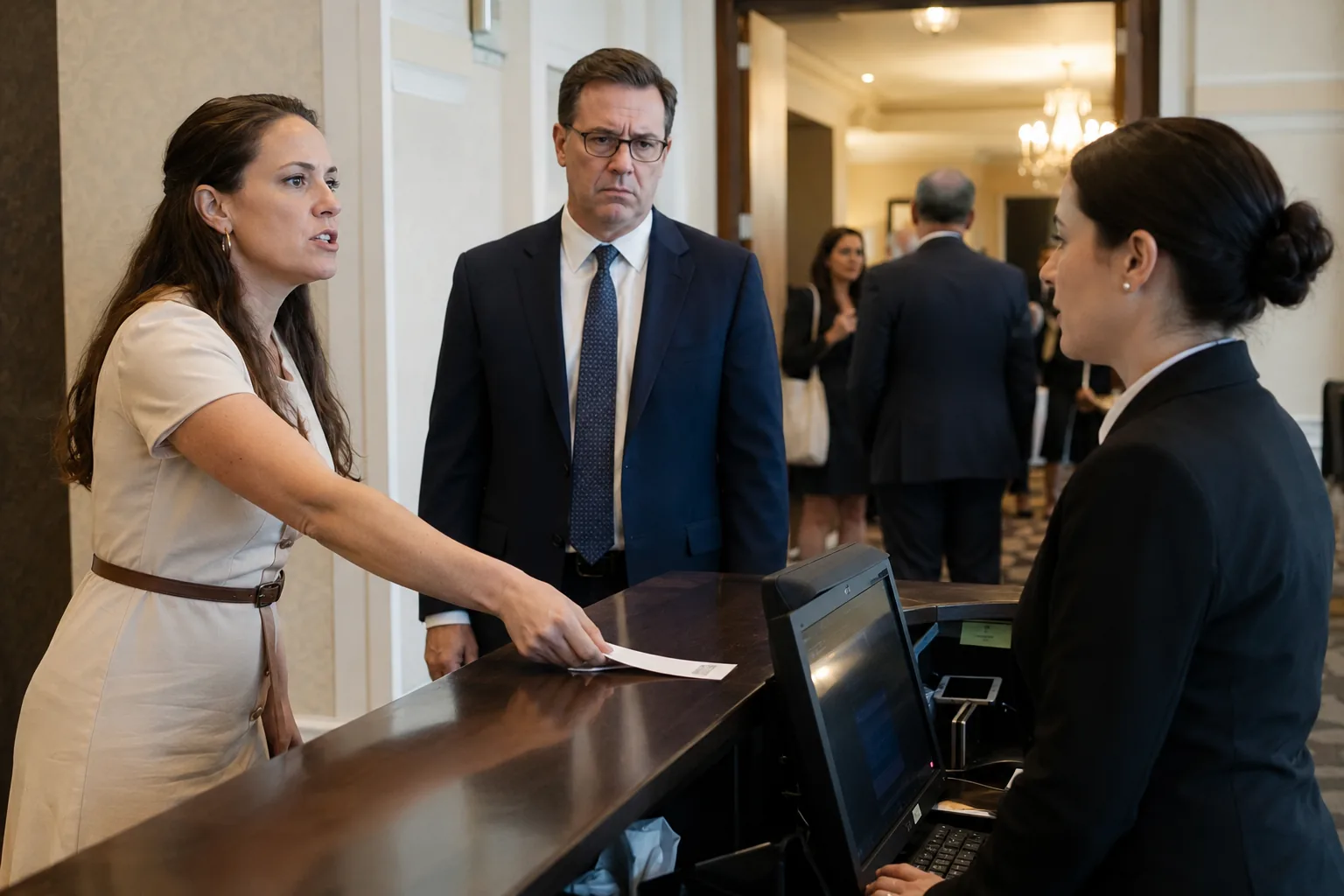
The phone kept ringing until Luis finally put it on speaker and set it faceup beside the receipt. The sound filled the little billing office, loud enough that even the carts in the hallway seemed to hesitate outside the door. I stayed at the counter with the bank alert in one hand and the deposit receipt in the other while Mara kept one shoulder turned toward the hallway, like she was checking who might be listening.
Luis tapped the screen again and said, “There is another entry here.”
He did not raise his voice. That made the words hit harder.
The clerk leaned in first. I saw his eyes move across the row, then back up. The manager table map was still spread open beside the folios, and now Luis used the edge of it to hold the receipt flat while he read the line out loud.
“Deposit posted at twelve thirty-nine,” he said. “Manual card entry at twelve forty-six. Decline at twelve forty-seven and ten seconds.”
Mara laughed once, but it sounded wrong in the small office. “That still does not mean anything.”
“It means the card ran after the deposit was already in the system,” Luis said. “That is the sequence.”
I looked at the phone screen where the bank alert showed the same decline time. Then I looked at the receipt again. Then I noticed something I had missed because Mara had been talking over everybody the first time through. The deposit receipt was not from the same counter stack as the folio copies. It had a handwritten note on the bottom corner in blue ink, and the note matched the clerk’s handwriting from the guest packet I had seen earlier in the ballroom.
I held it up. “This was filed after the charge attempt, not before it.”
Mara reached for the paper again. I moved it back.
Luis glanced at the clerk. “Did you move this receipt after the decline?”
The clerk did not answer right away. He looked at the ringing phone, then at the hallway, then at Mara. When he finally spoke, he kept his eyes on the desk.
“It was in the stack by the terminal,” he said. “I pulled it when the balance came up again.”
Again. That word landed in the room like a stone.
I said, “So the balance was already covered when you ran the card.”
No one answered me directly. The clerk looked at the screen. Luis looked at the timestamps. Mara looked at the door. Outside, a pair of banquet workers rolled a cart past the opening and slowed just enough to hear the conversation. One of them glanced in and kept walking, but not before I saw the look on his face change from curiosity to attention.
Luis reached for the phone and put the call on hold. The ringing stopped, and the sudden silence made the terminal beep sound sharper.
Then he said, very carefully, “There was no reason to re-run the charge if the deposit posted at twelve thirty-nine.”
Mara pushed both hands flat on the counter. “You are all acting like this is some big mystery. It is not. She said she would take care of it and now she is pretending she never did.”
I looked straight at her. “Show me where I told you to run my card after the deposit posted.”
She opened her mouth and did not answer right away.
Luis scrolled farther back in the log. His finger stopped. He frowned at the screen, then turned it toward me. It was not a long line. It did not need to be. The timestamp showed the deposit confirmation came through before the manual card entry, and the manual entry was made after someone had already flagged the room as paid. That was the missing step. Somebody had decided to try the card anyway.
I said, “Who flagged it?”
The clerk finally lifted a hand and pointed toward the back office without looking away from the screen. “Accounting called the desk,” he said. “They said the folio needed a backup form on file.”
Mara’s head came up so fast I could hear it. “No.”
Luis did not react to her. He just kept reading. “That note is not in the payment instructions. It is a desk add-on.”
I picked up the manager table map and saw a yellow sticky tab tucked under the corner with a note about ballroom seating changes and a second line about billing follow-up. The handwriting on the sticky was not mine, and it was not the clerk’s. I only needed one more second to understand what had happened here: somebody had used the desk process as leverage and then tried to hide behind the paperwork.
Mara saw me looking at the tab. “Put that down,” she said.
I did not. I read the note aloud instead.
“Run backup payment if room balance disputed,” I said. “That is what this says.”
Luis looked up at her for the first time. The clerk stopped moving. Even the phone, still on hold, seemed to drain the room of noise.
Mara said, too fast, “That was not supposed to happen yet.”
She did not get to explain what she meant, because the hallway carts stopped outside the door and one of the banquet workers said, loud enough for the office to hear, “Is this about the ballroom block?”
Luis straightened the papers in one clean motion. “It is now a timestamp issue,” he said.
And that was the moment I knew the story was not about a declined card anymore. It was about the order someone had tried to force on paper, and the order the record was now refusing to keep.