Story code: ST-000863
Part 2: The Word He Could Not Explain
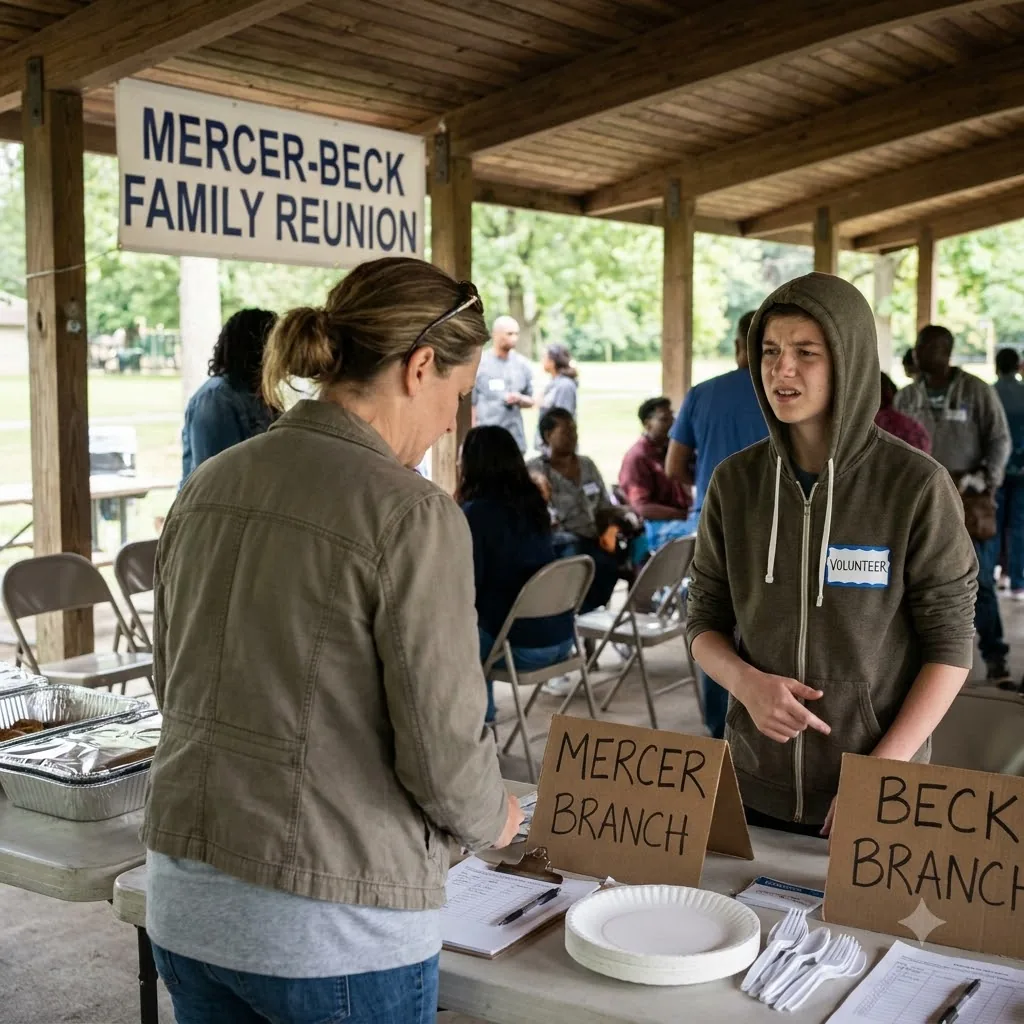
When Dana asked Evan what active meant on a family name tag, he did not answer like a kid defending himself. He answered like someone trying to remember the next part of instructions while adults around him waited. He looked down at the tag in his hand, then over toward Lori Beck’s clipboard, and the silence around the welcome table got louder than Aunt Renee had been a minute earlier.
Evan finally said, “It means that’s what the tag says.”
Dana did not move. “I can read what it says. I’m asking what the word means.”
He rubbed the marker cap with his thumb. “Like… not regular.”
“Not regular how?” Dana asked.
He had no follow-up. That was plain on his face and in the way he shifted the stack of extra tags from one hand to the other.
Aunt Renee tried to patch it over first. “He’s a child, Dana. He doesn’t have to explain every little thing if Lori already sorted it out.”
Dana turned to her. “Then why did you repeat it like it was a rule?”
Renee opened her mouth and shut it again. She looked toward Lori before speaking, which told its own story without saying all of it.
Miles stepped closer to the table and held out his hand. “Let me see that tag.”
Dana passed him the printed one but kept the little stub attached at the bottom. He compared the handwriting on Dana’s tag to the volunteer tags beside the sign-in sheets. Then he crouched and pulled open the supply bin under the folding table.
That mattered because he did it like someone who knew exactly what was stored there.
Inside were extra tag sleeves, two unopened marker packs, tape, and a short stack of printed name tags that had not been laid out yet. Miles lifted the stack and thumbed through it in front of everybody. A few names had handwritten notes added under the printed family branch lines. Most did not.
“These weren’t here by accident,” he said.
Lori came over then, still holding the clipboard with the master tag sheets clipped to it. She kept her voice flat and practical. “Miles, don’t make a mess of check-in. If there’s a question, bring it to me.”
He stood and handed one blank-backed tag to Dana, then held another up beside hers. “Same printer, same stock, same marker,” he said. “The added handwriting matches tags from this table, not something Dana brought in.”
Dana raised the stub she had kept. “And this one was attached to mine. So whoever made the tag made the stub too.”
Lori said, “Of course the tags came from this table. All the tags come from this table.”
That would have closed the point if the issue had only been where the cardstock came from. It did not close the point she thought it did.
Dana asked Evan, “Who handed you mine?”
He answered too fast this time. “I was helping.”
“Who handed you mine?” she repeated.
He looked at the clipboard in Lori’s hand, not at Dana. “I was told to give it when you walked up.”
Lori cut in. “Because he was greeting people. That’s all this is.”
Miles held out his palm toward her without touching the board. “Can I see the master sheet for the Mercer side?”
Lori kept the clipboard close against her body for a second, then flipped it around just enough to show the page. People had edged in by then, not crowding exactly, but near enough to hear. Plates stopped clinking. Someone turned down a portable speaker at the far end of the pavilion.
Miles scanned the page and said, “Dana’s name is printed here. Nothing beside it on this line.” He tapped lower. “But here, at the bottom margin, somebody wrote a note in marker. Different placement from the printed list. Same word as the tag. Active.”
Dana did not snatch the board or make a scene. She asked one question. “Why is there a handwritten instruction for me when everyone else has a printed tag by name?”
Lori answered in the clipped tone she used with volunteers all morning. “Some family situations require clarification at check-in.”
Aunt Renee nodded too quickly and said, “That’s what I was saying. Clarification.”
Dana looked at her. “No, you said correction. Same as him.”
That landed because everybody had heard it.
Miles turned one of the extra tags over. “And this isn’t random wording,” he said. “Look.” He handed a second tag to me and another to Dana. Each had a normal printed name on the front, but on the back of two of them were faint marker test strokes, like someone had practiced writing a specific word before putting it on the real one.
Dana held hers beside the first tag and read carefully. “Guest correction. Branch placement active.” She looked at Evan. “Did you write these words?”
He shook his head.
“Did you choose them?” she asked.
Another head shake.
Lori said, sharper now, “He’s not being interrogated at a picnic table. Give me the materials back and let people through.”
But the problem had already moved where she did not want it. It was no longer about whether Dana should wear a tag. It was about why a child had been handed a custom label and a line he could not explain, while the host stood ten feet away with the master sheets and the marker that matched the writing.
Then Miles said the one thing that made several people lean in closer.
“There are only two tags in this stack with that extra wording,” he said. “Dana’s, and one more with the name torn off the front.”