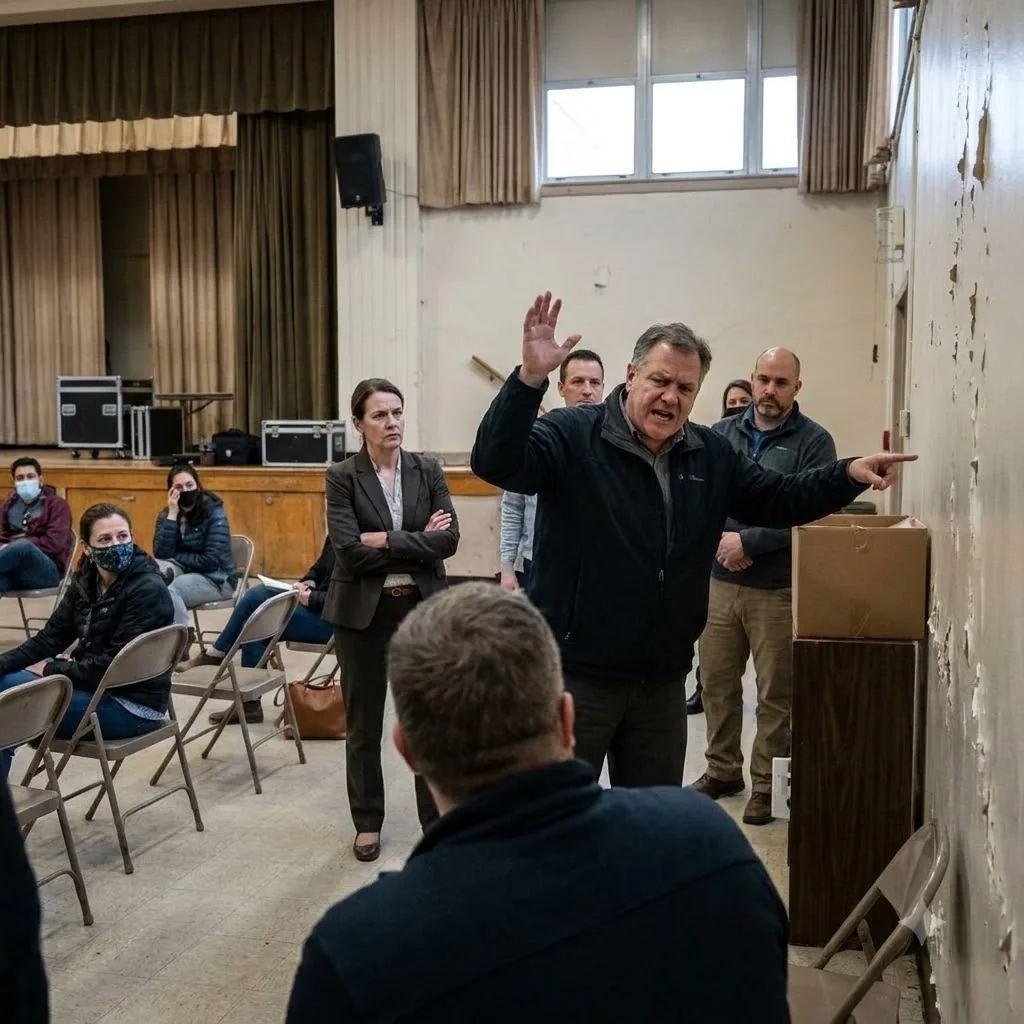
Story code: ST-000895
Part 3: The Check Had to Happen in the Open
Derek looked at the box, then at Nurse Park’s tablet, then at the auditorium doors like he was measuring how much room he still had to control.
Tina Park did not fill the silence for him.
She set her bag on the stage apron, pulled on gloves, and asked the next question in the same clipped tone. “Who first identified this item as the source of a breathing emergency?”
Derek answered fast. “I identified a hazard.”
“That is not what I asked,” she said.
Principal Ruiz pointed with two fingers, not dramatic, just direct. “He did. In front of the setup crew.”
Tina tapped that into the tablet. “All right. I need a clear lane. Nobody touches the box except me. Mara, Cal, stay where you can answer questions.”
Cal rolled his cart back half a wheel to open the aisle. I stepped to the edge of the stage apron with my clipboard against my ribs. The volunteers stayed near the rear aisle, close enough to hear every word. The sound tech remained onstage with one hand resting on a dead microphone stand.
Tina walked toward the side wall and stopped a few feet from the old mask box. From where I stood I could still see the torn flap, the faded printing, and a strip of yellowing packing tape stuck to one corner. It looked smaller now that nobody was pretending it had turned into a cloud.
“Has anyone reported active shortness of breath to me?” Tina asked the room.
Nobody spoke.
“Has anyone reported chest tightness, dizziness, coughing fit, or need for inhaler use since this complaint was made?”
The volunteer in the scarf said, “No.”
I said, “No.”
Cal said, “No.”
Tina looked at Derek.
He spread his hands. “People changed what they were doing because I told them to get away from it. That doesn’t erase the exposure.”
“Exposure to what?” Tina asked.
He hesitated just long enough for the room to hear it. “Old contaminated material.”
“Be specific.”
He pointed again, but lower this time. “Those masks. That whole box.”
Tina crouched beside the table without touching the box yet. “This is a standard cardboard supply box containing packaged masks,” she said, speaking as she observed. “Outer box is aged. Individual contents appear sealed.” She looked up at Principal Ruiz. “I am documenting condition before movement.”
Then she looked back at Derek. “Did you see loose particulate, mold, fluid, smoke, or any person in respiratory distress connected to this item?”
His jaw moved once. “I saw people working around it in a closed room.”
“That is not the question I asked.”
He shifted his feet and tried a new angle. “You don’t need to cross-examine me over common sense.”
“I need the reported hazard described in observable terms,” Tina said.
She held the tablet out just enough for Principal Ruiz to see while she entered the answers. No one crowded closer. The process itself was doing the work now. The questions were short. The pauses after Derek’s answers were longer.
Tina used a pen to lift the torn outer flap. Inside, the mask packs were still wrapped in clear plastic. She turned one bundle just enough for the manufacturing print to face outward.
Cal spoke before anyone asked him to. “That’s how they were when I moved the tape gun.”
Tina nodded once. “Visible inner packaging intact. No loose material visible. No active patient. No reported symptom event tied to this item at this time.”
Derek cut in immediately. “At this time because I intervened. That’s my point. I stopped it before it became worse.”
Principal Ruiz said, “A minute ago you said somebody couldn’t breathe.”
“I said somebody could have been put in that position,” he snapped.
The volunteer in the scarf lowered her hand from her face. “That isn’t what you yelled.”
He turned toward her so sharply she stepped back a half step. “People mishear things in panic.”
“There was panic because you yelled panic words,” I said.
He faced me next. “And you were going to keep setting up around old mask waste.”
Tina stood and removed one sealed pack, holding it at shoulder height where all of us could see it. Then she set it on a clean sheet from her bag on the stage apron, in the open, like a sample at a demo table. She checked the wrapper seam, the printed lot line, and the dry surface of the plastic.
“Live check,” she said. “Visible packaging sealed, item dry, no release, no active respiratory complaint, no indication of immediate contamination event from observation.”
Derek took a step forward. “You can’t determine that from waving one package around.”
“Then you are welcome to state your original report one more time for the record,” Tina said.
He stopped moving.
The whole room waited.
His mouth opened. He looked at the box, the sealed pack in Tina’s gloved hand, then at Principal Ruiz’s radio and tablet and my clipboard and the volunteers by the aisle. When he spoke, his voice had lost the big-room echo it started with.
“I want it noted,” he said, “that I raised a facilities concern about old masks being left out before the public event.”
Principal Ruiz answered right away. “That is not the report you used to stop this room.”
Tina entered something on the tablet and said, “I am documenting both statements, with sequence.”
That was the first moment Derek went still enough to look cornered by the order of the words instead of the people in the room.