Story code: ST-000895
Part 2: He Started Changing the Story in Real Time
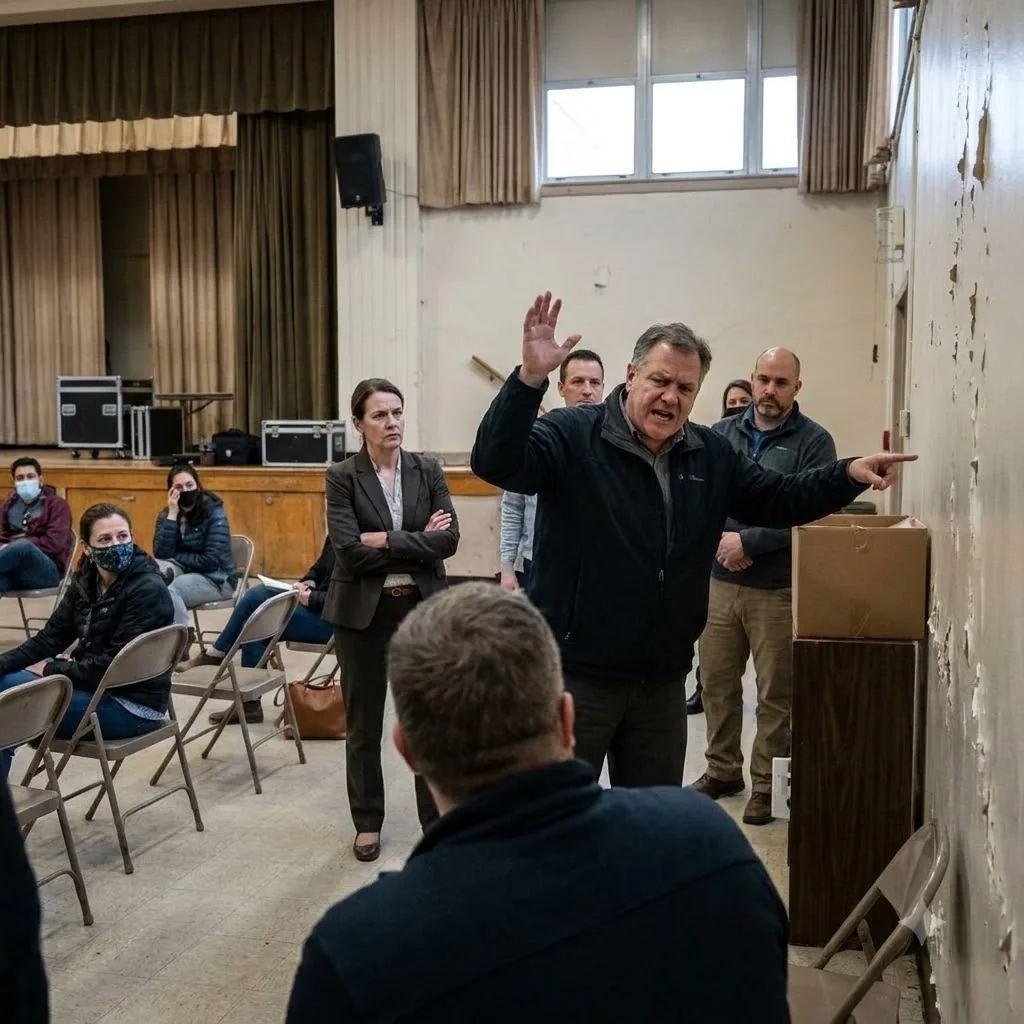
The room went quiet in that flat, public way a room does when everybody hears the contradiction at once but nobody says it yet. Derek had just spent a full minute ordering us around over a breathing emergency, and now he was telling Principal Ruiz not to “make it a whole thing” because Nurse Park was actually coming. Principal Ruiz kept the radio in her hand. “You requested a medical response,” she said. “I requested common sense,” Derek shot back. His voice was still loud, but the words got narrower. “You can use judgment without turning every little exposure issue into a formal scene.” He said little exposure issue while still standing in the aisle he had cleared himself. I picked my clipboard back up because I needed something steady in my hands. Cal stayed by the cart. The two volunteers had drifted together near the back end of the aisle, not leaving, just watching. Principal Ruiz looked at me. “Mara, what was happening in the room before this started?” I answered exactly from where I had been standing. “Chair setup, cable run, mic test. Cal’s cart came through this aisle. The mask box was on the side table by storage. Derek yelled to stop because he said somebody was having trouble breathing from contamination in the room.” She nodded once and turned to Cal. “Did anyone report distress to you?” Cal shook his head. “No. I moved a tape gun off the box this morning. That’s it. Nobody’s been handling it.” Derek cut in before she could ask the next thing. “You’re doing that thing where you wait for the perfect victim statement while people are standing in the same air.” “Who is affected?” Principal Ruiz asked again. He opened one hand toward the room like that was an answer by itself. “Anybody could be. That’s the point.” The auditorium doors swung again and Tina Park came in carrying a district nurse bag and a tablet tucked under one arm. She was moving fast, but not dramatically. She crossed to the open floor near the stage apron and stopped where she could see the box, Derek, Principal Ruiz, and the rest of us in one line. “Who is the patient?” she said. Derek answered before anyone else. “This isn’t about one patient. This is about unsafe contamination from old masks in a public indoor room.” Tina Park set her bag down. “Who is having breathing difficulty right now?” He pointed at the room again, not at a person. “People were forced to work around that box while chairs were being moved.” “Name the person with active symptoms,” she said. Nobody answered for a beat. The sound of a loose mic cable tapping the stage edge carried farther than it should have. I said, “No one came to me saying they couldn’t breathe.” One of the volunteers raised a hand halfway. “I covered my face after he yelled, but I didn’t say I was sick.” Tina looked at Derek. “Did you personally observe breathing distress?” He pulled at the cuff of his sleeve, then dropped his hand. “I observed a dangerous setup.” “That is not the same question,” she said. The old mask box sat where it had been all morning, half-collapsed at one corner, with a faded printed label and a torn flap folding inward. Nothing about it had changed except the amount of attention on it. Principal Ruiz asked me, “Has anyone moved the box since the complaint?” “No,” I said. “Not after he told everyone to back away from it.” “Good,” Tina said. “Then leave it in place.” Derek gave a short laugh with no smile in it. “Leave it there?” “Yes,” Tina said. “If you’re reporting an exposure concern, I need the scene as reported.” That line hit him harder than the first questions had. He stepped toward the side wall, then stopped when Tina lifted a hand. “Please don’t approach it,” she said. “I am trying to solve the problem,” he said. “No,” Principal Ruiz said. “You’re going to let Nurse Park assess the reported problem.” He turned his head toward the open auditorium doors as if checking how many more people might walk in and hear this. Then he looked back to Tina and changed the wording again. “I’m not saying it needs all this,” he said. “I’m saying somebody should use basic caution and maybe remove the box before the public comes in. That’s a facilities issue.” Cal answered from beside the cart, plain as ever. “A minute ago you said breathing emergency.” Nobody piled on. Nobody needed to. The words just stayed there. Tina tapped something into her tablet without looking rushed. “For my report, I need the exact original concern. Was there an active respiratory event, or was there a concern about an old supply box being present in the room?” Derek’s mouth opened, then closed. He rubbed one hand over the back of his neck and said, “There was a concern that could have become a respiratory event.” That was the third version in under five minutes. Tina did not argue with him. She just asked, “Has anyone touched the box since the room was stopped?” “No,” I said. “Good,” she said again, and this time she looked toward the stage apron and the open floor in front of it. “Then we can document the item where it sits and do a live check before anything gets moved.” Derek’s shoulders tightened under his jacket. He took a half step forward and then stopped himself. “You don’t need to put on a show,” he said. Tina lifted her bag by the handle and nodded toward the clear space by the stage. “If the complaint was serious enough to stop the room, it’s serious enough to verify in the room.” She said it in the same tone somebody would use to confirm chair count or test a microphone, and somehow that made it land even harder. Derek looked at the box, then.