Story code: ST-000979
Part 2: The Standard Gets Louder
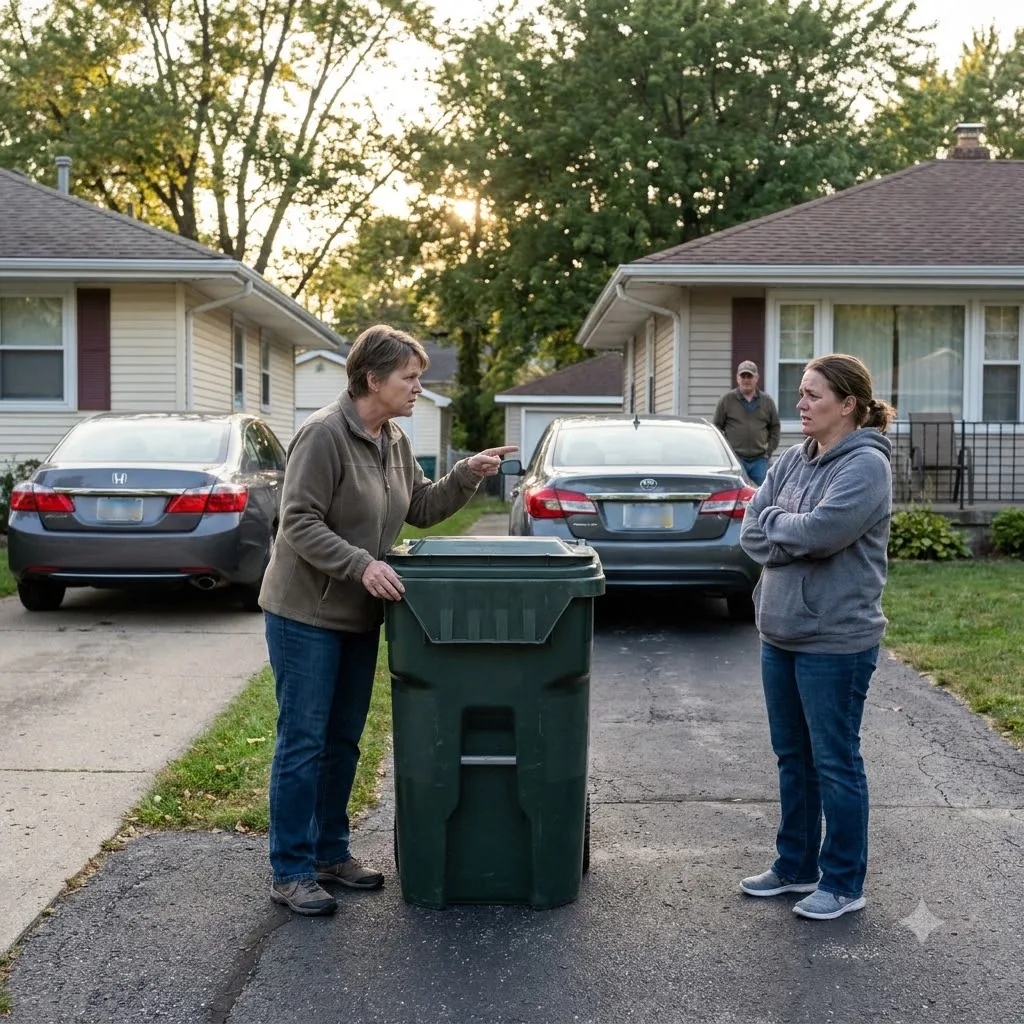
By the next trash morning, Darlene Pike had repeated her driveway rule often enough that it started sounding less like a complaint and more like a label she meant to hang on the Jensen house. She said it at the curb, she said it near the front walk, and she said it again when Mrs. Alvarez passed through with a grocery tote and slowed at the sound of raised voices. Each time, Darlene sharpened it: anybody who left a bin blocking shared access was careless, then rude, then the kind of neighbor who made a whole street worse.
Mara did not answer with equal volume. She watched where the bins stood, when the truck came, and what stayed on the concrete after pickup. That was all the driveway would give her, and it was more useful than arguing with someone performing certainty.
On Tuesday evening, the bins went out in ordinary sequence. Evan rolled the Jensen trash can to the curb first, the one with the white scrape on the left side. Mara followed with recycling and tucked it parallel to the street. Darlene came out a few minutes later from the Pike side, guiding her can along the narrow strip by the fence. Mrs. Alvarez was watering a planter two doors down and had a clear line of sight to the mouth of the shared drive.
“Please keep yours tight to the curb this time,” Darlene called, though the Jensen cans already were.
Evan did not stop walking. “They are.”
Darlene set her own bin down harder than necessary and adjusted it twice. “I’m saying it now so there’s no confusion in the morning.”
Mara noted the placement without commenting. Darlene’s trash bin was slightly behind the Jensen bins, not enough to block anything then, but far enough back that the wheels rested inside the shared throat of the driveway instead of at the curb line. The recycling bin beside it made the difference plain.
Before sunrise the next morning, Evan backed his car down slowly, then braked. Mara, standing at the storm door with a mug in hand, could see the reason. Darlene’s trash bin had drifted or been left farther inward overnight. It was not completely crosswise, but it narrowed the exit enough that Evan had to angle around it.
He got out, looked toward the Pike porch, then at the can. He did not touch it. He got back in, made a careful turn, and cleared the gap with inches to spare.
When he came in later, he spoke in the same short way he used when he wanted facts kept separate from annoyance. “Her bin was in the lane before the truck came. I didn’t move it.”
Mara nodded. That accounted for one slice of the morning and nothing more. The truck still had not arrived when Evan left. Final proof was still missing.
By late morning, collection was over. The curb showed the usual signs: damp scatter near the pickup point, a few flattened paper scraps, a faint drag line where a wheel had been pulled back from the street. Mara stepped out to bring the bins in and found Darlene already in the drive with Mrs. Alvarez there again, this time holding folded mail.
Darlene did not waste the opportunity.
“There,” she said, with a small sweep of her hand toward the center of the drive. “Again. I shouldn’t have to keep telling grown people the same thing. If your trash can ends up in shared space after pickup, that means someone in your house left it there wrong to begin with.”
Mara looked where Darlene indicated. A bin sat several feet back from the curb, angled into the lane.
It was not the Jensen bin.
The white scrape on the left side was missing. In its place was that same chalky curved rub low on the right panel. Near the wheel, a damp leaf was stuck to the plastic, and a second leaf lay on the concrete by the Pike-side fence opening. Mara had seen leaves collect there where Darlene staged her cans before rolling them out.
Mrs. Alvarez turned her head from the bin to Darlene. “That looks like yours.”
Darlene answered immediately. “No, mine was up at the curb. Somebody must have pulled it back.”
Nobody said anything for a beat.
Mara could only work with what was visible. The pickup residue at the curb was in a tight patch near the Jensen cans, but farther right, where Darlene claimed her can had stood, the concrete was cleaner. The wheel line that led back into the driveway started not from the Jensen side, but from the Pike side of the curb position, then bent inward. The recycling bin beside the Jensen trash can had never shifted and still marked the straight line a properly placed can would follow.
Evan came up the walk carrying a small bag from the hardware store and paused at the edge of the scene.
“What happened now?” he asked.
Darlene lifted her chin toward the bin. “Same disrespect as always.”
Evan set the bag down and looked once, carefully. “That’s your can.”
Darlene spoke over him. “The point is the rule. Whoever does this is inconsiderate.”
Mrs. Alvarez did not move. “You said last week there was no gray area.”
Darlene gave a tight little laugh that did not carry. “There isn’t. That’s why I’m saying something.”
But now the rule she kept repeating was no longer floating above the facts. It was landing on a specific bin with a specific mark, a wheel path bending back from the Pike side, and a pickup pattern that did not fit the accusation she wanted to keep using.
Mara said only, “Then let’s keep watching where it is before pickup, after pickup, and who moves it.”
Darlene’s hand stayed on the lid a second too long before she let go.
The can rocked once in the shared driveway and settled there, still carrying her mark.