Story code: ST-000979
Part 4: Same Rule, Same Bin
The final break came on the next pickup day, and it came so quietly that if Darlene had not spent weeks making speeches, it might have passed as nothing more than another awkward bin left in the wrong place.
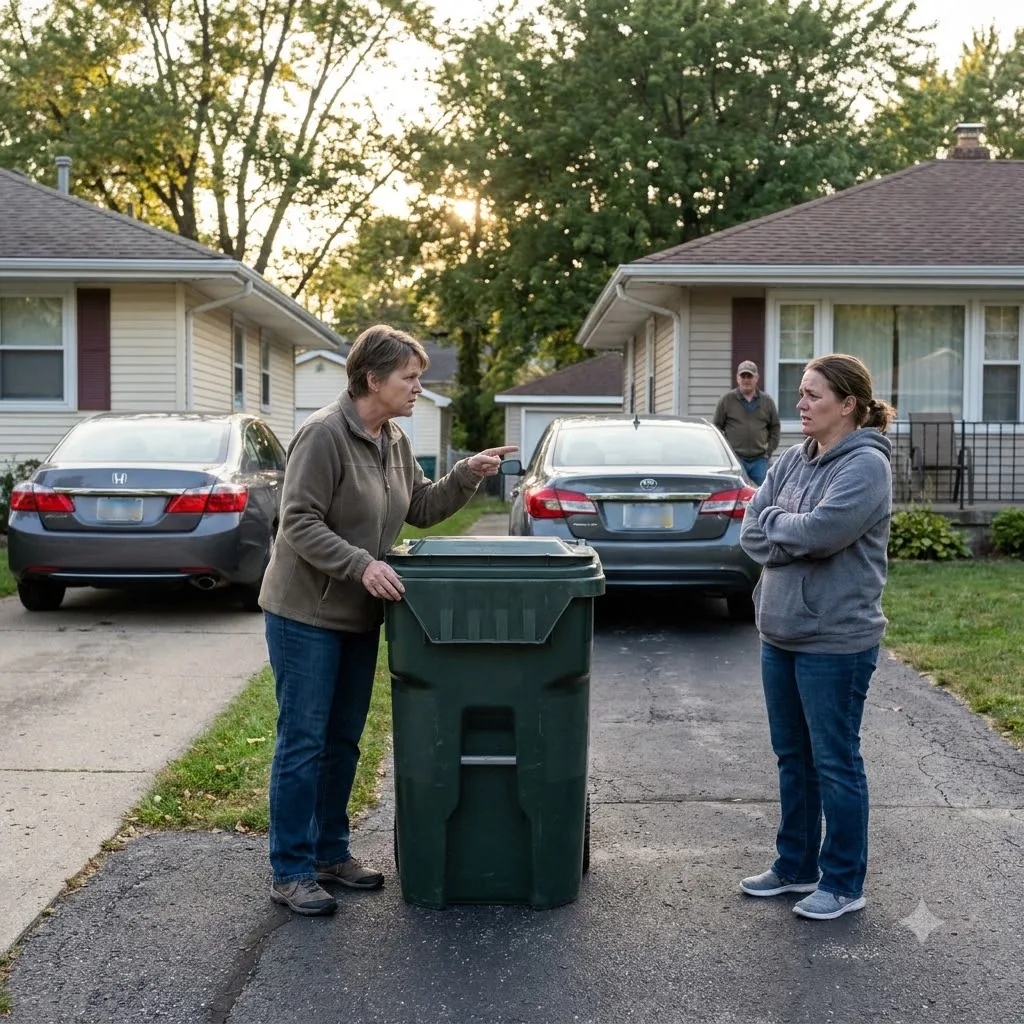
Mara was out early because she needed to move her car before a delivery. The shared driveway was still blue with first light. The Jensen trash bin and recycling bin stood tight to the curb in the same clean line Evan always used. Darlene’s bin, with the chalky rub low on the right side, sat a little farther back near the Pike edge of the mouth of the drive.
Mara noted it and went inside.
When the truck came through later, the usual sounds carried into the kitchen: brakes, lift, lids, the short metallic knock as emptied cans dropped back down. A few minutes after that, Mara stepped out with her keys to bring the bins in before the delivery van arrived.
Darlene was already there.
She had one hand on the handle of her empty trash bin and was pulling it backward from the curb into the shared driveway, not toward her fence opening, but diagonally across the narrow lane. The wheels left a wet track through pickup residue. The can rolled until it sat in the same obstructing position she had condemned from the first day, half in the center seam and half across the path both households used.
Mara stopped on the front walk.
Mrs. Alvarez was at the mailbox cluster again with two envelopes in her hand. She saw it too. Her head turned from the moving bin to Darlene’s face.
Darlene let go of the handle and looked up. For one second nobody filled the silence for her.
Then she said, “I was just moving it out of the way.”
The statement stayed hanging there because the can was visibly in the way, not out of it.
Mara walked down to the curbside area but did not touch any bin. “You just said the same thing couldn’t happen by accident,” she said.
Darlene reached for the lid, flipped it shut though it was already nearly closed, and answered too fast. “This is different. I hadn’t brought it in yet.”
Mrs. Alvarez looked at the wheel marks. “You pulled it back from the pickup spot into the drive.”
“For a second,” Darlene said.
Evan turned in from the sidewalk at that moment, coffee in one hand, having parked farther down the street after his early errand. He took in the position of the can, the fresh wet wheel line, and the two women standing there.
“That’s the whole thing you’ve been yelling about,” he said.
Darlene pressed her lips together and pulled the bin upright, but she did not take it straight to her side. She shifted it once, then again, talking while she moved.
“People are making this into something ridiculous,” she said. “A bin gets adjusted. That’s not the same as leaving it disrespectfully.”
Mrs. Alvarez did not raise her voice. “You said there was no gray area.”
The words landed with nothing dramatic around them. No crowd gathered. No one gasped. The truck was already gone, the paper scraps were flattening in the damp, and a delivery van slowed at the street because the drive entrance was pinched by the can Darlene had just rolled there herself.
The driver leaned out and asked, “Which house is Jensen? I can’t get up unless that bin moves.”
Evan answered by stepping aside and looking at Darlene.
She pulled the bin hard toward her fence line at last. One wheel caught the edge of the concrete and left a black scrape beside the wet track. The van eased in only after the lane cleared.
That was the visible consequence, and it did not disappear. The delivery driver, still holding his handheld scanner, looked at the marked-up entrance and said, mostly to nobody, “You all need one side kept open on pickup mornings.”
Mrs. Alvarez folded her envelopes together. “We do,” she said. Then she turned to Darlene. “And now we know who keeps putting it there.”
Darlene opened her mouth as if to start the rule again, then stopped. She glanced at the can, the track leading from the curb, the scrape by the concrete edge, and the van now halfway up the shared drive because it had been delayed at the mouth.
Mara did not need anything more elaborate than what was already on the ground. The same bin. The same rule. The act completed in plain view after pickup, exactly where Darlene had insisted only a selfish neighbor would put it.
By that afternoon, the practical change was small and final. Evan set two short landscape stakes with reflective caps along the Jensen side of the driveway mouth, just inside their edge, so delivery drivers and anyone moving bins could see the open lane line clearly. He did it in front of Darlene, in front of Mrs. Alvarez, and without commentary beyond one sentence.
“Our side stays open from here forward,” he said.
Darlene came out while he was pressing the second stake into the dirt border. She looked at the markers, then at the black scrape and damp wheel line that still had not fully dried from the morning. She did not repeat the rule. She did not correct anyone. She took her bin in by the Pike fence and shut the gate behind her.
The next trash day, her can sat flush to the curb, exactly lined with the street, well clear of the shared lane.
No apology was offered. None was needed. The driveway routine had closed over the lie in the driest way possible. Darlene had announced the standard, repeated it until it became a weapon, and then rolled her own bin into the same mess with witnesses standing there. After that, the rule still existed. It just no longer belonged to her.