Story code: ST-001057
Part 3: The Registry Audit
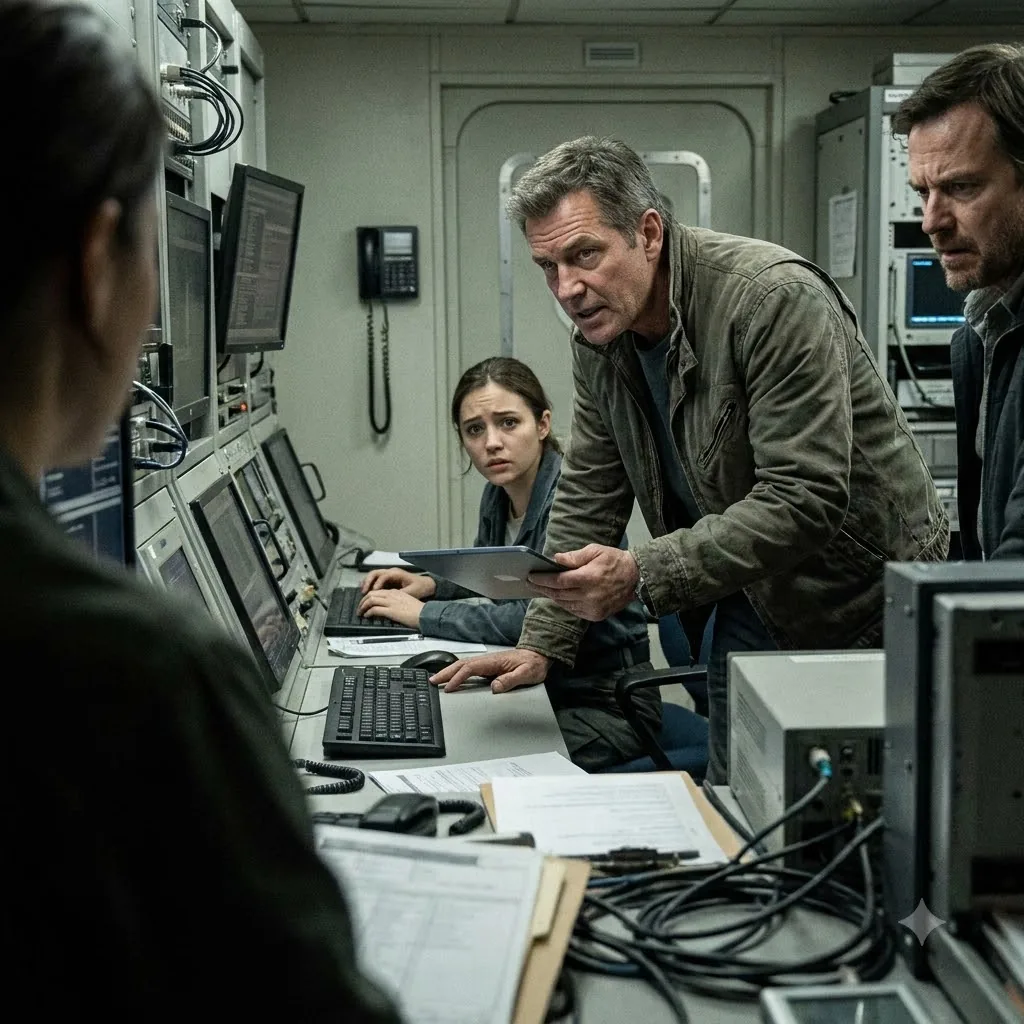
At 09:16 UTC, the terminal screen at Counter Desk Delta shifts from red to a steady, blinking amber. The timer on my hand-held diagnostic pad displays one minute and forty seconds remaining. Sarah Chen remains three paces back from the console, her hands resting flat on the metal casing of the pneumatic track. Her eyes do not leave the status monitor. Mission Liaison Raymond Vance keeps his right hand hover-locked above the input terminal. His fingers are rigid, the knuckles showing white under the glare of the ceiling strip.
“The core registry is querying the central colonial database,” I state, holding the diagnostic pad so the progress bar is visible to both of them. “There is no record of Subsection 9-E in the primary charter. The station network is treating the lack of a verified registration hash as a protocol anomaly.”
“The local charter allows for administrative buffers,” Vance says. His voice has lost its rapid pace, replaced by a low, deliberate cadence. “As liaison, I am authorized to establish temporary safety queues during operational windows. The system will accept my override code once the diagnostic interval completes.”
“The operational window closed when the telemetry streams were blocked,” Chen says, pointing to the secondary monitor. “The cooling loop logs for Sector 3 have completely ceased updating. The system is flagging the entire data stream as an unverified physical queue because of the override on the Model-9 capsule.”
I input a query command into my pad, linking it directly to the terminal’s active log. The terminal screen displays the diagnostic result:
CORE SERVICE QUERY: SUBSECTION 9-E
STATUS: NULL
REGISTRY HASH: NOT FOUND
WARNING: UNREGISTERED RULE DETECTED IN ACTIVE STACK
“The automated core requires a physical signature to validate an unregistered rule,” I tell Vance. “If you do not input an authorized charter hash, the terminal will require you to register the rule under your own personal token. By system law, any local rule registered this way must apply to the author’s session credentials immediately to prevent administrative policy loops.”
Vance does not move his keycard. The security solenoid inside the terminal terminal makes a sharp, metallic clicking sound, locking his Security Token Keycard into the slot. The countdown reaches forty seconds. The station’s central core has now isolated Counter Desk Delta, cutting off the local network from the secondary relay rooms to contain the telemetry freeze.
“If I register the rule locally,” Vance says, his eyes narrowing as he looks at the screen, “the capsule remains held until the next manual audit cycle. That is standard protocol for unverified packets.”
“If you register the rule locally without a charter hash,” I reply, “the system will evaluate your own credentials under the terms of that very rule. Every policy applied to the queue will be applied to the active session keycard. The console will treat your access rights exactly how you have treated the outbound capsule.”
Chen takes another step back, her boots clicking against the metal floor plates. The terminal monitor blinks once, then displays the final prompt:
ENTER OVERRIDE TO REGISTER LOCAL RULE ‘SUBSECTION 9-E’.
WARNING: SYSTEM POLICY EQUALIZATION WILL ENGAGE UPON EXECUTION.
“Execute the registration, Liaison,” I say, holding the diagnostic pad to record the transaction. “Or release the capsule.”
Vance reaches forward, his hand steadying against the edge of the desk. He presses his thumb against the terminal’s biometric scanner, initiating the local override. The system begins to process the registration, drawing the final line between the liaison’s fabricated rule and his own station authority.