Story code: ST-001057
Part 1: The Quarantine Protocol
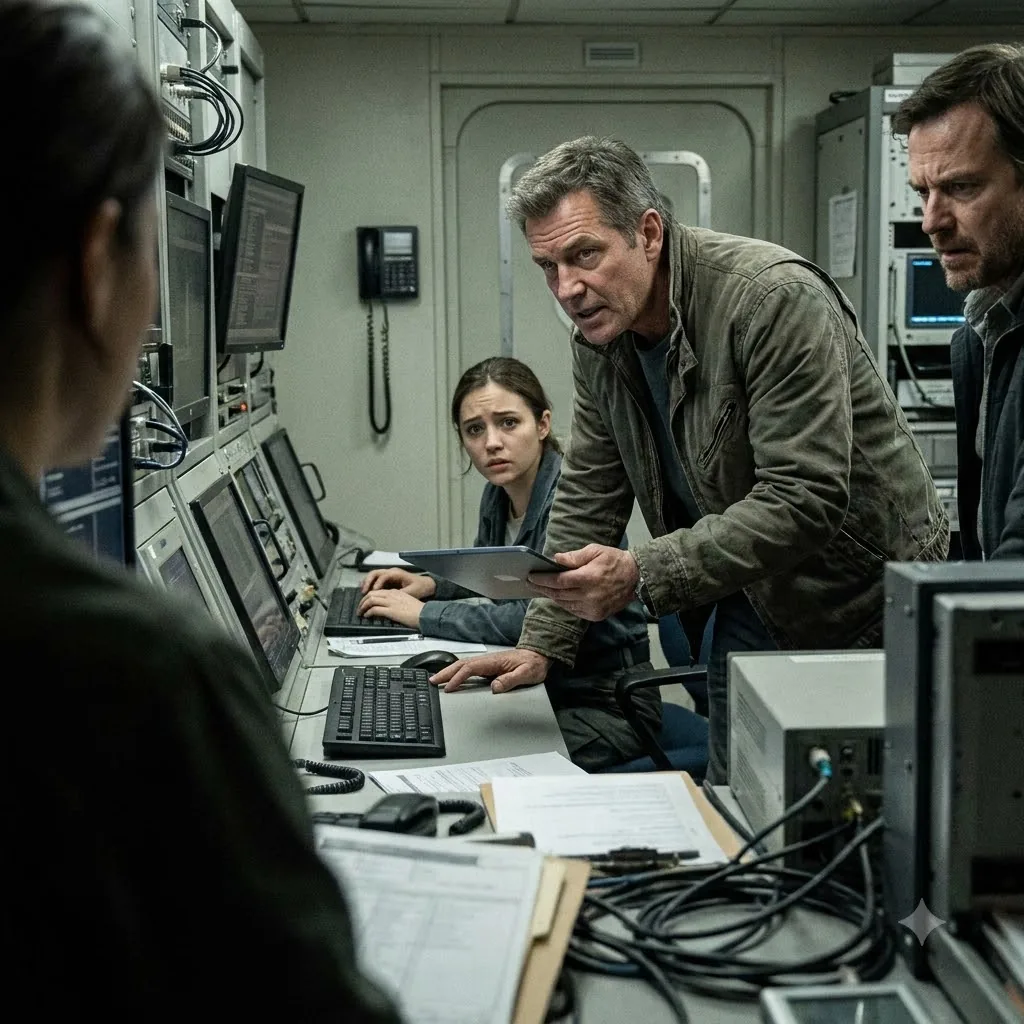
In the terminal log of Deep Space Relay Room 4, the transaction at Counter Desk Delta halts at 08:14 UTC, when Mission Liaison Raymond Vance used a manufactured safety-queue policy to block the dispatch of the outbound Delayed Message Capsule Model-9. Operator Sarah Chen had her hand on the release lever, ready to send the cylinder through the pneumatic launch track, when Vance announced with flat authority that all outbound physical logs were subject to immediate local quarantine under Subsection 9-E. He did not present a verification code, yet his order locked Chen’s console and denied the colonial outpost its scheduled weekly data transfer. I am reconstructing this sequence from the digital audit trails and the room’s fixed-angle cameras. On the video feed, Chen does not argue; her shoulders drop, and she turns her screen toward Vance. Her grease-stained jumpsuit is visible under the harsh fluorescent lights of the relay room. She points at the diagnostic screen. The Model-9 capsule remains seated in its brass receiver, its magnetic seals humming with a low vibration-a physical manifestation of the unresolved queue. Vance, wearing his crisp blue liaison uniform, keeps his arms crossed. He does not look at the capsule. “Subsection 9-E requires manual clearance for all mechanical data packets during terminal updates,” Vance says on the audio log. His voice is measured, defensive. “The terminal update completed three hours ago,” Chen replies, her voice flat. “And Subsection 9-E is a local administration draft. It is not in the system charter.” “It is a binding station directive,” Vance says. He slides his Security Token Keycard into the secondary slot of Chen’s console, locking the pneumatic gate manually. The mechanical latch clicks shut, securing the capsule in place. According to the system log, this keycard insertion created an overriding block. It is a physical action that cannot be cleared without an administrative override or a complete system diagnostic. At 08:30 UTC, I arrived at Relay Room 4. My hand-held diagnostic pad recorded no active safety directives from the central charter. As an investigator, my role is to reconstruct the process gap, and the gap here is absolute: there is no record of Subsection 9-E in the primary colonial databases. When I ask Vance to produce the authorization code for the lock, his fingers twitch against his cuffs. He repeats that the rule is local, designed to protect the queue from data corruption. “If Subsection 9-E is active for mechanical packets,” I tell him, noting the way his eyes remain fixed on the locked capsule, “then by system logic, it applies to all local data streams operating under the same routing protocol.” Vance nods once. “Exactly. Standardized queue management. It applies across the board.” Yet, when I request the documentation mapping this rule to the other channels, Vance’s posture stiffens. The console log shows he has already applied the rule to the outbound capsule, but the system now registers a pending conflict. If the rule applies to all data streams, then every active terminal on this deck must conform to it immediately. Chen watches us from her console, her eyes shifting from my diagnostic pad to Vance’s keycard, still inserted in the lock. The unresolved question hangs in the humid air of the relay room: if this rule is indeed a valid station directive, why does the station’s primary automated core show zero record of its registration, and why can the gatekeeper himself not explain how this policy applies to the rest of the sector’s traffic?
In the terminal log of Deep Space Relay Room 4, the transaction at Counter Desk Delta halts at 08:14 UTC, when Mission Liaison Raymond Vance used a manufactured safety-queue policy to block the dispatch of the outbound Delayed Message Capsule Model-9. Operator Sarah Chen had her hand on the release lever, ready to send the cylinder through the pneumatic launch track, when Vance announced with flat authority that all outbound physical logs were subject to immediate local quarantine under Subsection 9-E. He did not present a verification code, yet his order locked Chen’s console and denied the colonial outpost its scheduled weekly data transfer. I am reconstructing this sequence from the digital audit trails and the room’s fixed-angle cameras. On the video feed, Chen does not argue; her shoulders drop, and she turns her screen toward Vance. Her grease-stained jumpsuit is visible under the harsh fluorescent lights of the relay room. She points at the diagnostic screen. The Model-9 capsule remains seated in its brass receiver, its magnetic seals humming with a low vibration-a physical manifestation of the unresolved queue. Vance, wearing his crisp blue liaison uniform, keeps his arms crossed. He does not look at the capsule. “Subsection 9-E requires manual clearance for all mechanical data packets during terminal updates,” Vance says on the audio log. His voice is measured, defensive. “The terminal update completed three hours ago,” Chen replies, her voice flat. “And Subsection 9-E is a local administration draft. It is not in the system charter.” “It is a binding station directive,” Vance says. He slides his Security Token Keycard into the secondary slot of Chen’s console, locking the pneumatic gate manually. The mechanical latch clicks shut, securing the capsule in place. According to the system log, this keycard insertion created an overriding block. It is a physical action that cannot be cleared without an administrative override or a complete system diagnostic. At 08:30 UTC, I arrived at Relay Room 4. My hand-held diagnostic pad recorded no active safety directives from the central charter. As an investigator, my role is to reconstruct the process gap, and the gap here is absolute: there is no record of Subsection 9-E in the primary colonial databases. When I ask Vance to produce the authorization code for the lock, his fingers twitch against his cuffs. He repeats that the rule is local, designed to protect the queue from data corruption. “If Subsection 9-E is active for mechanical packets,” I tell him, noting the way his eyes remain fixed on the locked capsule, “then by system logic, it applies to all local data streams operating under the same routing protocol.” Vance nods once. “Exactly. Standardized queue management. It applies across the board.” Yet, when I request the documentation mapping this rule to the other channels, Vance’s posture stiffens. The console log shows he has already applied the rule to the outbound capsule, but the system now registers a pending conflict. If the rule applies to all data streams, then every active terminal on this deck must conform to it immediately. Chen watches us from her console, her eyes shifting from my diagnostic pad to Vance’s keycard, still inserted in the lock. The unresolved question hangs in the humid air of the relay room: if this rule is indeed a valid station directive, why does the station’s primary automated core show zero record of its registration, and why can the gatekeeper himself not explain how this policy applies to the rest of the sector’s traffic?