Story code: ST-001157
Part 2: The Contradiction Deepens
Leo’s statement immediately shattered the administrative facade Vance had built. On the recording, Leo stepped closer, pointing to the yellow zip-tie on Sarah’s tote. “He told me code 104-B was specifically for electrical and cooling units that might leak fluids into the cargo bay. Now he’s telling you it blocks a dry, sealed plastic container?”
Sarah’s defense became more direct. “Mr. Vance, is code 104-B a weight limit, a volume limit, a fluid hazard rule, or did you simply make it up to keep us from boarding?”
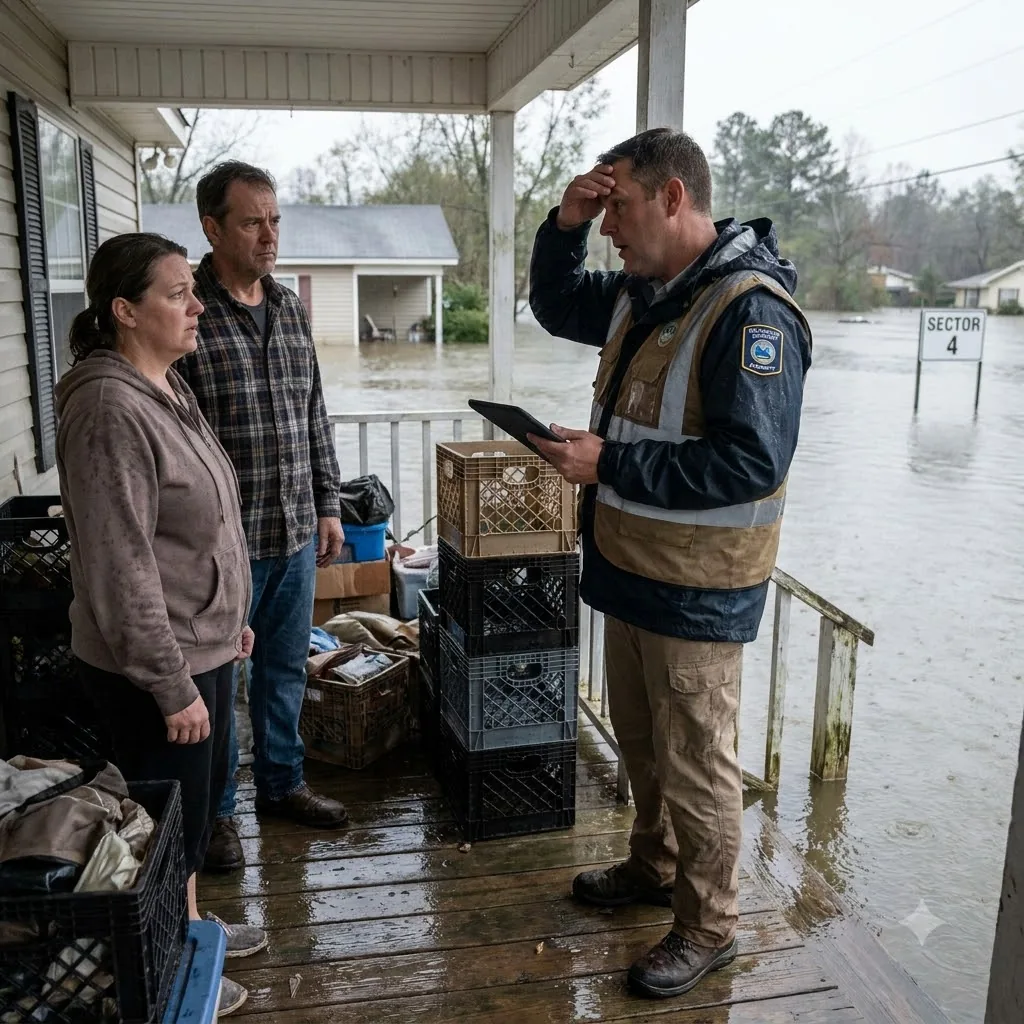
Vance’s posture, captured in the security log, stiffened. He adjusted the strap of his utility vest and tapped his terminal again, his fingers moving with visible hesitation. “The code is a multi-classification hazard index,” he said, his voice rising slightly over the sound of the rain. “It applies to any non-standard cargo that exceeds the baseline weight-to-volume ratio determined by the transit authority for flooded sectors. Both the cooler and the tote fall under its purview during emergency retreats.”
“A standard-issue evacuation tote distributed by your own agency is ‘non-standard’?” Sarah asked. She reached down and tapped the embossed logo of the Relocation Administration on the side of the heavy-duty plastic. “This container was mailed to us by your office three weeks ago. It is the exact model specified in the relocation manual.”
Leo laughed, a dry, sharp sound. “He told me my cooler was too wide, but he didn’t even measure it. He just saw the blue plastic and called out the code. He’s doing the same thing here. He’s using one fake rule to reject everything we try to bring.”
According to our forensic review of the sector’s communications, Vance’s supervisor had sent a warning to all field agents forty minutes prior, stating that ferry capacity had been reduced by half due to engine debris. However, no official weight restrictions or code 104-B protocols had been authorized. Vance was operating on his own initiative to slow down the boarding process at the porch level, preventing a bottleneck at the dock that would expose his agency’s logistical failure.
“I am enforcing the safety margins of the transport vessel,” Vance insisted, though his digital log shows he had not logged into the central database for over an hour. “If you refuse to leave the tote behind, I will be forced to mark your household as non-compliant. That means you stay here until the secondary wave of transports, which could be days.”
Sarah stood her ground, her fingers firmly gripping the yellow zip-tie. “Then enter the non-compliance code into your system right now, Mr. Vance. But you will have to note that you are declaring a standard-issue, sealed evacuation tote as non-compliant under code 104-B. Put it in the official log.”
Vance’s hand hovered over the screen. The reconstruction of his terminal’s activity indicates he opened the input field for the Miller household but hesitated. Typing a false code into the official log would leave a permanent digital trail. He looked at the tote, then at Leo, then back to Sarah’s determined expression. The pressure on the flooded porch was rising faster than the water around their ankles. If Vance logged the code, he would have to defend its definition to the regional auditors. If he didn’t, he would have to let them pass with the tote. He remained poised over the screen, the silence stretching. Would he risk entering the fake code into the permanent record, or would Sarah force him to expose the system’s empty threats?