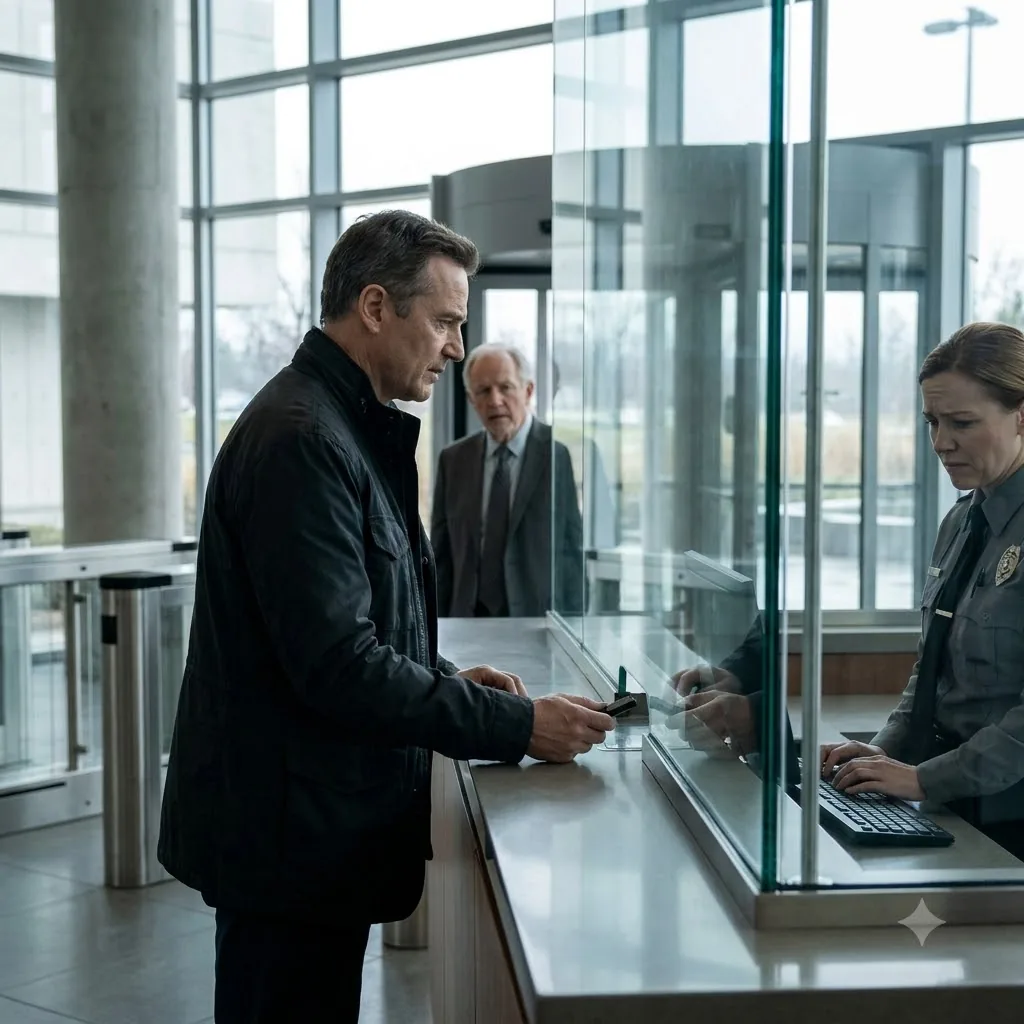
Story code: ST-001326
Part 2: The Cryptographic Footprint
The lobby master terminal displayed the raw clock-cycle count of Marcus Vance’s physical access token, and the numbers did not align with his claim. Clara Higgins pointed to the screen, where the sequence counter for the Model-9 sat at number 1042.
“According to the database,” Clara said, her voice dropping into a professional cadence, “the server logged a remote entry attempt at five o’clock this morning under your credentials. That remote attempt was registered as sequence number 1043.”
Marcus froze, his hand stopping mid-air. The silver token remained gripped tightly between his thumb and forefinger.
Dr. Sarah Vance stepped closer to her nephew, her eyes scanning the two numbers highlighted on the terminal screen. “A remote attempt? That must be a synchronization delay from yesterday’s calculations. The server is simply processing the remote data out of order.”
“The cryptographic system does not allow out-of-order processing,” Clara said, her gaze remaining steady on Marcus. “A physical connection must happen sequentially. If sequence 1043 was attempted remotely at five, the physical token in Marcus’s hand cannot still be at sequence 1042. A physical token cannot exist in the past of its own digital sequence.”
Marcus’s jaw tightened. He shifted his weight, his leather shoes squeaking against the polished terrazzo floor of the lobby. “The remote log is a ghost. I was physically in the clean room. The system is misinterpreting the remote ping.”
“The remote ping carried a signature that could only be generated by a user logged into the external VPN,” Clara said. She clicked the mouse once more, opening the network access map. A red dot appeared over a residential IP address registered to Marcus’s off-site apartment. “The server received the sequence request from this address at exactly 5:01 AM.”
Dr. Vance’s expression hardened. She looked at Marcus, then back to Clara. “This is an administrative matter, Clara. The system has clearly glitched during the transition from remote to physical access. I am directing you to issue a temporary sequence reset.”
“A sequence reset requires physical verification of the token’s current state,” Clara said. She reached out and touched the card reader mounted on the security side of the counter. “Marcus, please place the token on the reader.”
Marcus did not move. He looked at his aunt, his fingers tightening around the silver casing.
“Marcus,” Dr. Vance said, her voice dropping to a low, commanding whisper. “Put the token on the reader so Clara can clear the sequence mismatch.”
Marcus slowly reached through the opening in the glass partition. His hand trembled slightly as he set the Model-9 token onto the circular reader.
The terminal emitted a low, three-tone chime. The screen turned from blue to a deep amber, displaying a flashing yellow warning: Sequence Desynchronization Detected. Initiating Integrity Verification.
“The reader is verifying the internal clock-cycles of the token,” Clara observed, her face showing no emotion.
On the screen, the progress bar crept forward. The server log from five in the morning began to compare its cryptographic footprint with the physical chip inside the token on the desk. The discrepancy was absolute; the physical token had not been present at the institute when the dawn logs were generated.
Dr. Vance reached toward the partition. “Override it before the verification loop finishes, Clara. If it flags a security break, the system will lock the project’s entire directory.”
Clara kept her hands visible on the desk, away from the keyboard. The progress bar reached ninety percent.