Story code: ST-001340
Part 4: The Standard Baseline
The terminal screen emitted a quiet, rhythmic beep with every passing second, counting down from one hundred and twenty. The soft yellow light from the wall monitor cast long, anxious shadows across the sterile white panels of Neuro-mod Room 4.
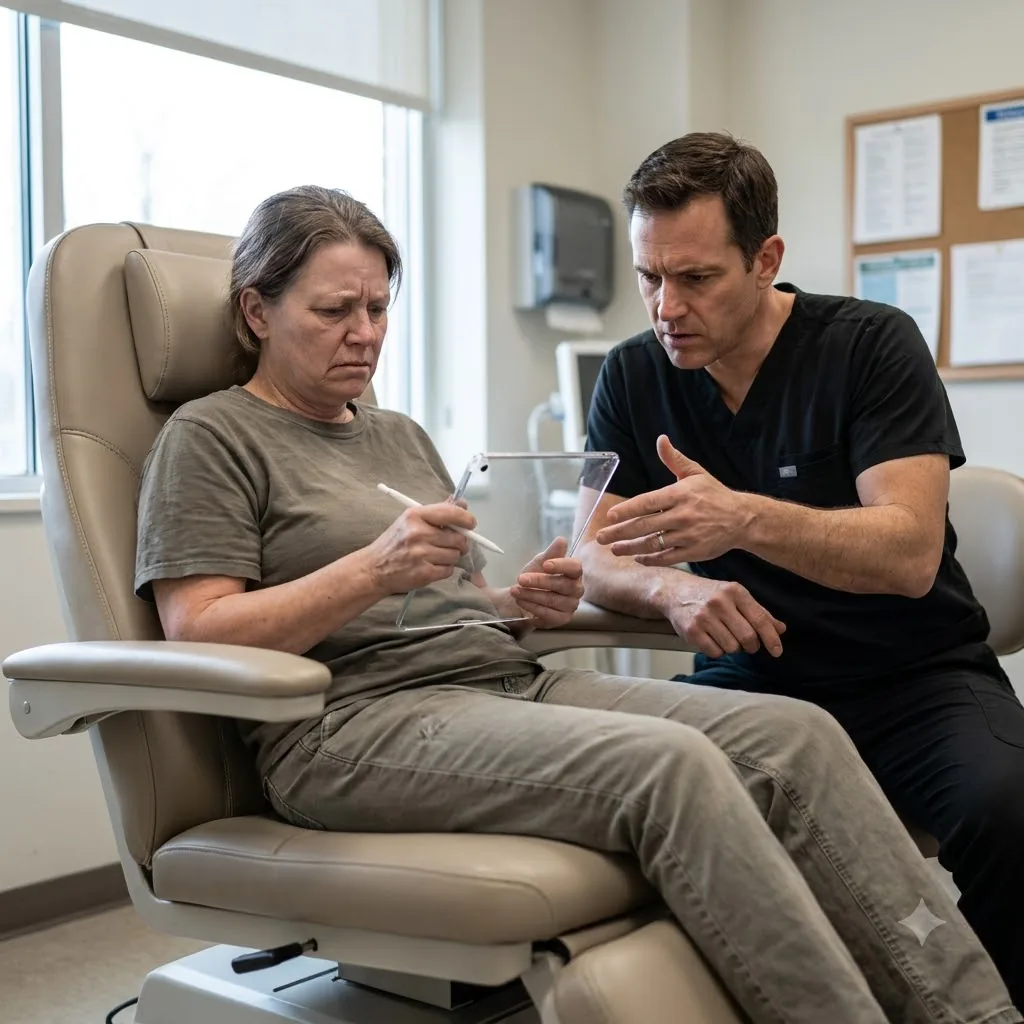
“Two minutes, Julian,” Marcus said, his voice trembling slightly as he held his technician badge over the reader. “If the board gets those logs, they’ll freeze your partition for a full investigation. You’ll be stuck with a buggy, uncalibrated system for weeks while they run diagnostics. Just sign the tablet. We can bypass the audit, and I can keep tuning your system for free.”
I looked at the blue glowing box on the tablet, then back up at Marcus. I kept my hands resting flat on the armrests of the recliner. “No. I am not signing away my rights to cover up your negligence. Cancel the custom patch. Reset me to the standard baseline. You have ninety seconds left.”
Marcus stared at me, his breathing shallow. He looked at the countdown timer, which was ticking past seventy-five seconds. His face was pale, his defensive posture collapsing under the reality of the digital logs. He knew that if the timer hit zero, his career at Synapse Pathways was finished.
With a sharp, frustrated sigh, Marcus tapped his badge against the terminal scanner. He grabbed a secondary stylus and began inputting a series of override commands on his screen, bypassing the consent form entirely. His fingers moved with frantic precision, entering his technician credentials to authorize the manual rollback.
On the glass-backed tablet in my lap, the screen flickered. The active calibration graphs showing the unstable orange waves disappeared. In their place, a gray system prompt appeared: *Initiating System Reset to Standard Profile. WARNING: All custom adjustments will be wiped. Device will be locked to the standard manufacturer configuration.*
“It’s done,” Marcus muttered, stepping back from the console. He wouldn’t look me in the eye. He stood with his arms crossed, staring at the floor as the progress bar on the tablet crawled toward completion. “Your implant is returning to the default baseline. You’re locked out of any custom optimization. No more tweaks, no more overrides. You’re on the standard profile now.”
“Good,” I said.
A final beep signaled the end of the process. The countdown timer on the terminal stopped at twelve seconds, and the yellow warning light faded back to the clinic’s standard soft white illumination. On my tablet, the progress bar finished, replaced by a solid green checkmark and a steady blue line.
Almost instantly, the heavy, metallic pressure behind my temples cleared. The minor visual lag that had bothered me all morning vanished, replaced by a clean, predictable stability. It wasn’t the high-performance focus that Marcus had used to lure me in, but it was safe, consistent, and entirely under my own control.
Marcus reached down and took the tablet from my lap, his movements stiff and mechanical. He kept his gaze focused on the screen as he closed the session and slotted the tablet back into its charging dock. He didn’t say another word.
I stood up from the ergonomic recliner, adjusting my jacket. The phantom debt that had weighed on me since I walked into the room was gone. I walked past Marcus, opened the glass door of Neuro-mod Room 4, and stepped out into the quiet corridor. As the clinic’s glass doors slid shut behind me, the cool, crisp air of the outside world hit my face. My system was locked to a basic profile, and I would have to pay full price for any future official maintenance, but the trap was broken. My mind belonged to me again.