Story code: ST-001340
Part 3: The Decisive Audit
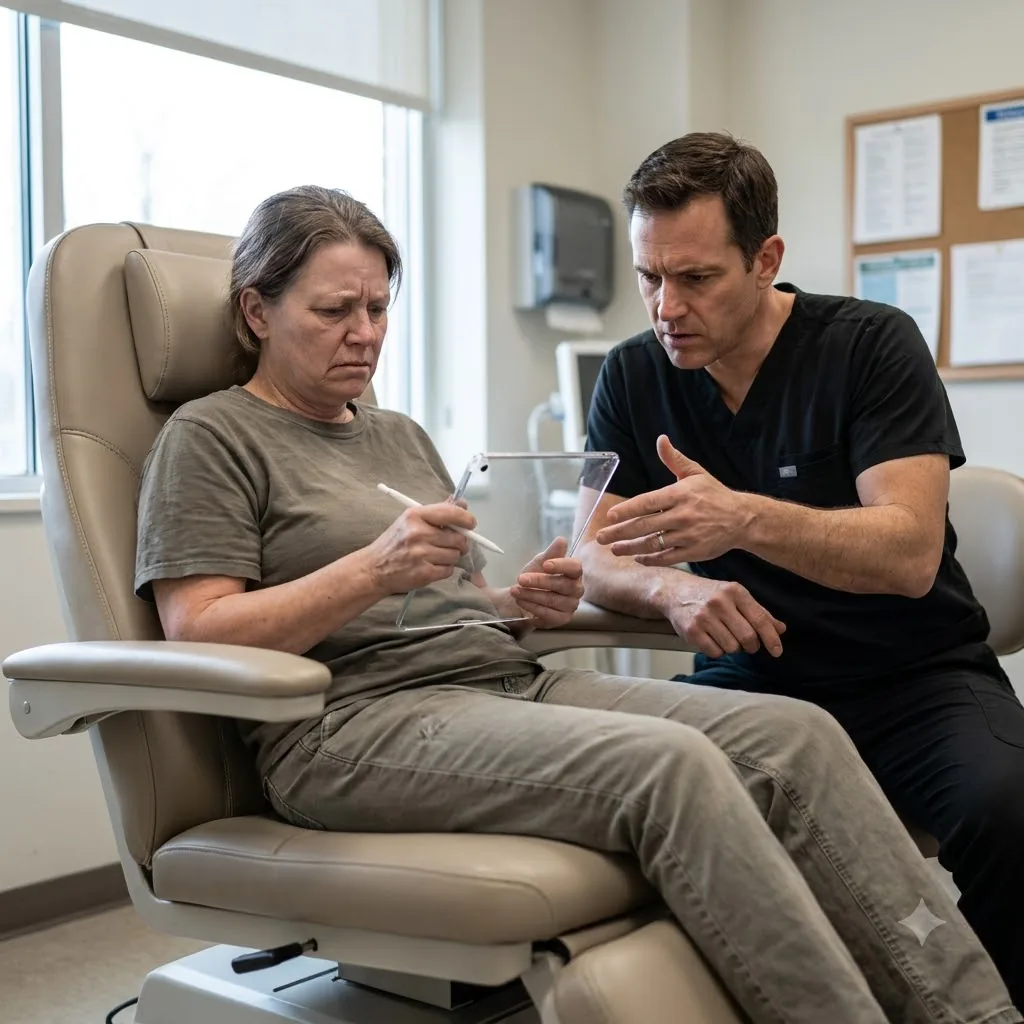
I looked at the blinking cursor on the tablet. I didn’t press my thumb to the screen. Instead, I tapped the history tab again, expanding the details of the crash log from last month. I wanted to make sure I had every detail right before I spoke.
“Let’s talk about last month, Marcus,” I said, keeping my voice low and controlled. I pointed directly to the red line on the glass screen. “The thousand-dollar calibration upgrade. You told me you did me a massive solid by waiving the fee. But look at this entry right here. Ten minutes before you applied that custom patch, there’s a critical system crash. Code 404-Partition-Breach, authorized under your tech ID, C2-Kane.”
Marcus stiffened, his hand hovering over the edge of the tablet. He made a subtle movement to pull the device back, but I gripped the side of the frame, keeping it firmly in my lap. I kept my thumb far away from the biometric signature scanner.
“You didn’t waive the fee out of the goodness of your heart,” I continued, looking up to meet his defensive gaze. “You misconfigured my implant during my routine check-up. The system crashed under your watch. If you hadn’t applied that custom patch immediately to stabilize the partition, the error would have automatically uploaded to the clinic’s central database. You would have been flagged for negligence, and with your record, you probably would have been fired.”
The color drained from Marcus’s face. He glanced toward the glass partition wall, checking if any of the passing nurses or patients were looking in. He took a half-step closer, lowering his voice to a sharp whisper. “Julian, you’re reading raw diagnostic code. You don’t understand the sequence of events. The system was already unstable before I touched it.”
“I’m a software quality analyst, Marcus. I spend forty hours a week reading execution logs. I know exactly what a timestamped override means. You broke my system, patched it to hide your mistake, and now you’re trying to pressure me into signing a safety bypass so the clinic’s automated audit tonight won’t detect your unauthorized work.”
He swallowed hard, his fingers twitching against the fabric of his blue clinic coat. “If I don’t run the bypass, your system rolls back. You’ll be the one suffering the cognitive drift. I was trying to keep you stable.”
“You were trying to keep your job,” I corrected him. “And you used my health to do it. Here is what is going to happen. You are going to wipe this custom patch. You are going to reset my implant to the clinic’s standard, locked baseline.”
Marcus shook his head. “A standard reset will wipe all the custom optimizations. Your system will be restricted to basic cognitive functions. You won’t get any of the custom tuning, and the clinic will charge you full price if you ever want to upgrade again. Besides, if I initiate a manual reset without a signed consent form on file, it looks suspicious.”
“Then you’ll have to figure out how to write it up,” I said. “Because if you don’t wipe this patch and restore my system to a clean, standard baseline right now, I am walking out of this room, going straight to the clinic director’s office, and showing them this tablet.”
Marcus stared at me, his jaw clenching. He slowly reached past me and pressed a command sequence on the diagnostic terminal. A yellow warning light began to pulse on the wall monitor, and a countdown timer appeared on his screen: 120 seconds.
“If I force a manual reset without your signature, the terminal initiates a security hold,” Marcus whispered, his voice tense. “We have exactly two minutes before the terminal locks down and automatically transmits the audit logs to the clinic board. If that timer hits zero, the logs go out, and we both lose control of this partition.”