Story code: ST-000004
Part 4: The Severance
The bitter, chalky residue of the pill clung to Corinne’s index finger, a terrifying testament to how close she had come to losing everything. On the screen above her, the grid of forty-two faces remained frozen in a collective tableau of shock. The silence in the regional quarterly review call fractured.
A chorus of overlapping, frantic voices erupted from the desktop speakers.
“Did she say fentanyl?” a voice gasped.
“Someone call an ambulance!”
“Oh my god, the baby, is the baby okay?”
Corinne couldn’t form the words to answer them. She remained slumped on the hardwood floor, her chest heaving as she held her sobbing toddler in a crushing embrace. She buried her face in his soft hair, rocking him, entirely indifferent to the audience witnessing her nightmare.
In the center of the grid, Diane’s pale face flushed with sudden, frantic panic. Her eyes darted off-camera, her hands flying over her keyboard as she realized the gravity of what she had just broadcasted to the entire region. “I-I’m ending the call,” Diane stammered, her corporate composure completely obliterated. “Everybody log off. I am terminating the feed right now!”
Diane’s digital window shook as she fumbled with her mouse. She clicked desperately, but the conferencing software, already strained by the override command and the aggressive facial-tracking program running simultaneously in the background, began to seize.
The pulsing red biometric box on Corinne’s monitor stuttered. The system’s warning klaxon-the synthetic buzzer demanding she return her eyes to the center of the screen-dragged out into a prolonged, distorted digital squeal. The timer froze. The grid of forty-two terrified colleagues smeared into jagged, pixelated streaks of color.
“Shut it down, Diane!” someone yelled through the static.
With a violent screen tear, the surveillance software collapsed. A fatal error message flashed across the monitor for a fraction of a second before the entire display snapped to a flat, dead black.
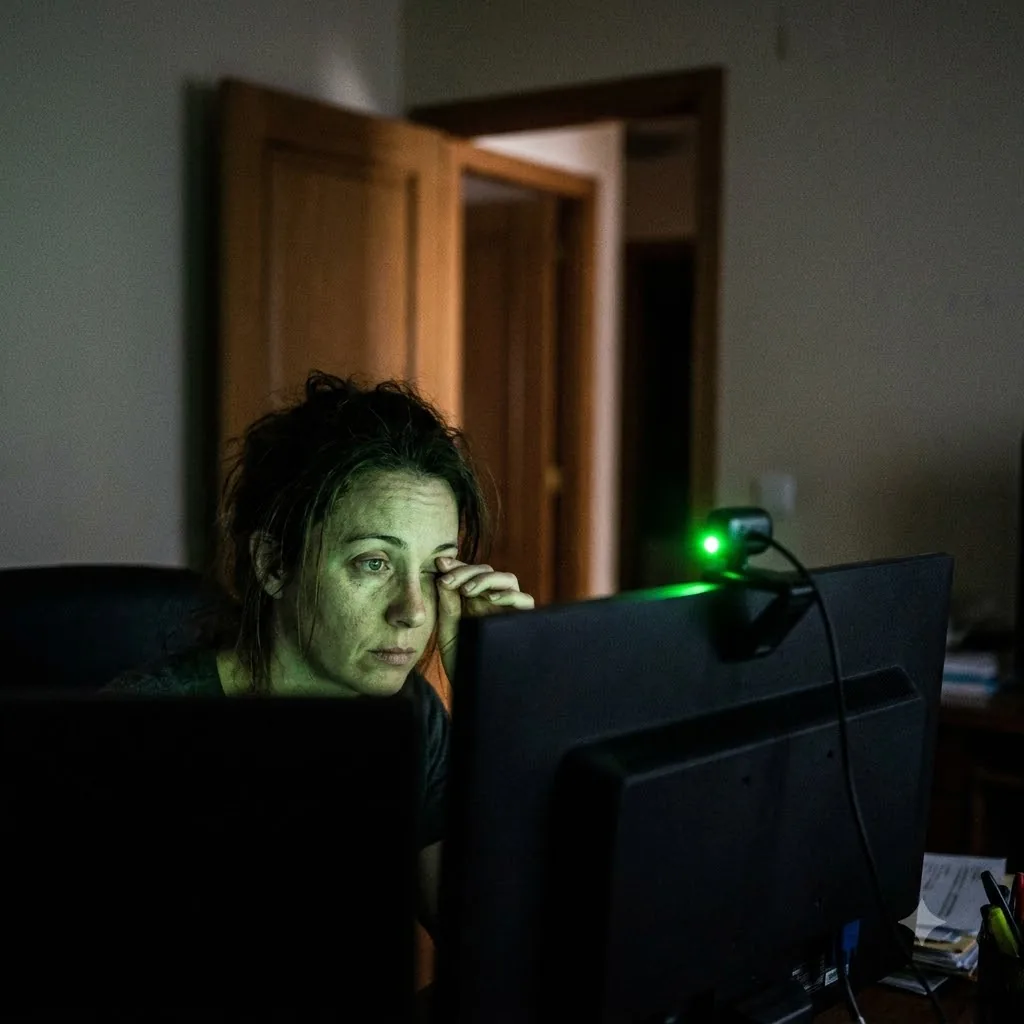
At the top of the monitor, the piercing green LED of the webcam finally blinked off.
The sudden absence of the light felt like a physical weight lifting from the room. The suffocating pressure that had drilled into Corinne’s skull for months evaporated. The only sound left in the dim office was the rhythmic, mindless whir of the mechanical mouse-jiggler spinning its plastic disc against nothing, and the wet, exhausted hiccups of her child.
Corinne slowly opened her eyes. The dark room was empty again. The audience was gone. The job was gone. The lock-out had finally happened, severing her connection to the company server, but as she looked at the dead black screen, she felt absolutely zero panic. The terror of eviction, the fear of starving-it all washed away, eclipsed entirely by the rhythmic rise and fall of her son’s small chest against hers.
She gently set the toddler down on the floorboards. Her legs trembled violently as she stood up, using the edge of the desk for support. She reached past the vibrating cell phone, past the useless mouse, and grabbed the webcam.
She didn’t hesitate. She squeezed the plastic casing and yanked it backward. The mounting clip snapped. The USB cable tore out of the back of the computer tower with a sharp crunch. Corinne stared at the dead lens for a single second, the cold digital eye that had dictated every waking moment of her grief-stricken life, and tossed it into the metal wastebasket beside the desk. It hit the bottom with a hollow, final clatter.
She reached down and pulled the plug on the mouse-jiggler. The mechanical whir died.
“Come here, baby,” she whispered, her voice thick and raw.
She scooped her son up into her arms and carried him out of the suffocating, stale air of the home office. She walked straight into the bathroom and flicked on the bright overhead lights. Setting him on the edge of the sink, she grabbed a washcloth, soaked it in warm water, and gently wiped the inside of his mouth. She scrubbed his tongue and his teeth until the last faint traces of pale blue chalk were gone. He whined, pushing her hand away, but his eyes were bright and focused. He was breathing fine. He was alive.
Corinne carried him into the living room. She walked over to the heavy blackout curtains she had kept drawn to appease the tracking algorithm and tore them open. Brilliant, blinding afternoon sunlight flooded into the house, warming the dust motes dancing in the air.
She sank into the center of the sofa, pulling his small, warm body onto her chest. He tucked his head under her chin, his thumb finding its way into his mouth as his exhaustion finally took over. As his breathing slowed into a steady, peaceful rhythm, Corinne closed her eyes. The dam broke. The tears she had rigorously suppressed for the camera, the grief over Mark’s empty side of the bed, the sheer exhaustion of her digital captivity-it all poured out in heavy, silent sobs. She had lost the paycheck, but as the sunlight warmed her face, she pulled her son tighter, finally free to mourn the husband she had lost, and to fiercely protect the child she had saved.