Story code: ST-000007
Part 2: The Harvest Audit
The dark figures moving out of the vans didn’t wear police uniforms or immigration badges. Mateo squinted through the settling dust, his pulse hammering a frantic, uneven rhythm against his collarbone. They wore charcoal-grey coveralls, the fabric stiff and unyielding, layered with heavy black utility vests. Their faces were entirely obscured by tinted, full-face respirators-the heavy-duty kind usually reserved for the high-yield pesticide sprayers-making them look less like men and more like mechanized drones. None of them carried visible firearms. Instead, each held a thick, yellow device that resembled an oversized, ruggedized barcode scanner, tethered to their vests by thick, coiled black cords.
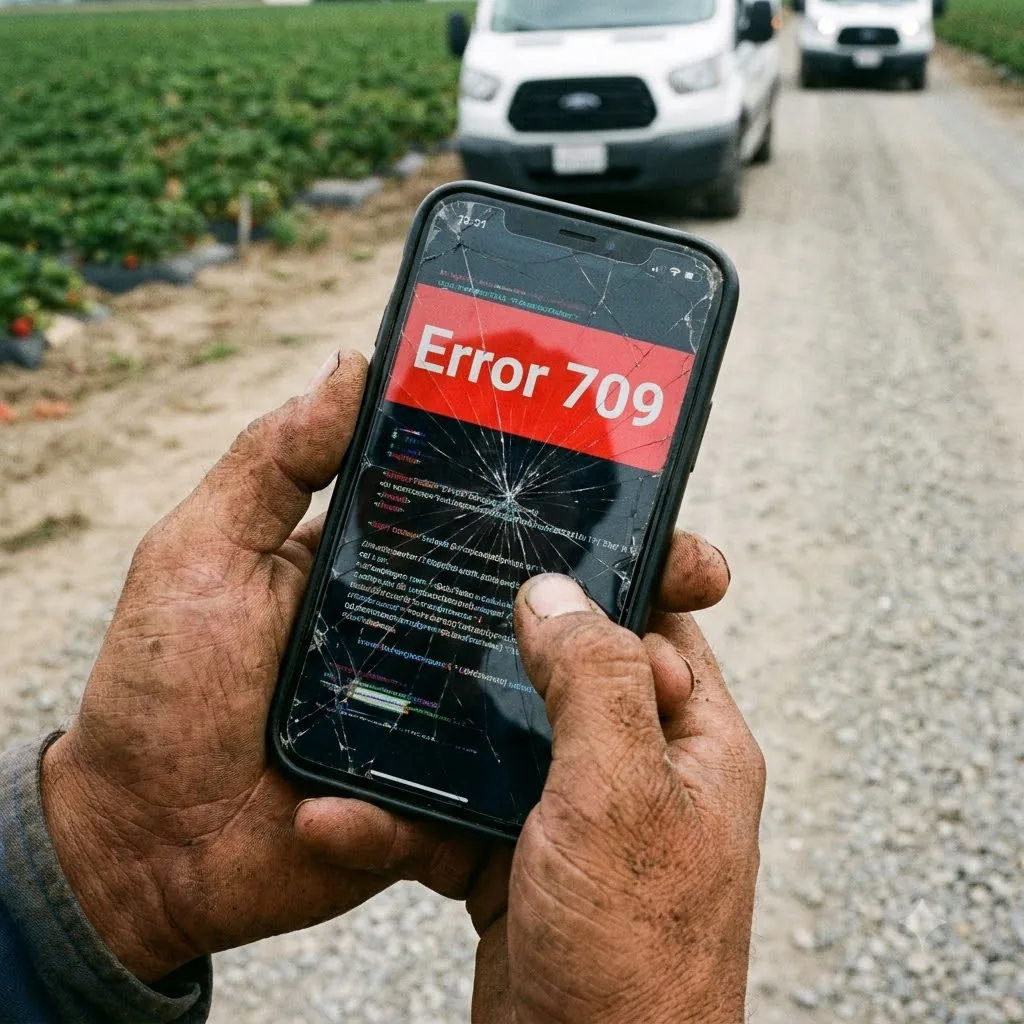
Mateo instinctively took a step back, his worn boots crunching loudly on the dry, hard-packed earth. His phone was still clutched in his trembling hand, its cracked screen glowing with that harsh, rhythmic crimson. *Error 709.*
“Attention. Drop your harvest bags and hold your registered devices in the air,” a synthesized, metallic voice blared.
It wasn’t coming from a megaphone mounted on the vans. The sound was emanating simultaneously from every single worker’s phone in the staging area. Mateo nearly dropped his device as the tiny speaker crackled against his palm, realizing the HarvestFlow app had bypassed his volume controls and hijacked the hardware completely.
“You are currently undergoing a mandatory corporate audit,” the voice continued, cold and pre-recorded, projecting from dozens of locked screens at once. “Error code 709 indicates a biometric mismatch, unauthorized crop-yield manipulation, or a pacing violation. As per Section 4 of your digital user agreement, all pending funds have been temporarily frozen pending a physical scan.”
Mateo stared down at his phone, the flashing red padlock icon mocking his exhaustion. *Biometric mismatch? Pacing violation?* He had done nothing but break his back for six solid weeks, pulling fruit off the vines until his fingernails were permanently stained purple. He hadn’t manipulated any yields. The app tracked their heart rates and picking speed through the mandatory smart-watches they all had to wear, punishing anyone who slowed down in the afternoon heat. Had he worked too fast? Too slow? The realization hit him like a physical blow to the sternum: the money wasn’t just delayed due to a server glitch. It was being actively targeted. The management company was using their proprietary app to manufacture contract violations, erasing their seasonal wages under the guise of an automated audit.
The grey-clad enforcers spread out in a disciplined, silent line, forming a solid barricade between the exhausted workers and the main exit to the county road. There were at least twenty of them, moving with synchronized efficiency through the fading light. One of the enforcers stepped toward the front of the crowd, reaching out and grabbing the arm of a young worker. Mateo recognized him instantly-Luis, a teenager who had just started his first season last week.
Luis yelped, trying to pull his arm away, but the enforcer’s grip was iron-tight. The man pressed the heavy yellow scanner directly against the screen of Luis’s phone. A sharp, ear-piercing *BEEP* echoed through the heavy twilight air. The scanner flashed a brilliant, blinding green, and a split second later, Luis’s phone screen snapped from the flashing red warning back to the sterile blue of the HarvestFlow dashboard.
“Scan complete. Zero balance verified. Penalty assessed and accepted. You are cleared to vacate,” the enforcer said, his real voice muffled and distorted behind the plastic respirator. He shoved Luis roughly toward the open gate. Luis stumbled over the gravel, looking frantically at his phone, his face draining of all color.
“Wait!” Luis cried out, his voice cracking with panic. “Where is my money? It says zero! I had eight hundred dollars in there!”
“Penalty assessed for Code 709 violation,” the enforcer repeated mechanically, not even looking at the boy as he moved past him to the next worker. “Vacate the premises or face trespassing charges.”
Mateo’s stomach plummeted into a cold abyss. That was the trap. If they scanned your phone, the system cleared the error code but permanently locked in the zero balance, legally stamping the stolen wages as a “penalty” that the worker supposedly accepted by being scanned. And if you didn’t get scanned? The imposing line of enforcers blocking the road made it entirely clear that leaving without a cleared device was not an option.
He looked desperately toward Hector, who was standing three rows away. The older man was clutching his phone tightly to his chest, shaking his head rapidly. Hector’s daughter was starting college in the fall; Mateo knew for a fact that Hector had been depending on his five thousand dollar payout to cover her initial tuition installment. They had talked about it every day during their brief lunch breaks.
“No,” Hector shouted, his voice trembling with a volatile mix of terror and rage as two enforcers approached his position. “No, you don’t touch my phone! I didn’t violate any pacing! I worked my rows! You owe me my pay!”
The enforcer didn’t argue. He simply lunged, grabbing Hector by the shoulder of his faded denim jacket. Hector shoved back, a desperate, clumsy push that barely moved the heavy man. It was enough of a reaction, though. A second enforcer flanked Hector, unhooking a short, solid black baton from his utility vest. He struck Hector sharply behind the knees. The older man cried out in pain, collapsing heavily onto the dusty gravel. The first enforcer pinned Hector’s arm to the ground with his knee, prying the flashing red phone from his calloused, dirt-stained fingers.
Mateo’s breath hitched in his throat, a surge of adrenaline washing away his exhaustion. He took another step backward, retreating quietly into the shadowy space between two towering stacks of wooden pallets used for loading the fruit. His heart slammed violently against his ribs. He couldn’t let them scan his phone. If they logged his device, his four thousand two hundred dollars was gone forever. His brother’s hospital debt would immediately go to aggressive collections, and Mateo would be stranded in the agricultural valley with absolutely nothing to show for his blood, sweat, and missing fingernails.
But the farm compound was heavily fenced in on three sides by ten-foot chain-link topped with rusted razor wire. The only way out was through the main gate, which was now completely cordoned off by the unmarked white vans and the ruthless grey-suited enforcers.
Mateo slipped further into the narrow, claustrophobic gap between the pallets, the rough, splintered wood scraping against his tired shoulder. He pressed his thumb as hard as he could over his phone’s speaker, desperately trying to muffle the relentless, electronic clicking of the red flashing banner. The crimson light bled through the gaps in his fingers, illuminating his terrified face in a rhythmic, inescapable pulse.
“Spread out,” one of the distorted voices barked, the sound echoing ominously across the quiet staging area. “Scan every flagged device. Detain anyone who refuses to authenticate the penalty.”
Heavy boots crunched on the loose gravel, the sound growing steadily louder as several enforcers moved toward the main packing shed and the pallet stacks. Mateo squeezed his eyes shut, trying to control his ragged, shallow breathing. The harsh, sweeping beam of a high-powered flashlight suddenly cut through the gathering darkness, raking across the wooden slats just inches from his face.
“Got a red flare reflecting behind stack four,” a muffled voice called out, the sound uncomfortably close. “Flushing him out.”