Story code: ST-000028
Part 2: The Silent Circle
Maya stared at the hollow, glowing faces of the bystanders, her stomach churning violently. The silence of this inner circle was a suffocating vacuum, completely detached from the chaotic roaring and shrieking of the fleeing crowd just yards away. She pushed herself up from the concrete, her scraped knees protesting with a sharp, fiery sting.
“Move!” Maya shoved a tall man wearing a pale blue polo shirt.
He didn’t blink. He merely stumbled a half-step backward, immediately correcting his posture and adjusting his grip on his smartphone to keep the bleeding boy perfectly centered in his frame. The woman next to him let out a soft, annoyed huff, leaning aggressively around Maya’s shoulder to maintain her unobstructed line of sight.
“What is wrong with you people?” Maya screamed, but her voice seemed to bounce off the invisible wall of their collective apathy.
She dropped to her knees on the sun-baked concrete beside the boy. Up close, the metallic stench of fresh blood was overpowering, thick and heavy in the humid summer air. The boy couldn’t have been older than twelve. His eyes were half-open, staring blankly up at the cloudless sky. A deep, ragged laceration tore through his upper thigh, right near the femoral artery. He hadn’t been shot. It looked as though a jagged piece of shrapnel or a shattered chunk of the stone fountain had impaled his leg during the initial deafening crack. The dark crimson blood wasn’t just pooling beneath him; it was pulsing outward in weak, rhythmic surges that matched his failing heartbeat.
Maya frantically tore into the sterile packaging of her rolled gauze with her teeth, spitting the plastic wrapper onto the pavement. She jammed the wadded material directly into the center of the laceration. The boy let out a wet, rattling gasp, his entire body convulsing weakly. His skin was rapidly draining of color, turning a dreadful, translucent shade of gray. The blood instantly soaked through the white gauze, bubbling up between Maya’s fingers and coating her hands in a thick, sticky warmth.
She locked her elbows and leaned her entire upper body weight over her palms, pressing down into the wound with everything she had. The heat radiating off the asphalt baked her legs, but a cold sweat drenched the back of her neck.
“Call 911!” she yelled, her voice scraping raw against her throat as it echoed off the brick restroom building. She glared up at the ring of unblinking camera lenses surrounding her. “Stop filming and call for help! Get an ambulance! He’s dying!”
Not a single person lowered their device. No one moved to dial. The tiny red recording lights on a dozen phones blinked back at her like a swarm of cold, mechanical eyes. A teenage girl in the front row took a slow half-step forward, sliding her thumb across her screen to zoom in on Maya’s blood-soaked hands pressing into the dying boy’s leg.
Maya’s forearms trembled under the immense physical strain. The blood was already seeping around the edges of her grip, flowing faster than she could contain it with just the gauze. She needed a tourniquet. She needed someone to relieve the pressure while she prepared one.
“Help me!” she shouted over her shoulder, twisting her neck to scan the chaotic plaza for the olive-drab tactical vests of the neighborhood watch. “Hey! Over here! I need a medic! Medic!”
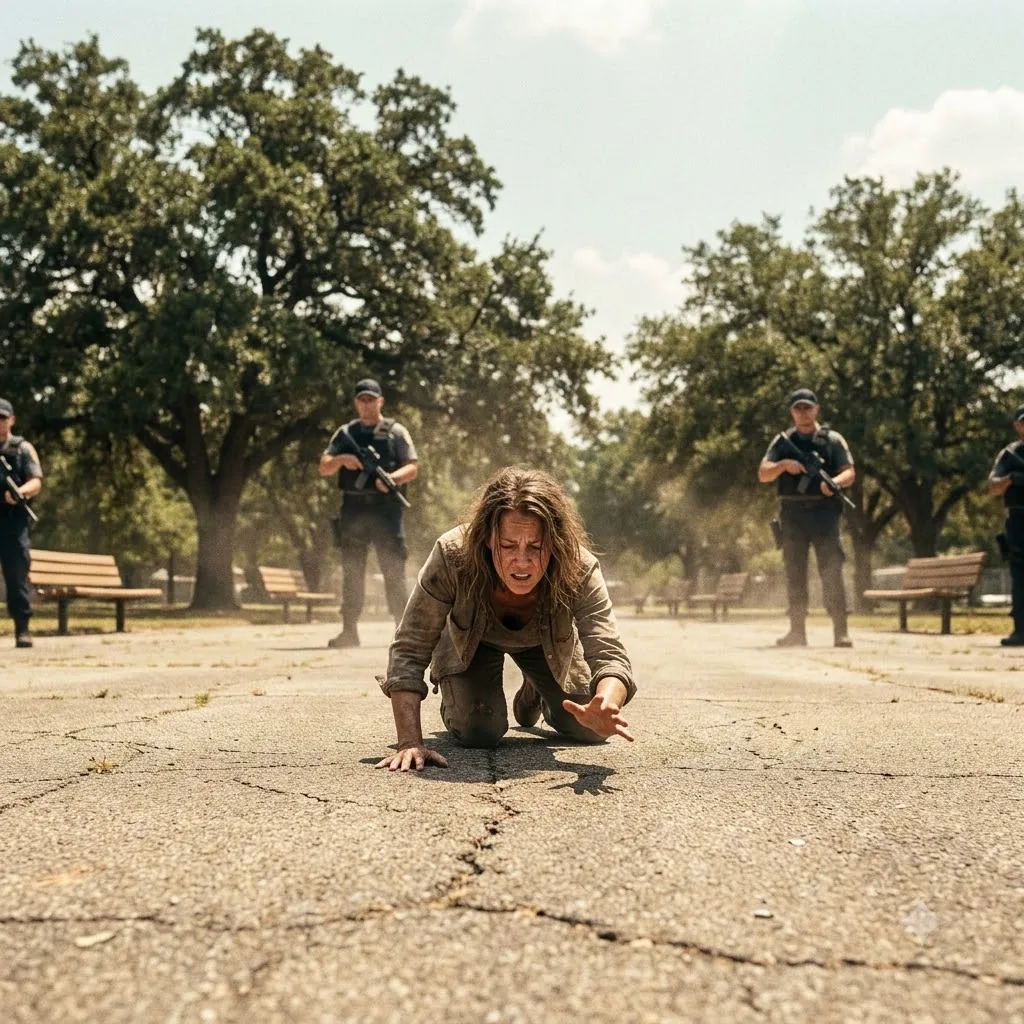
The heavy, synchronized thud of tactical boots suddenly pivoted in her direction. Through the narrow gaps in the wall of bystanders, Maya saw three of the armed patrolmen rushing toward the center of the plaza. Their rifle barrels swung in rapid, sweeping arcs, their eyes scanning the tree line and the rooftops. They were still hunting an invisible shooter, completely consumed by the adrenaline of a phantom firefight.
“Clear the line of sight! Clear!” the lead patrolman bellowed. His face was flushed dark red, rivers of sweat pouring from beneath the rim of his black tactical helmet.
The circle of bystanders finally shifted, taking a few synchronized steps backward to widen the ring, though they stubbornly kept their phones raised to eye level. The sudden movement exposed Maya and the critically wounded boy to the patrol’s direct view.
“I need a tourniquet!” Maya yelled, keeping her elbows locked and her weight pressed firmly onto the boy’s leg. “He’s bleeding out!”
But the patrolman wasn’t looking at the boy’s pale, lifeless face. His eyes locked onto Maya’s frantically moving, blood-covered hands, and the unidentifiable nylon pouch of her first-aid kit resting on the pavement beside her. The thick, suffocating paranoia radiating from the men hit Maya like a physical blow. They hadn’t found a shooter. They only had a panicked stampede, a deafening explosion, and now a chaotic scene at the epicenter with a woman covered in blood.
“Step away from the victim!” the lead patrolman ordered, his voice echoing with harsh, uncompromising authority. He raised his AR-15, the matte-black barrel snapping up to point directly at Maya’s chest.
Maya’s breath hitched, her heart slamming against her ribs. “What? No! I’m trying to stop the bleeding! He’s going to die!”
“I said step away! Now! Show me your hands!” A second patrolman flanked to the right, his heavy boots crunching on the gravel as he leveled his own weapon at her head. “Do it right now, lady! Hands where I can see them!”
Maya looked down at the boy. His chest was barely rising. The gauze beneath her palms was entirely saturated. She knew with absolute certainty that the moment she relieved the pressure, the pulsing arterial flow would resume, draining the last ounces of life from his small frame in a matter of seconds. She desperately needed to reach into her pocket for her own belt, or to tear the fabric of his shirt to twist a makeshift tourniquet.
“I can’t!” she cried out, tears of absolute frustration blurring her vision. “If I let go, he bleeds to death!”
“Last warning! Step away or we will engage!” The sharp, metallic click of a safety being flipped off snapped through the stifling air, a sound far more terrifying than the deafening crack that had started the panic.
The crowd of bystanders remained entirely mute, their camera lenses zooming in to capture the impending violence. They were perfectly content to let the tragedy play out, documenting the standoff in high definition.
Maya knelt paralyzed on the scorching concrete, the boy’s blood slicking her palms. The muzzles of the rifles did not waver. If she reached into her pocket to save the boy, the sudden movement would inevitably trigger the twitchy, adrenaline-blinded patrolmen. If she raised her hands and surrendered, the boy would bleed out into the fountain drain while the crowd silently live-streamed his final breath.