Story code: ST-000072
Part 2: The Demolition Directive
“DEMOLITION.” Wade whispered the word, his voice scraping against his dry throat and barely breaking the sterile hum of the air conditioner.
The heavy black letters seemed to warp and bleed into the thick paper. He dragged his eyes down to the subtext, his heart hammering violently against his ribs. It wasn’t a proposal. It was an active, finalized decree. The state wasn’t bringing factory jobs back to the decommissioned sectors; they had sold the entire regional grid to a private resource extraction firm. The document authorized the immediate leveling of his neighborhood, citing aggressive mandates for stripping the topsoil and sealing the underlying bedrock.
“Look at the effective date, Wade,” Elena instructed. Her voice had dropped its bureaucratic, customer-service tone, replaced by something much colder and far more authoritative.
He forced his eyes to scan the bottom of the page. The final authorization stamp was dated for tomorrow morning.
“No,” Wade said, his calloused hands trembling as he gripped the edges of the heavy cardstock. “The mayor stood on 4th Street just three weeks ago. He looked right into the news cameras. He promised-”
“He looked into the cameras and bought us the three weeks we needed to finalize the Texas logistics without a public uprising,” Elena interrupted seamlessly. “Now, look at the photographs.”
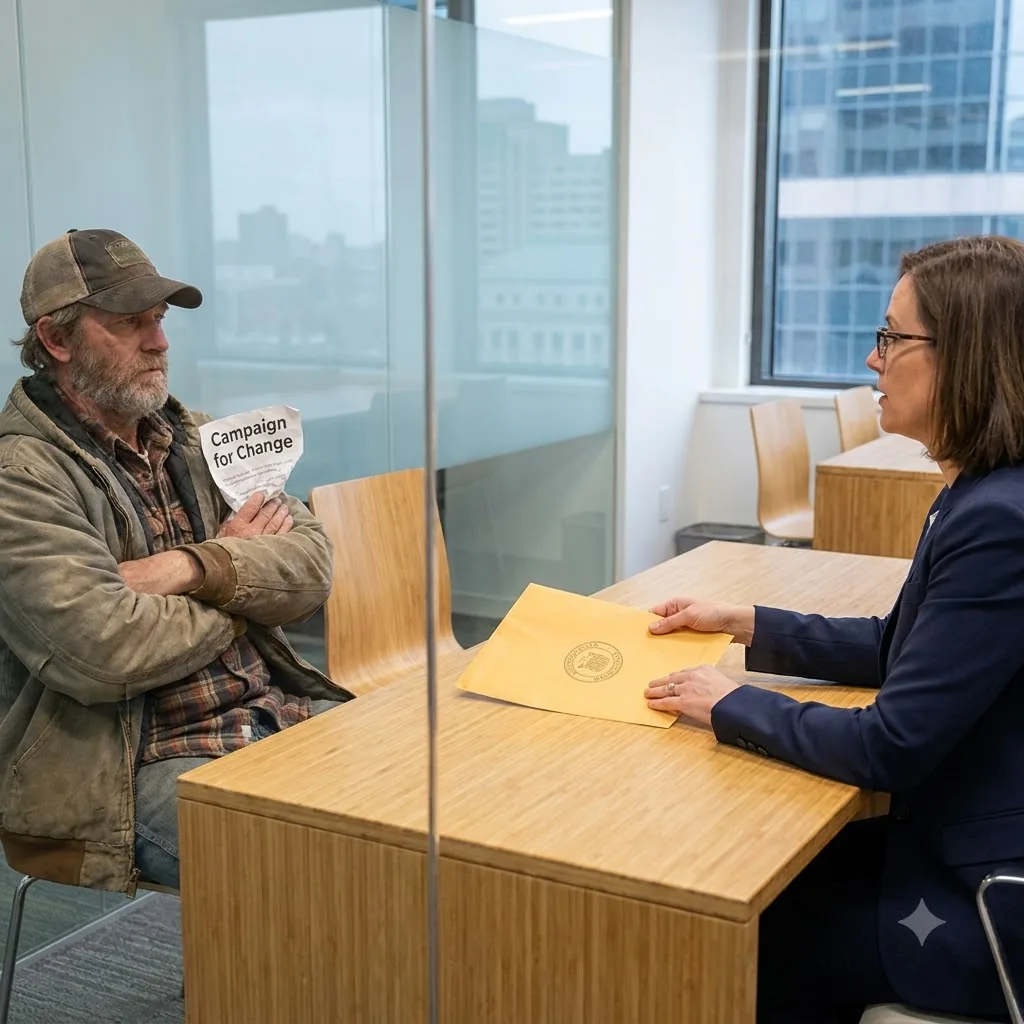
Wade swallowed hard, the harsh citrus antiseptic smell of the room suddenly making him deeply nauseous. He reached back into the open manila envelope and pulled out the stack of glossy, heavy-stock photographs. They slipped slightly in his sweaty grip.
He flipped the first one over, and his breath hitched. It was a high-resolution, aerial shot of his street. The familiar, cracked pavement and the concrete stoops where he had played as a child were completely cordoned off by massive, steel barricades. But what chilled him to the bone were the bright red digital gridlines overlaid on the image, marking every single home for structural collapse.
He shoved it aside and stared at the second photo. It was taken from the ground level. Massive, windowless excavators painted in flat, military-grade gray were already tearing into the brick side of the local elementary school. The dust cloud in the picture was thick, blocking out the morning sun. Wade checked his watch in a panic. The angle of the shadows in the photograph meant it had been taken only hours ago. While he had been sitting in the lobby of this very building, sipping bitter water from a paper cup and waiting for an unemployment extension, they were already tearing down his life.
But it was the third photograph that made the blood freeze in his veins.
It was a candid shot of the demolition staging area, taken from a slight distance. The mayor was in the center of the frame, wearing a pristine white hard hat and shaking hands with a woman in a dark tailored trench coat. Wade brought the photograph closer to his face, his eyes narrowing as he studied the woman. She was holding a thick binder bearing the same bold logo that was stamped across his Texas relocation contract. She was turning slightly toward the camera, her face caught in mid-conversation.
It was Elena.
Wade slowly lowered the photograph, his gaze locking onto the woman sitting across the frosted glass desk. She didn’t flinch. She didn’t look away. The perfectly pressed gray suit she wore today was nothing but a costume. She wasn’t a low-level state counselor processing unemployment extensions. She was the architect of his eviction.
“You,” Wade choked out, his knuckles turning white as he crumpled the edge of the photograph. “You’re not state labor. You’re with the Texas complex. You’ve been here this whole time, making sure we get starved out so we have to leave.”
“I am an acquisition director for the complex, yes,” Elena said, her tone utterly devoid of any guilt or hesitation. She folded her manicured hands neatly on top of her desk. “Your neighborhood was built on top of a highly profitable aquifer. The state government couldn’t afford to extract it, so my employer bought the land. The mayor’s speech was just a pacifier to keep the riots down while we mobilized the heavy equipment in the background.”
Wade stood up, his chair scraping violently against the pale laminate floor. The noise echoed loudly in the enclosed glass cubicle. “I’m going to the press. I’m going to the local news. You can’t just pave over thousands of people!”
Elena didn’t blink. She calmly reached under the lip of her desk. A heavy, electronic lock clicked inside the frame of the cubicle’s glass door. Wade shot a frantic glance over his shoulder. The small green light by the door handle had turned a solid, unforgiving red. He was locked in.
“The local news is owned by our parent company, Wade,” Elena said, her voice dropping to a near-whisper. “And there are no thousands of people left. Over the last three weeks, I have sat in this exact chair and convinced every single one of your neighbors, your former shift supervisors, and your local business owners to sign the relocation contracts. You are the very last holdout in Sector 4.”
Wade’s chest heaved. The profound isolation crashed down on him like a physical weight. He thought of his neighbor, Mrs. Gable, who had packed up a rented truck suddenly last Tuesday without saying goodbye. He thought of his cousin, Marcus, who had completely stopped answering his phone over the weekend. They hadn’t just given up and moved on. They had sat in this chair, across from this exact woman, and been fed the exact same terrifying ultimatum.
Elena slid the thick Texas relocation contract forward again, placing the heavy silver pen directly on top of the signature line. Then, she reached into the manila envelope one last time and pulled out a single sheet of bright yellow paper. She laid it carefully next to the contract.
Wade’s eyes darted to the yellow sheet. It was a local police detention log. At the very top, highlighted in stark black ink, was his younger brother’s name.
“Your brother tried to cross the concrete barricades an hour ago to get back to your house,” Elena stated, her eyes locking onto Wade’s with predatory stillness. “He is currently sitting in a private security transport vehicle. If you sign the Texas contract, he gets on the bus with you tonight, and you both get jobs, housing, and a future. If you refuse, I shred the contract, you remain utterly penniless, and he will be prosecuted for trespassing on a federal demolition site.”
Wade stared at his brother’s name on the yellow paper, the harsh, unnatural hum of the air conditioning suddenly roaring in his ears. The silver pen gleamed under the fluorescent lights, a heavy instrument of total defeat waiting for his trembling hand.