Story code: ST-000094
Part 3: The Burden of Proof
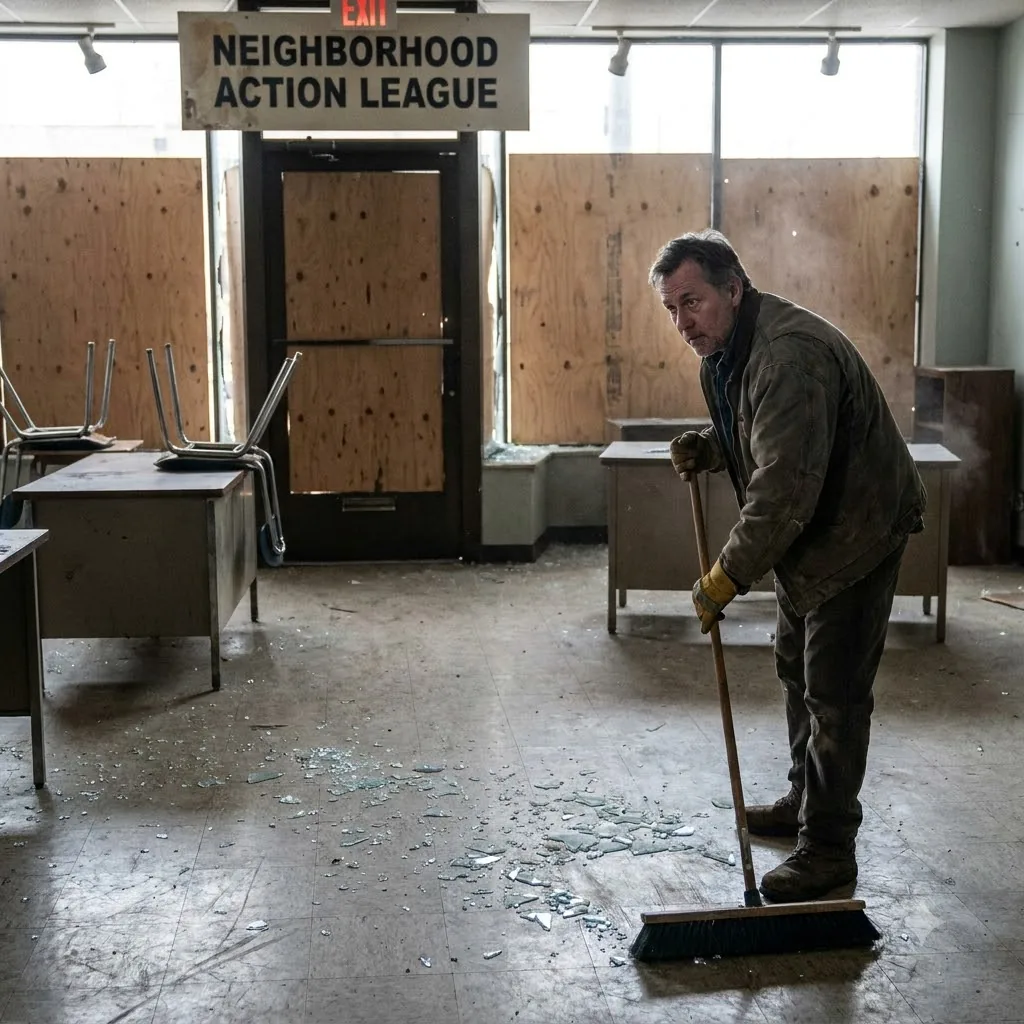
The stiff, starched collar of Marcus’s borrowed suit jacket dug fiercely into his neck, a suffocating reminder of how far he had stepped outside his element. For three grueling weeks, the civil trial against the City of Oakridge had dragged on inside the sterile, fluorescent-lit confines of Courtroom 4B. Marcus sat rigidly at the heavy mahogany plaintiff’s table, his heavily scarred hands folded neatly on top of his legal pad. He stared at the deep grooves in his knuckles, remembering the cold, heavy steel of the pistol he had pulled from his floorboards a year ago. He had gone to Task Force Director Croft’s suburban home that night, fully prepared to let the monster out of its cage. But he hadn’t pulled the trigger. Instead, the weapon had merely been the brutal leverage he needed to force Croft to open his personal safe, securing the encrypted hard drives that had ultimately brought them to this room. He had chosen the excruciatingly slow machinery of the law to permanently protect his neighborhood, keeping Darius and the Eastside boys at bay with desperate promises of justice.
On the elevated witness stand sat Captain Thomas Rayburn. Rayburn was the tactical muscle behind the city’s redevelopment task force, the commanding officer who had personally orchestrated the destruction of the community center. Dressed in his immaculate navy-blue dress uniform, the brass buttons polished to a blinding shine, Rayburn looked entirely unfazed by the proceedings. For the past two hours, he had confidently fielded questions, his voice projecting the calm, unshakeable authority of a man who believed the system belonged to him.
Elias Thorne, Marcus’s lead attorney, paced slowly in front of the jury box. Thorne adjusted his wire-rimmed glasses and looked up at the captain. “Let us review your testimony regarding the night of October 15th, Captain Rayburn. You maintain, under oath, that your tactical unit breached my client’s property under the strict belief that it was a front for organized crime?”
“That is correct,” Rayburn answered smoothly, resting his hands on the wooden railing of the witness box. “Based on the intelligence provided by the redevelopment task force, we had actionable reason to believe Mr. Vance was stockpiling gang-affiliated intelligence dossiers.”
“And you had absolutely no knowledge that the community center was functioning as a legitimate violence-interruption safe haven?” Thorne asked, his tone deceptively mild.
Rayburn shook his head, offering a condescending smile to the jury. “None whatsoever, counselor. As far as the Oakridge Police Department was concerned, Mr. Vance was using the guise of a community center to facilitate illicit communications between the Eastside boys and the Kings. We seized those files to prevent further criminal enterprise.”
Marcus clenched his jaw so hard his teeth ached. The lie was polished to a mirror shine. For weeks, the city’s defense team had painted Marcus as a master manipulator who was weaponizing his violent past, completely ignoring the fact that homicides had dropped to zero during his tenure.
Thorne stopped his pacing. He walked back to the plaintiff’s table, picked up a thick manila folder, and turned back to the judge. “Your Honor, at this time, I would like to submit Plaintiff’s Exhibit 414 into evidence. These are subpoenaed internal dispatch emails, retrieved directly from Captain Rayburn’s official encrypted municipal server.”
The city’s lead defense attorney immediately half-stood from his chair, a frown creasing his forehead, but before he could formulate an objection, the judge nodded. The bailiff carried a copy of the printed emails up to the witness stand and handed them to Rayburn.
Marcus watched closely as Rayburn looked down at the top sheet of paper. The captain’s condescending smile did not vanish immediately, but the muscles in his jaw suddenly tightened. The relaxed slope of his shoulders grew rigid beneath his decorated uniform.
“Captain Rayburn,” Thorne said, his voice echoing loudly in the silent courtroom. “Please direct your attention to the email dated October 12th-exactly three days before you ordered the raid on my client’s center. Could you please read the recipient’s name and title for the court?”
Rayburn swallowed. His eyes darted toward the defense table for a fraction of a second. “The recipient is… Martin Hess. Chief of Staff to the Mayor.”
“And the subject line?” Thorne pressed, stepping closer to the stand.
“Subject line is… ‘Q4 Tactical Quotas,'” Rayburn read, his voice losing a fraction of its commanding boom.
Thorne tapped a button on his podium, and the email flared to life on the large digital projectors mounted on the courtroom walls. Marcus looked up at the glowing black text. The brutal truth of the raid was suddenly ten feet tall for the entire jury to see.
“Allow me to read your own words, Captain,” Thorne said, his voice ringing with absolute clarity. “‘Martin, I have reviewed the latest crime metrics for the South Ward. Vance’s operation is unfortunately legitimate. The center is a verified safe haven, and the ceasefire he has brokered between the local networks is holding firm. Violent crime has plummeted.'”
A low, collective murmur rippled through the jury box. Marcus leaned forward, his heart hammering against his ribs. The heavy burden of the last year-the agonizing struggle to convince the neighborhood that the peace was worth saving-suddenly felt validated by the very man who had tried to destroy it.
Thorne did not stop. He raised his voice over the murmurs. “‘However, this unprecedented drop in violence is gutting our department’s gang-arrest metrics just weeks ahead of the mayor’s reelection campaign. We are drastically behind on the projected numbers.'”
Rayburn shifted his weight, the leather of his chair squeaking loudly in the tense air. He opened his mouth to speak, but Thorne sharply raised a hand.
“You continued, Captain, by outlining your exact strategy,” Thorne said, reading the final paragraph on the screen. “‘I am authorizing a full tactical sweep of the center specifically to seize their mediation files. Without those documents, the gangs will suspect betrayal and fracture the ceasefire. Once the retaliatory violence reignites, we will have the necessary pretext to flood the zone, sweep the corners, and manufacture the gang-arrest quotas the mayor requires to secure his tough-on-crime platform.'”
The courtroom erupted into a chaotic symphony of gasps and furious whispers. The city’s defense attorney was frantically flipping through his own files, his face completely drained of color.
Thorne stepped directly in front of the witness stand, locking eyes with the captain. “You didn’t raid the center to stop organized crime, did you, Captain? You knew exactly what my client was doing. You deliberately destroyed a legitimate sanctuary and tried to spark a deadly gang war just to manufacture arrest quotas for your mayoral ally.”
Rayburn stared down at the subpoenaed emails trembling slightly in his hands. He looked up at Thorne, then over at the horrified jury, his mouth opening and closing as the suffocating silence swallowed his shattered defense.