Story code: ST-000146
Part 2: The Six A.M. Deadline
Mateo’s pulse hammered against his ribs, a frantic, bird-like rhythm completely out of sync with the dead, manicured silence of the suburban cul-de-sac. The white-hot glare of the motion-sensor lights burned his retinas, casting sharp, elongated shadows across the pristine concrete of the driveway. He didn’t dare blink. Vance stopped just three feet away. The heavy tactical gear on his chest seemed to swallow the harsh light, projecting an aura of absolute, indisputable authority.
“Late night, neighbor?” Vance’s voice was smooth and practiced. It was pitched at a conversational volume, yet it somehow carried the crushing weight of a judge’s gavel.
Mateo forced his dry throat to open, tasting the bitter almond dust that coated his tongue. “I just got back from the orchards. The harvest…”
“The harvest,” Vance interrupted softly. His eyes drifted downward, taking in the powdery dirt caked onto Mateo’s work boots, the frayed hems of his jeans, and the worn fabric of his jacket. “Right. The Central Valley agricultural boom. Lots of hard work out there in the heat. Lots of… temporary hands required.”
Vance let the word *temporary* hang in the cool night air, cold and deliberate.
Mateo kept his hands visible, palms slightly open, resting carefully at his sides. He had learned long ago, through bitter experience, how to stand around men in uniforms. No sudden movements. No clenched fists. Eyes lowered just enough to show deference without looking suspiciously evasive. “I’m sorry about the truck,” Mateo said, his voice barely above a whisper so as not to wake the surrounding houses. “I didn’t know about the new HOA rule. I can move it. I’ll park it on the main street outside the subdivision.”
“Move it where?” Vance asked, tilting his head slightly. He gestured casually toward the locked, single-car garage door. “You and I both know the property owner uses that space for his personal storage. That’s a violation of section four, paragraph two of our community bylaws, by the way. But we’re focusing on the commercial equipment tonight. The truck is an eyesore, Mateo. It brings down property values.”
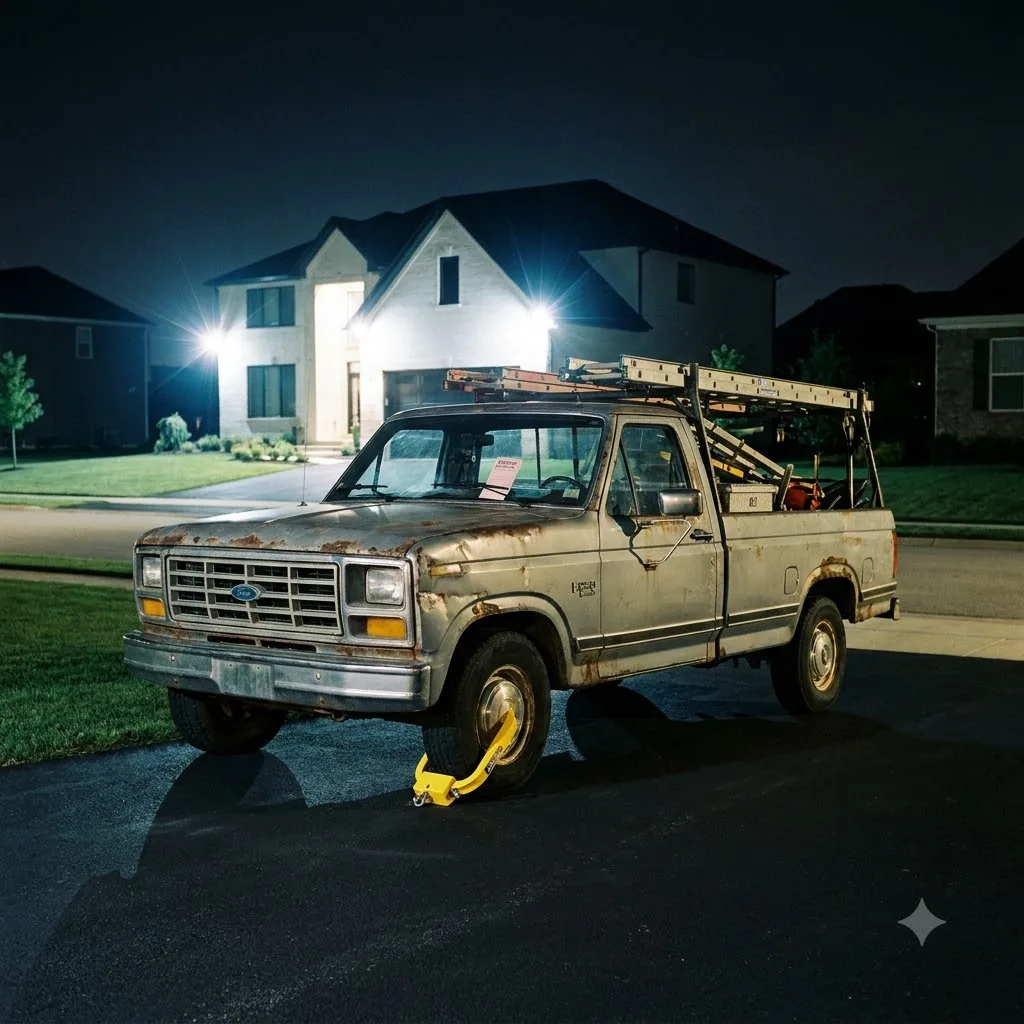
Vance stepped closer and tapped the reinforced toe of his combat boot against the heavy yellow metal clamped to Mateo’s front tire. The hollow, metallic clang echoed violently off the stucco walls of the identical houses.
“This parking boot is a courtesy, Mateo,” Vance continued, his tone dripping with false neighborly concern. “To prevent the unsightly equipment from leaving the premises until the citation is cleared. The new board is trying to clean up the neighborhood. We want to ensure that everyone living here actually belongs here.”
Mateo swallowed hard. The five-hundred-dollar fine was already a death sentence for his fragile finances, but the man wearing the federal immigration insignia was a literal eraser to his existence. The math was impossible. “I don’t have five hundred dollars to give you tonight,” Mateo pleaded softly. “If I can’t drive to work tomorrow morning, I lose my job. If I lose my job, I can’t pay the rent for this house.”
“That sounds like a personal logistical issue,” Vance said, his tight smile vanishing completely. He unclipped a small, high-powered flashlight from his tactical vest and shined the blinding beam directly onto the truck’s rusted, mud-splattered license plate, holding it there for a long moment before clicking it off. “The HOA board is strictly enforcing penalties now. Fines must be paid in full to release the immobilizer. Furthermore, as the new president, I have taken it upon myself to update our resident registry. We need to verify that everyone in the subdivision is properly documented.”
Vance reached into a secure pouch on his heavy duty belt and pulled out a small, thick black digital device. It looked like a mobile fingerprint scanner, or perhaps a direct wireless terminal to a federal database. Mateo’s blood ran ice cold. The citation in his pocket felt heavy as lead.
“Since you’re awake and outside,” Vance said, his tone shifting from neighborhood busybody into an authoritative, institutional clip, “I’ll need to see your government-issued identification. Driver’s license, passport, or resident alien card will suffice. We need to scan it for the HOA files, of course.”
Mateo’s hands began to tremble despite his intense effort to keep them still. The envelope of cash hidden in his kitchen cabinet wouldn’t save him from this. He didn’t possess a California driver’s license. The passport hidden under his mattress was expired and issued by a country he had fled a decade ago. If Vance ran his name-if Vance pressed his thumb onto that glowing green scanner right now-Mateo wouldn’t just be evicted from the subdivision. He would be sitting in a federal detention processing center by sunrise.
“My… my ID is inside the house,” Mateo lied, his voice tight and breathless. “In my other pants. I just got off a fourteen-hour shift in the dirt. I’m covered in grease and dust. I wouldn’t want to dirty your equipment.”
Vance stared at him. The silence stretched out, agonizing and suffocating. Above them, the motion lights flickered slightly, emitting a low, electric buzz that sounded like angry hornets. Vance slowly lowered the digital device, though he notably did not put it back into its pouch.
“I appreciate your respect for federal property,” Vance said, his eyes locking onto Mateo’s with predatory stillness. “But the community rules are the rules. The fine is five hundred dollars. Plus a fifty-dollar daily impound fee for the boot. If the balance isn’t settled by six o’clock tomorrow morning, I have authorization from the board to tow the vehicle. And once it goes to the impound lot, recovering it requires a valid, state-issued identification. Which you will show me. Tomorrow morning.”
Mateo looked down at the heavy yellow steel clamped mercilessly to his wheel. He checked his watch. It was just past one in the morning. He had less than five hours until six o’clock. Less than five hours before his truck was taken, his livelihood destroyed, and his lack of legal status exposed to a man whose day job was hunting people just like him.
“Six a.m. sharp,” Vance repeated. He took a deliberate step backward, retreating toward the shadows at the edge of the driveway. “I’ll be knocking on your front door, Mateo. Have the money. And have your legal documents ready. We wouldn’t want any unfortunate misunderstandings regarding your residency status.”
Vance didn’t wait for a reply. He turned on his heel and walked down the dark sidewalk, the heavy, rhythmic crunch of his boots echoing into the quiet night.
A moment later, the motion-sensor lights clicked off, plunging Mateo back into the suffocating darkness of the driveway. He stood completely alone, his whole body shaking, the bitter scent of almond dust thick in his lungs. The yellow boot locked onto his tire weighed fifty pounds and was forged from industrial, hardened steel. He had no key. He couldn’t pay the ransom, and he couldn’t survive the ID check. If the truck was still here at dawn, his life in America was over.
Mateo dropped to his knees on the concrete, running his calloused hands blindly over the cold, unyielding metal jaws in the pitch black. He had to break it off. Tonight.