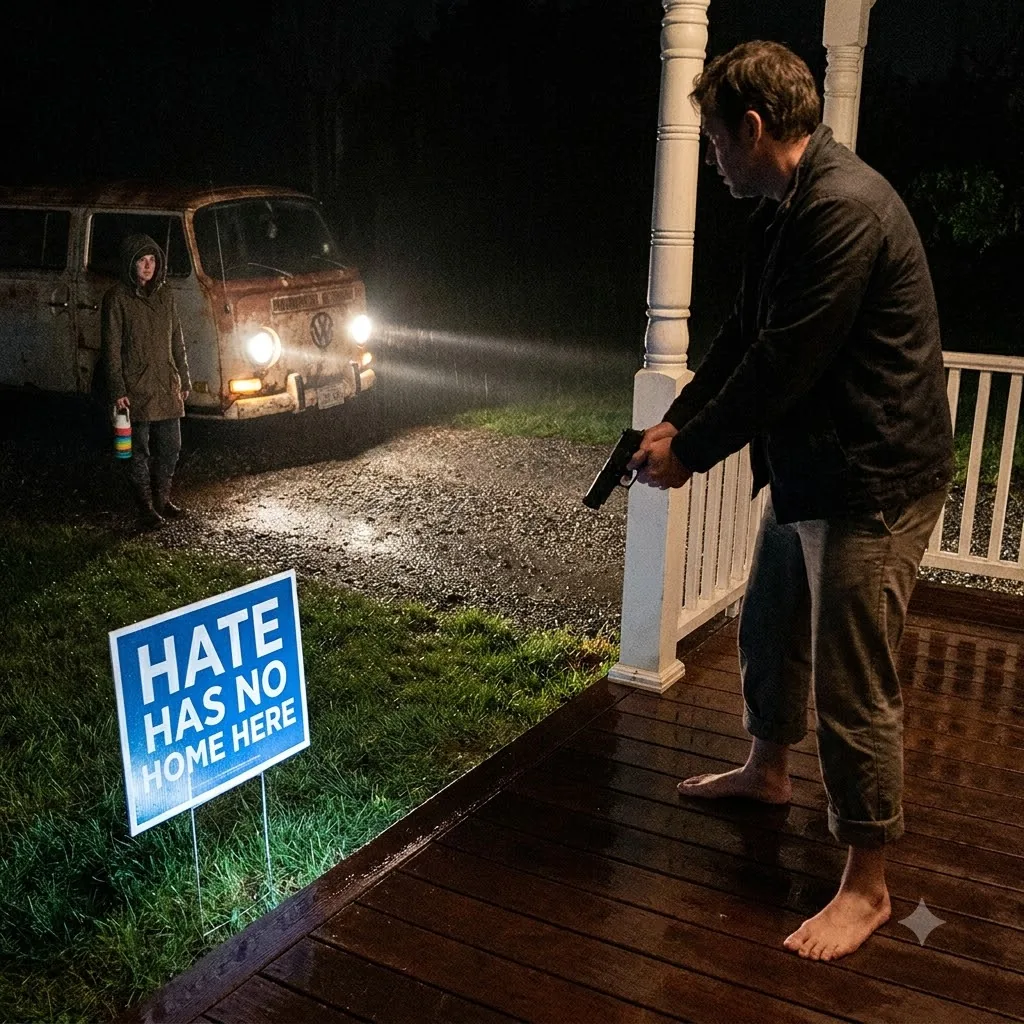
Story code: ST-000113
Part 2: The Eyes of the Cul-de-Sac
“Stop right there!” Silas finally found his voice. It tore from his throat, a jagged, unfamiliar sound that lacked the booming, authoritative pitch he had envisioned.
She didn’t stop. Three more agonizingly deliberate paces brought her to the very base of the mahogany porch stairs. She was close enough now that Silas could smell the stale, acrid odor of cigarette smoke clinging to her faded parka, mingling heavily with the sharp, metallic tang of the motor oil bleeding from her dying minivan.
“I said stop!” he shrieked. His index finger trembled violently against the trigger guard. He took a hasty step backward, his leather slipper catching the thick weave of the welcome mat. For a sickening fraction of a second, he flailed, the heavy 9mm bobbing erratically in the night air before he slammed his back against the oak front door to steady himself.
The woman halted. She stood squarely beside the glowing “All Are Welcome” yard sign, its small solar-powered LED casting an ironic, warm halo over her scuffed, salt-stained boots. Up close, the deep purple bags sagging under her eyes looked like fresh bruises.
“Are you going to shoot me?” she asked. Her voice was flat, raspy, and entirely stripped of the panic he expected. It wasn’t a plea for mercy. It sounded like a genuine, exhausted inquiry from someone who had simply run out of patience for the world.
Silas swallowed hard, his throat feeling as though it were lined with crushed glass. “You’re trespassing,” he managed to say, rigidly reciting the legal defense he had rehearsed in his head the day he brought the firearm home. “You need to step back and leave my property immediately.”
She didn’t glance at the trembling gun. Instead, she looked down at the progressive slogan planted next to her leg, then back up at Silas, her eyes lingering on the luxurious, pristine cashmere enveloping his shivering frame. Slowly, she extended her left arm, offering the bright pink plastic thermos toward him.
“I need hot water,” she said. “Tap water is fine. But it has to be hot.”
Silas stared at the cartoon unicorn plastered across the cheap plastic cylinder. The sheer absurdity of the demand completely short-circuited his racing mind. “What?”
“Hot water,” she repeated, her tone hardening into a demand. “For the formula. It’s powdered. It doesn’t dissolve right in the cold.”
The word *formula* hung in the freezing air, heavy and loaded. Silas’s widened eyes darted past her shoulder to the rusted Honda Odyssey. The engine was still choking, a rhythmic, mechanical death rattle that seemed to vibrate through the soles of his feet. The heavily tinted rear windows were opaque, impenetrable blocks of black.
“I-I don’t know who else is in that van,” Silas stammered, gripping the pistol tighter with both hands, trying to steady the iron sights on the center of her chest. “I’m calling the police. They can bring you water. They can help you.”
“If you call the cops, they’ll tow the van. We’ll be out on the street.” She took another step, placing her foot firmly on the bottom stair. The imported mahogany gave a soft, tortured creak under her weight.
“Don’t come up here!”
“I just need water!” she snapped, a sudden flash of teeth breaking her terrifying stoic facade. “Look at your damn sign! Read it!”
Before Silas could shout another warning, a sharp, mechanical click echoed through the silent cul-de-sac.
Silas flinched, his head whipping to the left. Two houses down, the massive array of motion-sensor floodlights on the Abernathy estate blazed to blinding life. The sudden, intense illumination spilled across the dormant, manicured lawns, erasing the shadows hiding Silas’s porch. A distinct silhouette appeared behind the sheer curtains of the Abernathy’s front bay window-a neighbor, undoubtedly drawn out of bed by Silas’s frantic yelling.
Panic, icy and razor-sharp, flooded Silas’s veins, entirely eclipsing the immediate physical fear of the woman. *They can see me.*
He was Silas Vance. He was the co-chair of the neighborhood diversity committee. He had successfully lobbied the rigid Homeowners Association to allow those exact yard signs to be displayed. He was the man who hosted charity galas and quoted civil rights leaders at upscale dinner parties. If Arthur Abernathy, a retired corporate litigator with a notorious penchant for neighborhood gossip, saw him leveling a loaded handgun at an impoverished woman holding a child’s thermos… his life as he knew it would be over. The social crucifixion would be absolute. The ring-camera footage would be on the community Facebook page by morning. He would be ruined, ousted, and disgraced.
Instinctively, Silas lowered the gun. He didn’t re-engage the safety, but he dropped his arms, pressing the black metal weapon against the dark fabric of his trousers, desperately trying to shield it from the street’s view behind the thick, decorative cedar post of his porch.
The woman noticed the sudden shift immediately. She tracked his panicked, wide-eyed glance toward the Abernathy house, then looked down at the hidden gun. A bitter, knowing smirk crept across her cracked lips. She instantly understood the immense social leverage she had just been handed.
“Fill the thermos,” she said, her voice dropping to a harsh, commanding whisper. She climbed to the second step. The protective gap between them was rapidly shrinking.
Silas pressed his back harder against his front door, trapped between the sanctuary of his home and the nightmare unfolding on his steps. “Back away,” he pleaded, his voice suddenly stripped of all lethal threat, reduced to a pathetic, desperate hiss. “Please. Just take your van and go. I’ll give you money.”
“The transmission is dead. And my baby is freezing.” She took the third step.
A sudden, screeching grind of metal tore Silas’s attention back to the illuminated driveway. The Honda’s passenger-side sliding door, which he had assumed was locked tight, violently shuddered. Slowly, agonizingly, it scraped open along its rusted track, shrieking like a wounded animal against the frozen metal frame.
Silas’s breath caught in his throat. He strained to peer past the woman, staring into the pitch-black void of the minivan’s interior. He braced himself, expecting to hear the desperate, high-pitched wail of an infant.
Instead, a heavy, steel-toed work boot dropped out of the darkness, slamming heavily onto the icy concrete.