Story code: ST-000157
Part 3: The Loophole
The darkness in the server room pressed in, thick and suffocating. Without the massive industrial fans, the ambient temperature began rising almost immediately, the heat radiating off the towering black racks of equipment. Chloe’s breath hitched in her throat. She yanked her encrypted flash drive from the dead terminal and shoved it deep into her blazer pocket. She had no way of knowing if the transfer had hit one hundred percent before the system died. Panic spiked, hot and sharp behind her ribs, but she forced it down. She didn’t need the digital contract anymore. The sheer hostility of the lockdown proved her point.
By commercial fire code, the server room maglocks could not engage from the inside without a manual override. She dragged her hands along the cold, rough cinderblock wall, shuffling blindly past the blinking green LEDs of the dormant servers. Her fingers finally brushed a hard plastic casing near the door frame. She slammed her palm against the glow-in-the-dark emergency exit button. The heavy magnetic lock disengaged with a loud, metallic clunk. She shoved the steel door open and stumbled out into the dim sub-basement hallway.
The power outage seemed strictly isolated to the server block. The overhead fluorescent lights in the corridor hummed steadily. Chloe pulled her phone from her pocket. There was no cell signal down here, but she didn’t need one. She had taken screenshots of the federal Department of Labor codes at two in the morning, her insomnia fueled by the initial theft of her Slack channels. She stared at the highlighted text on her screen, her jaw set. Marcus was banking on her being too scared, too pregnant, or too overwhelmed to fight back. He was banking on the saccharine “wellness” angle to legally shield the company from a standard grievance.
But Richard’s panicked flight from the executive suite and the shredded Q3 financials piled in Marcus’s trash can painted a violently different picture. They weren’t protecting her. They were trying to silence her before the ship went under.
Chloe took the stairs two at a time, her calves burning with the exertion. She bypassed the empty reception area and marched straight into the third-floor HR suite.
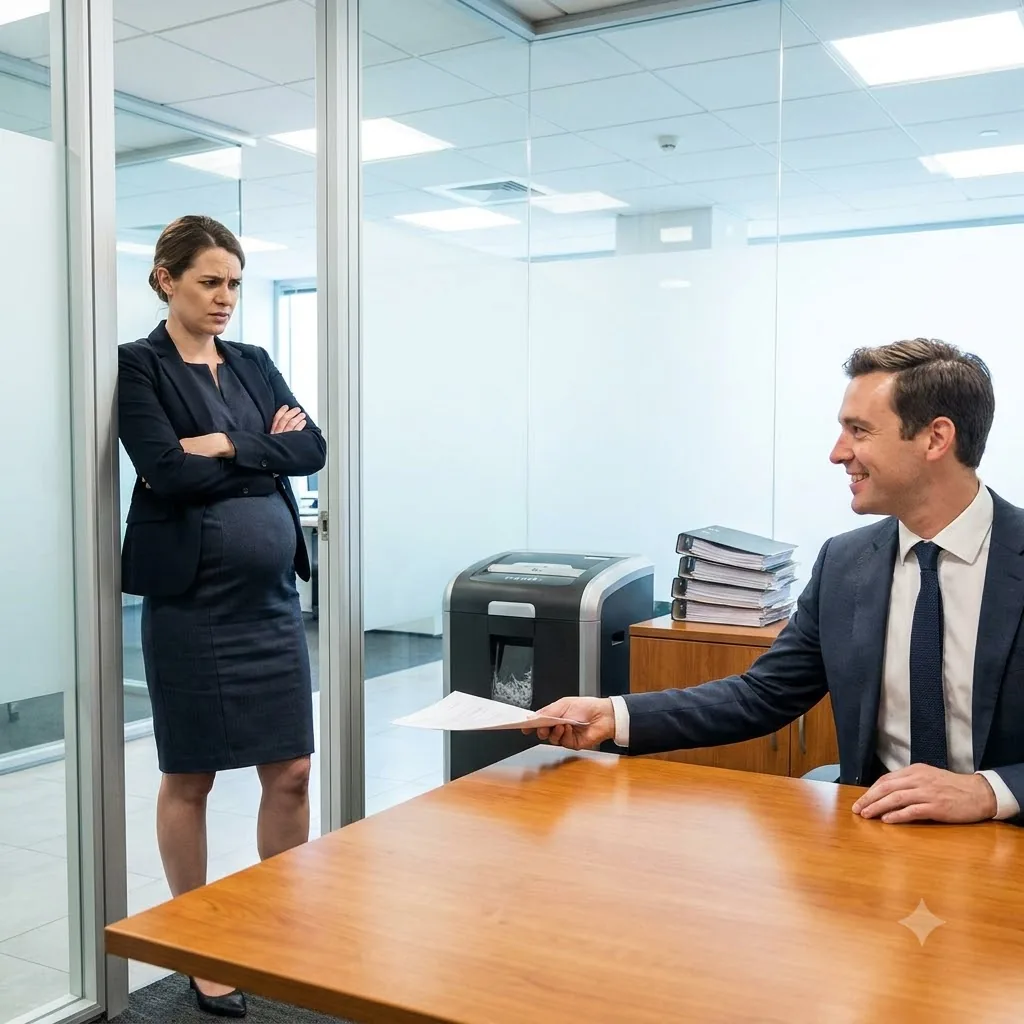
Marcus was standing by his assistant’s desk, quietly directing a junior associate to load a stack of external hard drives into a cardboard box.
“Marcus,” Chloe said, her voice ringing out, sharp and authoritative across the silent lobby.
He stiffened. The junior associate froze, a silver hard drive hovering in the air.
“Chloe, your access has been temporarily suspended,” Marcus said, keeping his back to her for a second before turning slowly. “I thought I made it clear that you need to go home and review the accommodation paperwork.”
“Title VII of the Civil Rights Act,” she interrupted, closing the distance between them until she was standing inches from his desk. She held her phone up, the screen glowing directly in his line of sight. “Specifically, the Pregnancy Discrimination Act of 1978. It is a federal offense to alter a compensation structure, reassign established accounts, or force reduced-pay leave based on a medical disclosure.”
Marcus let out a long, patronizing sigh. He lowered his voice to a harsh, placating hiss. “Keep your voice down. We are offering you a generous accommodation to protect your health.”
“You are offering a demotion disguised as an accommodation,” she shot back, refusing to lower her volume by a single decibel. “And I am refusing it. Which means if you do not reinstate my commission dashboard and confirm my sixty-thousand-dollar bonus in the next five minutes, I am calling the Equal Employment Opportunity Commission. I am filing a formal complaint for retaliatory discrimination.”
Marcus’s jaw tightened. A muscle feathered in his cheek. “You don’t want to do that, Chloe. It’s a massive, drawn-out legal process. It will be incredibly stressful for the baby.”
“Don’t you ever weaponize my child against me again,” she snapped, her eyes blazing. “Do you know what an EEOC complaint triggers, Marcus? An immediate federal injunction. They will mandate a third-party investigation. They will subpoena the server logs. They will subpoena the Q3 audits I literally just watched you shred. They will freeze every single executive operating account while they investigate the exact timeline of my medical disclosure versus my lockout.”
All the manufactured corporate calm drained from Marcus’s face. The mention of frozen accounts and subpoenaed server logs hit him like a physical blow. He stared at her, his composure violently fracturing. His eyes darted to the junior associate, who was watching them with wide, terrified eyes, then back to Chloe.
“No,” Marcus breathed, his voice suddenly stripped of all its polished HR cadence. “No, you can’t bring federal regulators in here. Not right now.”
“Watch me,” she said, her thumb hovering aggressively over her phone’s dial pad.
“Stop!” Marcus dropped his hands to his sides. The mask completely dissolved, leaving behind a frantic, desperate man. He grabbed her by the elbow-a sharp, entirely unprofessional grip-and dragged her away from the assistant’s desk, pulling her toward the secure executive conference room.
“Let go of me,” she demanded, wrenching her arm out of his grasp as he shoved the heavy glass door open.
“Get inside,” he pleaded, his voice cracking with genuine panic. “Please, Chloe. Just look.”
She stepped cautiously into the room, keeping her back to the door. Marcus slammed it shut and immediately engaged the privacy blinds, plunging the room into shadow. He hurried to the head of the long mahogany table, flipped open his laptop, and aggressively typed in his master administrative password. He spun the screen around to face her.
It was a master payroll and revenue ledger, completely raw and heavily detailed, entirely different from the sanitized charts she usually saw on her sales dashboard.
“Look at column F,” Marcus said, his hands physically shaking as he pointed at the screen. “Look at the year-to-date operating cash flow.”
Chloe leaned in. The numbers cascading down the column were entirely bracketed in red. The deficit at the bottom was staggering.
“We are negative four point two million dollars,” Marcus whispered, the words tumbling out in a jagged rush. “Meridian was supposed to save us in Q3, but the profit margins were completely eaten by overseas supply chain failures. The company is functionally insolvent. We are going to miss payroll next Friday.”
Chloe stared at the bleeding spreadsheet, her mind struggling to process the sheer scale of the collapse. “But my commission… I closed the deal. The funds were escrowed.”
“We don’t have it!” Marcus slammed his hand flat onto the table, the smack echoing loudly in the enclosed space. “We don’t have your sixty thousand dollars, Chloe! We don’t have Richard’s end-of-year bonus, which is why he’s currently running for the parking garage. We don’t even have the money to keep the lights on in the IT sector, which is why we’re selectively rolling blackouts to the non-essential grids down there!”
She looked up from the glowing screen, staring at his sweaty, panicked face. The pieces slammed together in her head. “Then why single me out? If the company is dying, why not just lay people off? Why use my medical disclosure?”
Marcus swallowed hard, his eyes dropping to the mahogany table. “Because a mass layoff triggers a WARN Act notice. It legally signals to our creditors that we’re defaulting, and they will call in our massive outstanding loans immediately. We needed to cut exactly sixty thousand dollars off the books this morning just to make the Friday payroll run.”
He looked back up at her, his expression a twisted, ugly mix of guilt and sheer, survivalist desperation.
“Your disclosure yesterday gave me an out,” he confessed, his voice dropping to a hollow, broken rasp. “I didn’t reassign your account to protect you. I used your pregnancy as a legal loophole to classify the massive pay cut as a ‘wellness accommodation.’ If I didn’t steal your commission today, I had to fire five junior developers by noon. You were the only way to balance the ledger without triggering a corporate panic.”