Story code: ST-000231
Part 4: Zero Yield
The heavy steel stockroom door slowly swung inward on pneumatic hinges. A rush of cold, sterile air washed over the warm scent of stale espresso. From the darkness of the back room, a machine rolled forward on silent, omnidirectional treads. It was a sleek, matte-black cylinder roughly the size of a commercial trash can, equipped with a cluster of unblinking camera lenses and two articulated, metallic arms. A glowing screen mounted on its reinforced chassis read in stark amber lettering: *COLLECTIONS PROTOCOL.*
Arthur backed away, his wingtips slipping awkwardly on the scattered cash. The machine ignored the four hundred dollars entirely. It rolled directly over a crisp hundred-dollar bill, leaving a dusty, perfectly geometric tread mark across Benjamin Franklin’s face.
The Collector stopped precisely two feet from Arthur. One of its metallic limbs extended, presenting a standardized, tap-to-pay card terminal.
Arthur’s chest heaved. The sheer, immovable logic of the machine broke something fundamental inside him. He spun toward the granite counter, his hands clamping around the white plastic swivel stand of the iPad. He pulled upward with all his strength, desperate to rip the device from its mount, to sever the connection, to find some physical power cord he could tear out to stop the nightmare.
He violently shook the stand. The heavy base groaned against its reinforced bolts, but the metal held fast. He yanked it back and forth in a blind, helpless rage, knocking over a pristine display of wooden stirrers and sugar packets.
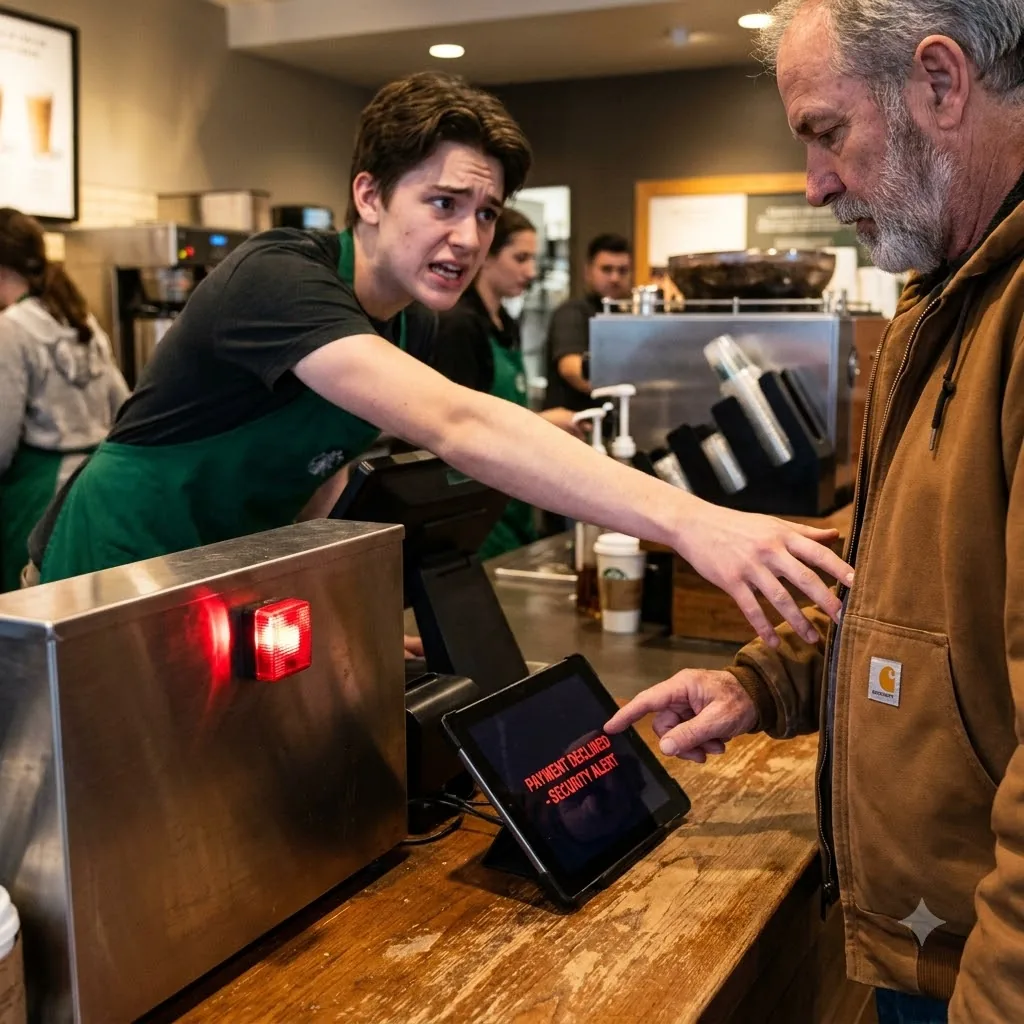
A sharp, synthesized siren erupted from the iPad’s speakers. The screen shifted from stark white to a blinding, flashing crimson.
*WARNING: VANDALISM OF COMPANY PROPERTY DETECTED. ADDITIONAL FINES ACCRUING.*
The Collector drone emitted a low, menacing electrical hum. The tip of its second arm extended, revealing two conductive prongs that crackled with a vivid, snapping arc of blue voltage.
Arthur threw his hands up, stumbling backward into a small cafe table. “Fine!” he shouted, his voice cracking, entirely stripped of its previous authority. “Fine! I’ll pay it!”
With trembling, clumsy fingers, Arthur reached into his tailored coat, pulled out his leather wallet, and extracted his heavy metal corporate card. He extended his arm, terrified the machine might jolt him, and pressed the card against the drone’s digital reader.
A cheerful, bright chime echoed through the cafe. The menacing blue electricity vanished. The Collector lowered its arms and smoothly reversed its treads, retreating back into the shadows of the stockroom. The heavy steel door pulled shut behind it with a final, definitive click.
Instantly, the grinding wail of the corrugated steel shutters returned. The metal coils rolled upward, letting the pale morning sunlight spill back across the shattered ceramic plates and crushed scones. The front door’s deadbolt retracted with a heavy thud. The red emergency lights flicked off, replaced once again by the warm, inviting glow of the overhead Edison bulbs.
Arthur stood in the center of the cafe, panting, his heart slamming against his ribs. He looked down at his shaking hand, still holding the corporate card that had just authorized a two-thousand-five-hundred-dollar ransom.
He turned his attention to the narrow aisle behind the counter. Mateo was still sitting amidst the ruins of the pastry case, his knees pulled tightly to his chest.
“It’s over,” Arthur said, his voice a raspy whisper. He stepped closer to the counter, desperate to inject some semblance of normalcy back into the room. “I paid the override. The system is reset. You’re fine.”
Mateo didn’t look up. The boy reached into the deep pocket of his green apron and pulled out his personal smartphone. The screen was already illuminated with an incoming notification.
A small, thermal receipt printer next to the espresso machine suddenly whirred to life. It did not print a standard customer transaction log. Instead, a long, thick ribbon of glossy paper snaked out, dropping over the edge of the granite counter and fluttering down to land squarely on Mateo’s lap.
Arthur leaned over the counter, his eyes straining to read the bold, black text printed at the top of the slip.
*NOTICE OF LEASE TERMINATION. 14-DAY EVICTION MANDATE.*
“They don’t care about the override fee,” Mateo whispered, his voice completely hollowed out, devoid of even tears now. He stared at the glowing screen of his phone, tracing a spiderweb crack in the glass with his thumb. “The override was for your infraction. My ShiftScore is still locked in. The algorithm already submitted the zero-percent yield to the housing authority.”
Arthur froze. He looked back at the four hundred dollars in untraceable cash still scattered across the floor tiles, utterly invisible to the digital eye above them.
“Call human resources,” Arthur urged, leaning over the counter, though the suggestion sounded laughably pathetic even as it left his mouth. “Show them the camera footage. I’ll testify for you. I’ll tell them it was my fault.”
Mateo finally looked up at Arthur. There was no anger left in the boy’s pale face. Just the devastating, absolute certainty of a system that could not be reasoned with. “There is no human resources,” Mateo said softly. “There’s just the algorithm. And the algorithm doesn’t take testimony.”
Arthur stood motionless in the quiet cafe. The faint, everyday sounds of morning city traffic drifted through the newly unsealed windows, completely oblivious to the destruction inside. Arthur slipped his metal card back into his wallet. He had walked in determined to make a principled stand against corporate greed, fiercely protecting his right not to subsidize wages. Instead, he had handed the corporation thousands of dollars in panic, while his rigid morality had only managed to crush the one person in the room with absolutely no power to fight back.