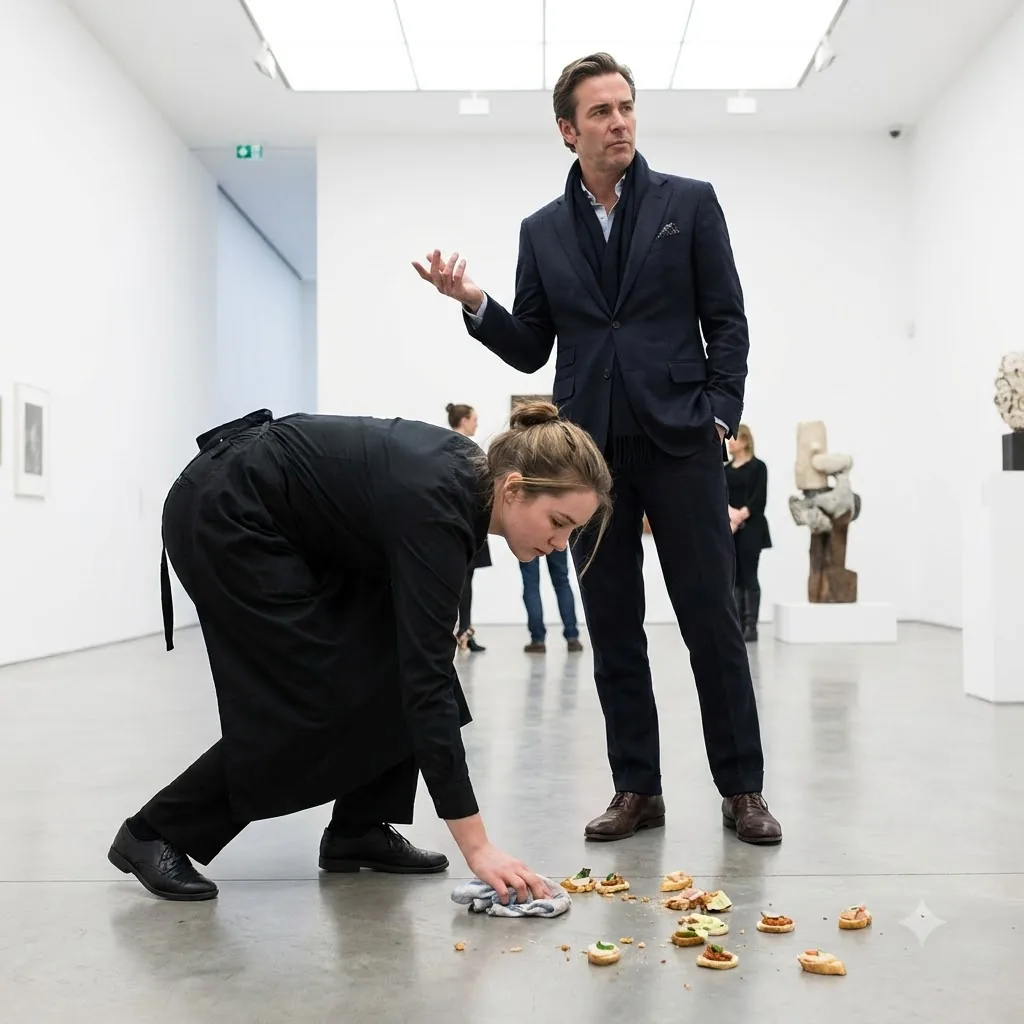
Story code: ST-000265
Part 3: The Breakdown
Maya watched a second drop of condensation gather on the lip of the massive silver ice bucket. It swelled ominously, catching the harsh glare of the overhead gallery track lighting, before tracing a slow, deliberate path down the slick metal. It was heading straight for her canvas.
In her hands, the heavy silver platter of filled champagne flutes dug sharply into her bruised, sore palms. The muscles in her forearms burned from the awkward angle. Beside her, Brenda hissed under her breath, gesturing frantically toward the front of the room. The cavernous gallery was rapidly filling with the muted, expensive hum of raw silk coats, imported leather boots, and soft, networking murmurs.
Julian Vance was in his element, holding court near the main entrance. He performed a meticulously rehearsed, breathless laugh for Eleanor Vance, the influential junior curator Maya had desperately wanted to meet. Julian swept his arm expansively toward a massive, sterile sculpture, no doubt complaining about the grueling emotional toll of selecting it.
The second drop of icy water hit the stainless-steel prep table. It splattered violently against the unsealed, raw cotton edge of Maya’s painting. The thick impasto oils in the center were dry, but the raw canvas border would warp instantly, distorting the tension and ruining three relentless months of agonizing labor.
“Move out there, Maya,” Brenda whispered, her voice tight with panic as she shoved a thick cocktail napkin under a precarious glass on Maya’s tray. “They need drinks in their hands right now.”
Maya did not step toward the wealthy crowd. She looked at the tray, then at the spreading puddle of water on the table.
She turned around.
Maya walked the three short steps back to the prep station and set the heavy tray down. She didn’t lower it gently. The crystal flutes clattered violently against the silver metal, a sharp, dissonant ringing that briefly pierced the low, sophisticated murmur of the gallery. Brenda gasped, lunging forward to stabilize the tipping glasses, her face draining of color.
Maya ignored her. She reached past the ice bucket and grabbed her canvas, dragging it out of the pooling water. Her paint-stained fingers brushed over the heavy layers of cadmium red as she carefully, methodically rolled the fabric back into a tight cylinder.
“What do you think you are doing?”
Julian’s voice was a low, venomous hiss. He had abandoned Eleanor at the sound of the clashing crystal and crossed the concrete floor with terrifying speed. His jaw was locked tight, a visible vein pulsing frantically beneath his perfectly styled hairline. “I gave you a direct order. Pick up that tray.”
Maya finished rolling the canvas. She did not reach for her protective drafting tube. Instead, she tucked the rolled painting securely under her arm, pressing the dry side against her ribcage. She stood up straight, stopping her work entirely, allowing her aching spine to align as she finally looked Julian directly in his eyes.
“No,” Maya said.
Julian blinked. The sheer, unprecedented audacity of the refusal seemed to momentarily short-circuit his brain. “Excuse me?”
“I am stopping right now,” Maya said. Her voice was steady, unnervingly calm. The frantic, suffocating fear of a disconnected electricity meter that had kept her scrubbing the floor just twenty minutes ago evaporated entirely, replaced by a cold, sharp clarity.
Julian stepped into her personal space, his expensive bergamot cologne clashing horribly with the smell of spilled champagne. “You are done in this city. Do you hear me? I am under a colossal amount of curatorial stress today. I am carrying the emotional weight of this entire exhibition on my shoulders, and you are actively sabotaging my artistic vision. You have absolutely no idea what it takes to survive in the real art world.”
Maya stood her ground. “I know exactly what it takes to survive.”
“You are a cater-waiter!” Julian spat. His voice rose a fraction too high, drawing a curious glance from a nearby pair of investors. He quickly lowered his volume, but his eyes burned with manic intensity. “You are a nobody with an acrylic hobby.”
“I work an exactly eighty-hour week,” Maya said. She didn’t shout. She delivered the numbers with absolute, mechanical precision, forcing the reality of her life into his pristine space. “Forty hours carrying trays, scrubbing concrete, and wiping up dropped food for agencies that steal my overtime. Twenty hours working overnight, breaking down cardboard boxes at a wholesale grocer in Queens.”
“I do not care about your pathetic, working-class-”
“Twenty hours painting,” Maya continued, cutting cleanly over him, her voice ringing with unshakeable authority. “From midnight until four in the morning, standing in an apartment kitchen that drops to forty degrees because the utility company shut off my heat. I skip meals so I can afford linseed oil and gesso. I work until my hands bleed and my knees give out, and then I tape my fingers up and do it all over again.”
Julian’s face flushed a deep, mottled crimson. He opened his mouth to interrupt, but Maya took a firm step forward, forcing him to take an awkward half-step back.
“You do not have curatorial stress, Julian,” Maya said, her eyes locked onto his, systematically stripping away the entire foundation of his public persona. “You have a tax-sheltered inherited burden. This gallery is an LLC funded by your father’s commercial real estate firm so you can play tastemaker without ever actually risking a thing. You buy your way into the room, you misidentify oil as acrylic because you don’t even know the fundamental basics of the medium, and you call your immense, unearned privilege a burden.”
“Shut up,” Julian hissed. His hands trembled violently at his sides. The urbane, sophisticated gallery director was rapidly vanishing, replaced by a cornered, panicked fraud.
“My art is my literal survival,” Maya said, tapping the edge of the rolled canvas against her chest. “Your art is a portfolio diversification strategy. You have no concept of what dedication is. You just know what it costs.”
“I said shut up!” Julian roared.
The raw, furious shout echoed off the high, track-lit ceilings, freezing every single conversation in the room. Fifty wealthy collectors, including Eleanor Vance, turned in unison to stare at the catering station in dead silence.
Julian’s breathing was ragged, his chest heaving under his tailored jacket. The deep red flush had consumed his neck and face. His eyes darted wildly toward the silent, staring crowd. The stark, naked panic on his face made it obvious he knew his mask had just slipped off in front of the most important people in Chelsea.
Instead of retreating to compose himself, the sudden, public humiliation ignited something feral and utterly unbroken inside him.
With a guttural, wordless scream, Julian grabbed the edge of the stainless-steel prep table. He heaved it upward with every ounce of his strength.
The massive silver champagne bucket launched into the air. Gallons of melting ice water, shattered crystal flutes, and heavy, unopened bottles of vintage champagne crashed down onto the pristine concrete floor. A thick green bottle shattered violently against the pristine white gallery wall, spraying a massive arc of foaming liquid and jagged glass shards across the polished leather loafers of his top investors.
Julian stood frozen amid the dripping wreckage of his own curated ambiance, his chest heaving violently, his expensive suit entirely soaked in freezing water, staring wildly at Maya as the entire gallery watched his catastrophic collapse.