Story code: ST-000304
Part 4: The Weight of the Law
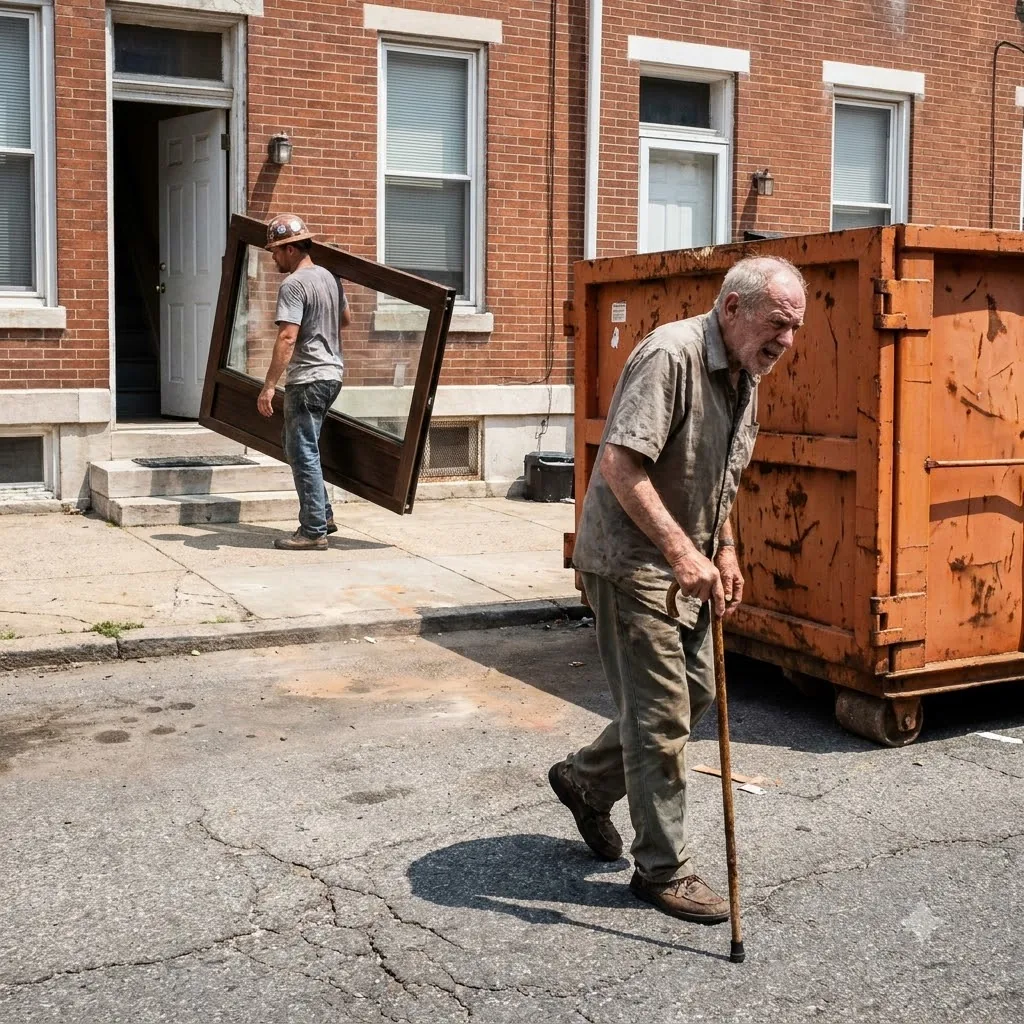
The suffocating silence that followed Sarah Vance’s outburst was violently broken by the rising wail of an approaching siren. Gary, the foreman, must not have cancelled his call to dispatch in time. A white-and-blue police cruiser turned sharply onto the narrow street, its heavy tires crunching over the scattered gravel and pulverized drywall. The vehicle rolled to a stop just behind Vance’s luxury SUV, its red and blue lightbar flashing harsh, rhythmic reflections against the gutted brick facades and the rusted metal of the roll-off dumpster.
Two uniformed officers stepped out into the sweltering morning heat. Marcus recognized the driver immediately. It was Officer Hayes. For the past six years, Hayes was the patrolman assigned to block off the main intersection for the neighborhood’s annual Memorial Day parade. He was the officer who always made a point to walk over to Marcus’s porch, offer a firm handshake, and deliver a crisp, deeply respectful salute as the local color guard marched past.
“What seems to be the problem here?” Hayes asked, resting a hand casually on his utility belt as he approached the standoff.
Vance instantly pivoted, smoothing her blazer and snapping her polished corporate mask back into place. She stepped right up to the officer, completely ignoring the mail carrier who had finally lowered his recording phone and hurried away. “Officer, thank goodness. I am the project manager for Apex Development. We hold the deed to this property, and this man is trespassing on an active, hazardous worksite. He is harassing my crew, blocking our demolition path, and attempting to steal materials from our debris bin.”
Hayes looked past Vance’s shoulder, his expression dropping into one of heavy, uncomfortable recognition. “Marcus? What are you doing out in the street?”
Marcus leaned his weight heavily onto his cane, his right knee radiating a blinding, continuous fire. He clutched the heavy mahogany shadowbox to his chest, the thick glass slick against his sweat-soaked shirt. “They are throwing away Arthur’s life, Hayes. You knew Arthur. You ate hot dogs at his block parties. They’re tossing his military records and family albums into a dumpster.”
Hayes visibly hesitated, his eyes darting to the towering metal bin and the shattered wood strewn across the asphalt. He looked back at Marcus, his jaw tightening. “Marcus, I know it’s hard. I’m sorry about Arthur. But if this company bought the property, those items belong to them. They have the legal right to dispose of whatever was left behind.”
“It’s his legacy!” Marcus pleaded, his voice cracking, the abrasive plaster dust tearing at his throat. He pointed a trembling finger at Vance. “She waited until he was on a ventilator to buy the tax lien out from under his daughter! It’s theft!”
“It is a fully legal municipal transfer,” Vance interrupted sharply, holding up her smartphone to display a digital copy of the deed. “And I want him removed from my site. Now.”
Hayes sighed, a heavy, defeated sound that carried over the idling diesel engines. He stepped forward, his posture shifting from a friendly neighborhood patrolman to an agent of the state. The warmth completely vanished from his eyes, replaced by a cold, procedural detachment. “Marcus. Sir. I need you to step back across the street. You are interfering with lawful commerce, and you are trespassing on private property.”
“No,” Marcus said, planting his cane firmly onto the scorching blacktop. “I am not letting them destroy the rest of his records.”
“Don’t make me do this, Marcus,” Hayes warned, his voice dropping into a stern, authoritative command. He nodded to his partner, who flanked Marcus on the left. “Sir, this is a lawful order. Move, or we will have to move you.”
Marcus didn’t budge. He tightened his grip on the shadowbox, bracing himself.
Hayes and his partner closed the distance in two quick strides. They grabbed Marcus by the upper arms, their grips tight and unyielding. The sudden, forceful tug completely threw off Marcus’s fragile center of gravity. As they pulled him backward away from the dumpster, Marcus’s bad knee buckled entirely. He gasped in agony as his weight dropped, his fingers slipping on the sweaty, polished wood of the frame.
He couldn’t hold both the cane and the heavy frame while being manhandled. The shadowbox tumbled from his grasp.
It hit the edge of the concrete curb with a sickening crack. The thick, protective pane of glass shattered instantly, fracturing into a chaotic spiderweb of jagged lines directly over Arthur’s Silver Star and the smiling black-and-white photograph.
“Alright, easy, easy,” Hayes muttered, practically dragging Marcus the remaining few feet to the sidewalk across the street. The officers deposited him roughly onto the concrete curb. Hayes took a step back, pointing a stern finger at him. “You stay right there, sir. Do not cross this street again.”
Marcus sat in the hot dust, his chest heaving, his knee screaming in white-hot agony. He didn’t look at Hayes. He looked across the asphalt at the broken shadowbox resting in the gutter.
Behind it, Vance gave a curt, satisfied nod to her foreman. The heavy machinery roared back to life. The rhythmic, bone-jarring thud of the sledgehammers resumed. Marcus watched, entirely powerless, as the two workers scooped up the heavy, leather-bound journals and the loose family photo albums from the porch, heaving them carelessly over the rusted lip of the metal dumpster.
Officer Hayes stood in the center of the street, his thumbs hooked into his utility belt, standing shoulder-to-shoulder with Sarah Vance. He watched the crew destroy Arthur’s history, standing guard to ensure the developer’s property rights were perfectly protected.
Marcus reached out with a trembling hand, tracing his fingers over the jagged, splintered glass obscuring Arthur’s medal. The bitter, suffocating reality settled heavily into his chest. The Fourth of July parades, the crisp salutes, the speeches, and the endless handshakes-it was all just theater. It was a hollow, conditional patriotism that existed only until a veteran’s legacy occupied a piece of real estate someone else wanted to sell.