Story code: ST-000330
Part 3: The Survivor and the Stream
The sharp, metallic click of the holster’s snap cut through the ambient hum of the cafe like a physical blade. To Leo, the sound didn’t belong in a brightly lit coffee shop. It belonged to the darkest, most barricaded corner of his mind. The noise resonated deep in his chest, vibrating against his ribs and unlocking the suffocating memory he had been violently fighting back since the man first walked through the door.
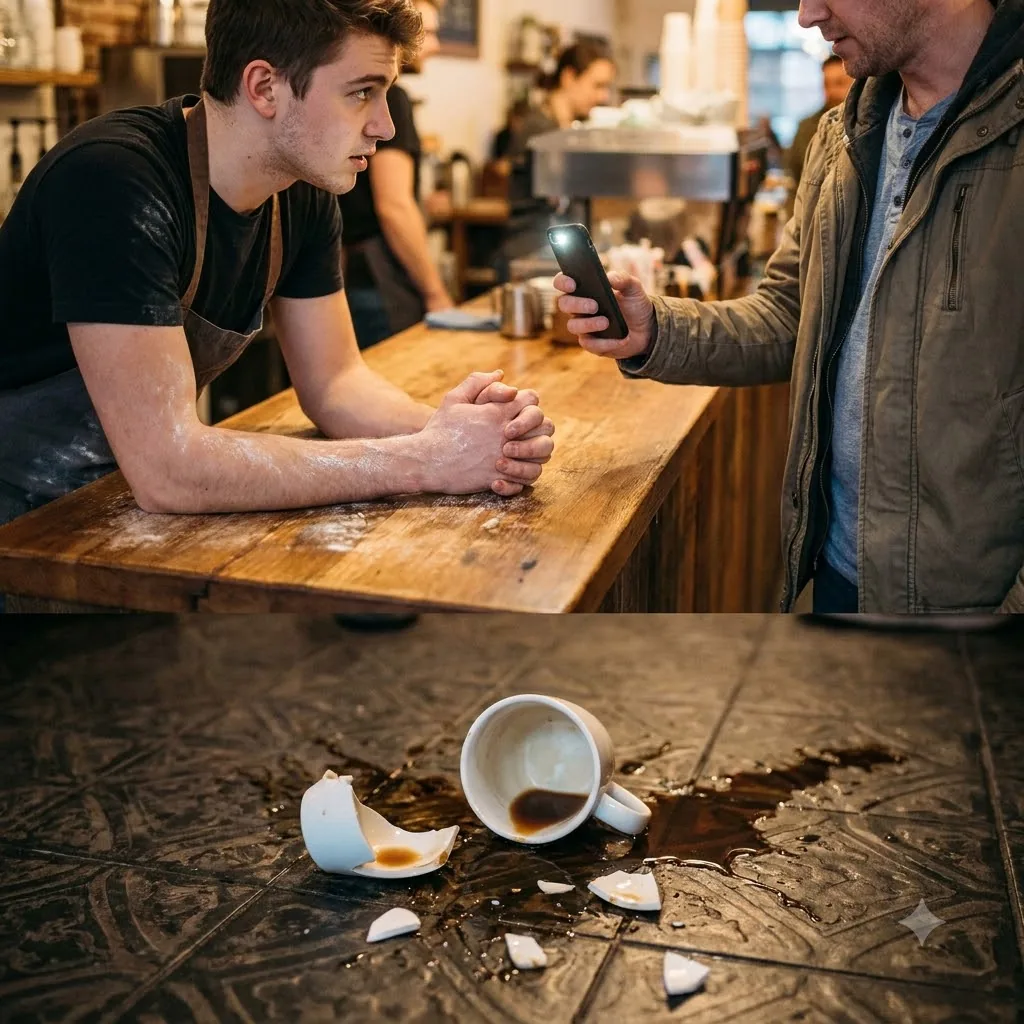
The activist didn’t draw the weapon, but he left his right hand resting heavily over the exposed black steel. He angled his smartphone back toward himself, his expression settling into a mask of grim, patriotic duty. The red recording dot in the corner of the screen pulsed, broadcasting the threat to thousands.
“You see this, folks?” the man asked his audience, his voice dropping into a solemn, theatrical register meant to sound heroic. “This isn’t about a cup of coffee anymore. This is about our fundamental right to self-preservation. The corporate elites want us disarmed and vulnerable. Just look at the Oakhaven School District, right here in this very county. Total gun-free zones. Sitting ducks.”
The man leaned closer, the leather of his jacket creaking. “We have a duty to stand up and show we are ready to protect our children, because the establishment won’t do it. The police won’t do it. I carry this lawful hardware to protect kids from the real threats out there.”
Oakhaven.
The word hit Leo like a sledgehammer to the sternum, knocking the remaining breath from his lungs. The buzzing panic in his ears fractured into phantom sounds: the shrill shriek of a fire alarm, the shatter of wire-mesh safety glass, the heavy thud of tactical boots echoing down a linoleum hallway.
The man leaned over the counter, thrusting the camera back toward Leo’s face, catching the terrified barista in the blinding LED flash. “So go ahead, son. Tell the thousands of people watching right now why you’re so afraid of a good guy with a gun. Tell them why you’re against protecting children.”
Leo looked at the glowing phone. The harsh light no longer blinded him. The icy, paralyzing terror that had gripped his limbs suddenly crystallized into something entirely different-a sharp, freezing clarity born of profound trauma. The frantic shaking in his hands began to subside. His fingers, still slick and burning from the spilled dark roast, uncurled from the edge of the stainless steel counter.
“I’m not,” Leo said.
His voice was no longer the reedy, pathetic whisper from before. It was dead flat, hollowed out by a sudden, jarring calm that felt alien in his own throat.
The activist blinked, his triumphant sneer faltering as he was caught off guard by the abrupt tonal shift. He adjusted his grip on the phone, his thumb tapping the side of the case. “Speak up into the mic. The audience can’t hear you over your own trembling.”
“I said, I’m not,” Leo repeated, raising his chin. He didn’t look at the exposed hammer of the gun. He didn’t look at the man’s camouflage cap or tactical sunglasses. He looked directly into the tiny, unblinking black lens of the phone camera. “I went to Oakhaven.”
The man’s bravado stalled for a fraction of a second. He frowned, his eyebrows knitting together. “What are you mumbling about?”
“Oakhaven High,” Leo said, his voice gaining strength, projecting clearly through the quiet cafe over the hum of the display refrigerators. “Two years ago. I was a junior.”
The man’s mouth opened, but his booming broadcast voice failed to materialize. His right hand remained frozen over his unstrapped holster, his aggressive posture suddenly looking stiff and awkward.
“I was in Mr. Harrison’s AP History class in Room 114,” Leo continued, his words slicing cleanly through the activist’s fabricated narrative. “When the lockdown alarm went off, we thought it was a standard drill. Until the first shots hit the cafeteria windows.”
“Listen, kid-” the man started, his face suddenly flushing a deep, mottled red as he realized where the broadcast was heading.
“No, you wanted me to talk to your audience,” Leo interrupted, taking a deliberate half-step forward. He didn’t care about the corporate media policy or termination anymore. He only cared about the glaring red recording light and the thousands of strangers peering into his workplace. “You want to talk to them about protecting children at Oakhaven? I was one of them. I spent four hours huddled under a computer desk. I held my best friend’s hand while we listened to someone walk down our hallway, pulling on door handles.”
The man took a small, involuntary step backward. His hand finally slipped away from the gun, falling uselessly to his side. The phone dipped slightly, the framing of the live shot dropping to capture Leo’s chest and the dark coffee stain soaking his green apron.
“Keep the camera up,” Leo demanded, his voice hardening into unyielding steel. “You wanted to show your viewers a victim of liberal brainwashing, right? Show them. Show them who you’re intimidating.”
The activist swallowed hard, his Adam’s apple bobbing, but he didn’t raise the phone. He glanced nervously at his own screen. Even from across the counter, Leo could see the rapid-fire scrolling of the live comments had suddenly transformed. The flood of patriotic emojis and cheering remarks had vanished, replaced by a chaotic blur of text the man couldn’t control. The audience was turning.
“You come in here, you scream at a teenager making minimum wage, and you unstrap your weapon because I spilled your coffee,” Leo said, his gaze locked intensely onto the man’s widening, panicking eyes behind the sunglasses. “You tell your stream you carry that thing to protect kids like me. But you aren’t protecting anyone today. You just walked into my cafe, trapped me behind a counter, and made me relive the exact same terror I barely survived two years ago.”
The silence that followed was absolute. The mechanical hiss of the espresso machine had stopped. The only sound left in the building was the faint, rhythmic dripping of the spilled coffee hitting the floor tiles, pooling around the shattered ceramic fragments.
The armed man looked down at his phone, watching his own audience react to the pale teenager staring him down. His jaw worked silently. He stammered, frantically searching for a slogan, a talking point, an excuse to salvage the broadcast, but he produced absolutely nothing.