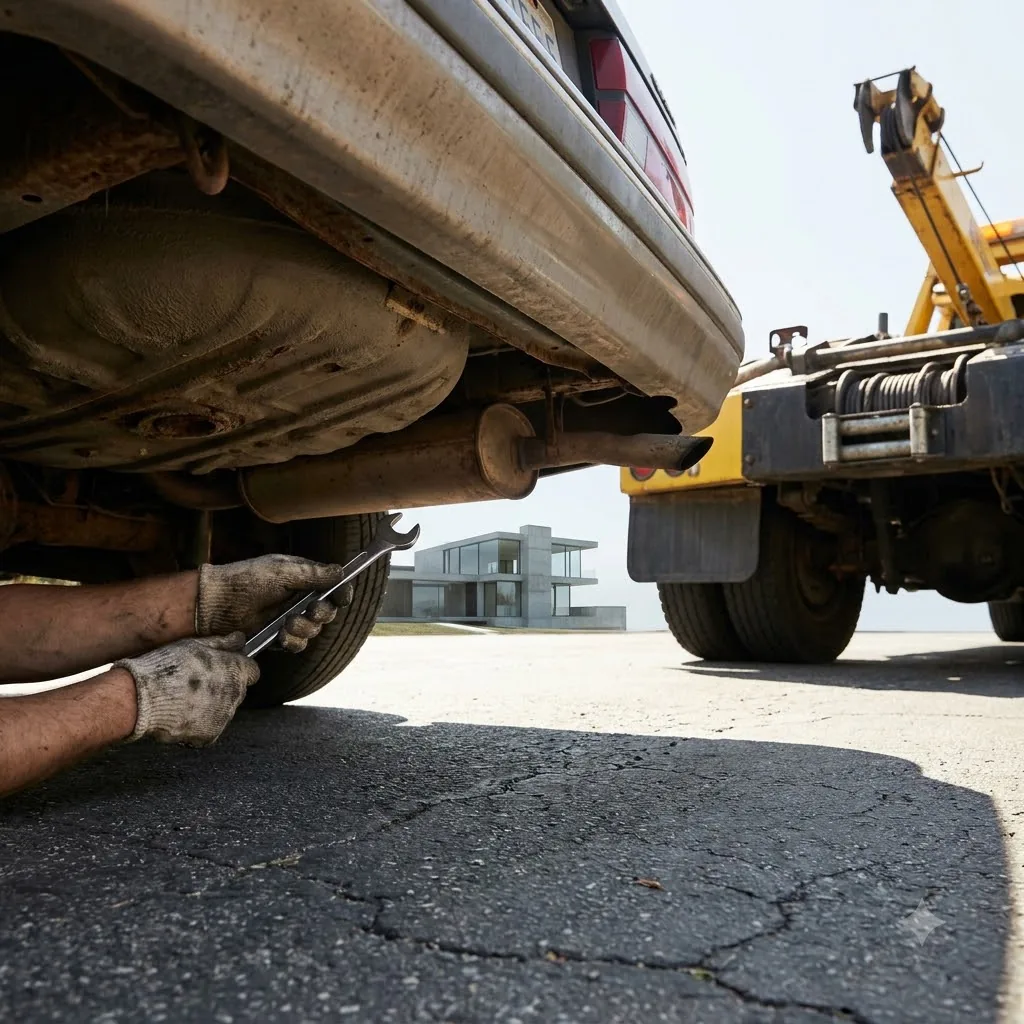
Story code: ST-000392
Part 2: The Code of Attrition
Marcus marched across the lush, springy turf. Each heavy footfall felt like a violation of a pristine, alien landscape. The red LED ring of the security camera mounted under the eaves swiveled, tracking his every move with mechanical precision. He reached Elias’s towering, custom-milled oak front door and hammered his grease-stained fist against the wood.
“Elias! Open up!” Marcus shouted, his voice echoing off the brick facade.
Silence. Then, a soft chime emanated from a sleek video doorbell mounted at eye level.
“Marcus,” Elias’s voice crackled through the tiny speaker, calm, perfectly modulated, and dripping with synthetic politeness. “I would kindly ask you to step off my Kentucky Bluegrass. It’s freshly rooted, and heavy work boots are terribly damaging to the soil aeration.”
“Call them back,” Marcus demanded, leaning into the doorbell’s wide-angle lens. “You know exactly what you did. That car belongs to Sarah from the diner. She needs it to pick up her kids. There was no oil leak. There was no public hazard.”
“I simply utilize the city’s 311 app to report neighborhood blight,” Elias replied, the audio compressing slightly. “It is a citizen’s duty to maintain property values and municipal standards. The city determines the appropriate response, not me. Now, please vacate my property before I am forced to report a hostile trespasser.”
The intercom clicked dead with a sharp hiss of static. Marcus stood on the porch, his jaw tight, staring at the impassive black lens of the doorbell. The red ring of the dome camera above was still pointed directly at the back of his neck.
Returning to his cracked concrete driveway, Marcus pulled his phone from his pocket. He had to get Sarah’s car out before the daily storage fees hit. He dialed the number printed on the back of the crumpled citation slip. After twenty minutes of automated menus and maddeningly cheerful hold music, a bored clerk at the municipal impound lot finally answered.
Marcus quickly explained the situation, rattling off the license plate and citation number.
“Yeah, I see it,” the clerk said, accompanied by the loud clacking of a mechanical keyboard. “2006 Honda. Towed for unlicensed commercial repair and hazardous fluid discharge. We can’t release it today.”
“I have the four hundred dollars,” Marcus lied, knowing he would have to completely drain his meager savings to cover the base fee.
“Base fee is four hundred,” the clerk corrected, her tone completely flat. “But there’s an environmental hold. City code 14-B. Hazardous fluid on a public right-of-way requires a certified hazmat inspection before the vehicle can be legally discharged. The inspection fee is eight hundred dollars, plus a four-hundred-dollar environmental penalty. Total is sixteen hundred. Cash or cashier’s check only. And we can’t schedule the inspector until Tuesday.”
“Tuesday?” Marcus choked out. “Today is Thursday. Sarah needs that car tomorrow morning. And there were no fluids! The driveway is bone dry!”
“Take it up with the municipal hearing officer. I just read the screen,” the clerk said. “Every twenty-four hours is another hundred bucks in storage. Have a nice day.”
The line went dead. Sixteen hundred dollars. Plus storage. It was a ransom he couldn’t pay, for a crime he didn’t commit, orchestrated by a man hiding safely behind a smart doorbell.
Marcus shoved the phone back into his pocket and walked heavily into his kitchen. The small, dated room felt suffocating. He washed his hands at the sink, watching the dark chassis grease swirl down the drain, mirroring the sudden, uncontrollable spiral of his morning. Through the window, he could see the top of Elias’s pristine privacy fence, a stark white border seemingly designed to box him in.
A sharp knock at the front door made him jump.
He hurried out of the kitchen, momentarily expecting to find Elias finally willing to speak face-to-face. Instead, he opened the door to a mail carrier holding a thick, brown envelope and an electronic clipboard.
“Certified delivery, Marcus. Need a signature,” the carrier said, his expression sympathetic.
Marcus signed the digital pad and tore open the heavy paper. Inside was a multi-page document bearing the official watermark of the City Department of Code Enforcement. The bold header read: *Notice of Persistent Violations and Intent to Lien.*
He scanned the dense legal text, his stomach dropping. It wasn’t just about the Civic. The document listed fines for an ‘unpermitted secondary structure’-his aluminum tool shed, which had sat quietly in the backyard for twenty years. It cited ‘improper storage of industrial equipment’-his rolling tool chest inside his own open garage. The accumulated fines, aggressively backdated over the last thirty days, totaled over twelve thousand dollars.
Attached to the back of the citation was a stack of grainy, timestamped photographs. Every single image was taken from a high angle, looking down onto his property. They were high-definition screenshots from Elias’s security camera. The city wasn’t just blindly acting on Elias’s complaints; they were officially utilizing his surveillance feed as indisputable documentation.
At the very bottom of the envelope, a separate, glossy card fluttered to the porch floor. Marcus picked it up. It wasn’t from the city. It was a heavy-stock mailer from ‘Apex Holdings LLC.’ The bold text read: *Drowning in City Fines? We Buy Distressed Properties For Cash! Close in 7 Days!*
Marcus stared at the card. The registered address for Apex Holdings was a P.O. Box in a neighboring town, but the motive was suddenly, terrifyingly clear. Elias wasn’t just an overzealous neighbor obsessed with aesthetics. He was systematically weaponizing the municipal code to bankrupt Marcus, forcing a distress sale so he could acquire the lot and expand his estate. The impossible four-minute tow truck response, the fabricated hazmat hold, the twelve thousand dollars in retroactive fines-it was a highly coordinated siege.
Before Marcus could even process the full magnitude of the trap, the deep rumble of a heavy engine vibrated through his floorboards.
He stepped back out to the edge of his porch. A white city inspector’s SUV was parked at a sharp angle across the end of his driveway, boxing in his own aging pickup truck. A man in a crisp blue polo shirt with the city seal embroidered on the chest stepped out, carrying a digital tablet and a heavy-duty staple gun.
Marcus walked down the porch steps, the certified letter trembling in his grip. “Can I help you?”
The inspector didn’t make eye contact. He walked directly to the wooden load-bearing post of Marcus’s front porch, raised the staple gun, and fired twice with a loud, metallic *clack-clack*.
A bright orange placard was now affixed securely to the wood. The bold black letters screamed: *STOP WORK ORDER / CONDEMNATION WARNING.*
“You have forty-eight hours to clear the property of all commercial equipment and remit payment in full for outstanding liens,” the inspector recited mechanically, tapping his tablet screen. “If the hazardous conditions are not abated by Monday morning, the city will officially condemn the structure and physically seize the property.”
“Condemn the structure?” Marcus yelled, stepping toward the inspector. “Look at this place! It’s perfectly safe! You’re taking orders from a guy next door who just wants to steal my land!”
The inspector slid back into his SUV, rolling up the tinted window without another word. The vehicle backed out rapidly and sped away down the quiet suburban street.
Marcus stood entirely alone on his lawn, the neon orange placard burning in his peripheral vision. He slowly turned his head toward Elias’s house. The black dome of the security camera shifted slightly on its axis, the red light pulsing rhythmically in the shadows, recording his every helpless moment as the invisible clock ticked down to Monday morning.