Story code: ST-000442
Part 3: The Obsolescence Engine
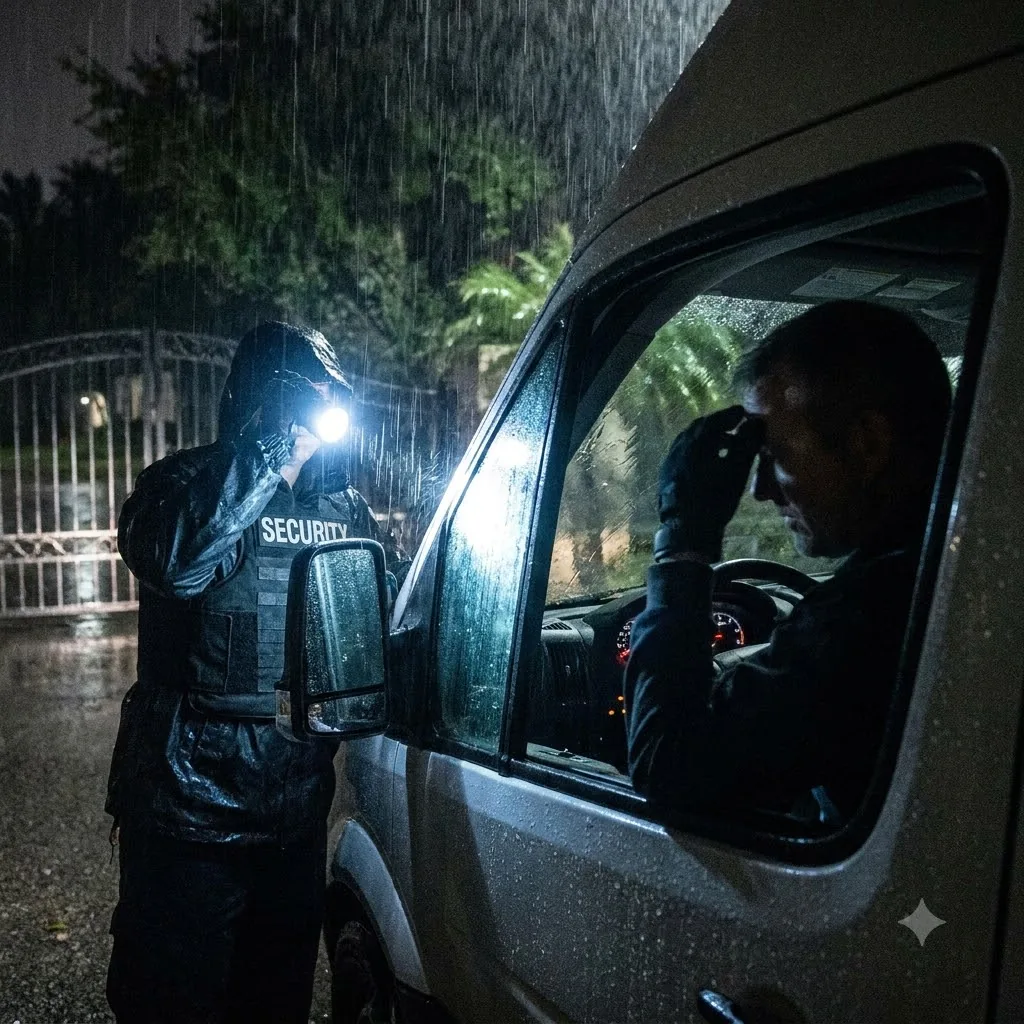
The distant, rising wail of sirens sliced through the heavy thrum of the rain. Arthur stood perfectly still in the headlights, his combat boots submerged in an inch of freezing runoff. The bright green chat banner on the eight-inch screen held his gaze like a tractor beam. *The police are coming.* The words should have triggered an immediate flight response. They should have sent him sprinting up the hill toward his sprawling colonial to beg Evelyn for forgiveness, or at least to strip off his pathetic tactical vest before the cruisers arrived. But he didn’t move.
Ahead of him, the white transit van was pinned at an awkward angle against the guardhouse pillar. The terrified young driver had kept his foot slammed on the accelerator in his panic, the rear tires spinning furiously and sending a rooster tail of muddy water splashing across the brickwork. The sickening crunch of the rear impact had buckled the van’s frame just enough to shatter the driver-side window, leaving jagged teeth of safety glass clinging to the weather stripping. Inside the cabin, the driver sat curled against the center console, hyperventilating, his hands raised defensively over his head.
Arthur took a slow step forward, his heavy soles dragging across the asphalt. He approached the exposed cabin. The driver shrieked, a raw, guttural sound of pure terror, kicking wildly at the dashboard as he tried to force his body over the gearshift and onto the passenger seat stacked with the flat-packed moving boxes.
But Arthur wasn’t looking at the young man. He wasn’t looking at the boxes that were meant to pack up his children’s lives. His eyes were locked entirely on the glowing tablet still clamped to the dashboard air vents.
Something was wrong with the display. Not the horrifying message from his wife, but the user interface itself. The chat banner at the top of the screen… it was a highly specific hexadecimal shade of green. *Mint 42C9A9.* The font wasn’t a standard system default; it was a custom sans-serif with uniquely tightened kerning around the capital letters. And the dark-mode GPS map tracing the blue path through Cypress Point? It wasn’t using standard commercial API mapping. It was actively rendering topographical elevation changes, prioritizing flat-grade routes to conserve hypothetical fleet fuel consumption.
Arthur shoved his arm right through the shattered window.
The driver screamed again, scrambling backward against the passenger door, but Arthur simply clamped his hand around the edges of the tablet. He gave a violent, downward yank. The plastic vent mount snapped with a sharp crack, freeing the device. Arthur pulled the tablet out into the freezing storm, completely indifferent to the rain immediately slicking the glass screen.
He stared at the interface. His breathing turned shallow and rapid. This wasn’t just some off-the-shelf application leased by a gig-economy courier network.
It was OptiRoute v4.
It was *his* software. The exact predictive logistics algorithm he had spent the last three years developing as Regional Director of Supply Chain Integration. It was the massive, department-consuming project he had proudly presented to the executive board just last week. The very same board that, only this morning, had abruptly informed him that his division was being dissolved, his algorithm was far too buggy for production, and his services were no longer required.
Arthur wiped the pooling rainwater off the screen with his heavy thumb. His hands moved entirely on muscle memory, driven by years of exhausting late-night debugging sessions. He didn’t even have to think about the sequence. He placed three fingers on the upper right corner of the display and double-tapped the battery icon.
The consumer-facing user interface instantly vanished, snapping away like a cheap theatrical curtain. In its place, a raw, black diagnostic terminal dropped down, filling the screen with rapidly cascading lines of white system data and active execution threads.
Arthur ignored the terrified driver sobbing inside the ruined van. He ignored the flashing blue and red lights that were just beginning to reflect off the low, storm-swollen clouds at the bottom of the hill. He tilted the screen to shield it from the heaviest sheets of rain, his eyes frantically scanning the flowing text.
He found the active routing module. He tapped the block of code to expand the developer notes embedded in the current task architecture. The screen refreshed, pulling the deep-level metadata for the exact process that had guided this unmarked transit van to his neighborhood.
There, glowing in stark white text against the black background, was the initialization string:
`// BUILD: OPTIROUTE_V4.2`
`// COMPILED_BY: EMP_ID_80924_AP`
`// STATUS: ACTIVE_DEPLOYMENT`
*80924_AP.* Arthur Pendelton.
The breath left his lungs in a single, hollow rush. They hadn’t scrapped his project. They had stolen it. The executives had lied to his face, fired him, wiped out his entire department to save on overhead salaries, and immediately pushed his beta software to the live logistics fleet.
The machine he built to completely automate regional shipping was working flawlessly. It was so terrifyingly efficient that on its very first day of live deployment, it had successfully processed an emergency dispatch for moving supplies, mapped the optimal route to bypass traffic, and delivered the boxes directly to his own home so his wife could escape him.
Arthur stood paralyzed in the flooded roadway, clutching the cold, wet tablet against his chest rig. The high-pitched wail of police sirens tore through the neighborhood entrance just a few blocks away, screaming closer by the second, but Arthur couldn’t look away from the glowing alphanumeric string of his own employee ID. He had engineered his own perfect, devastating obsolescence.