Story code: ST-000236
Part 2: The Blind Test
Dr. Sloane did not raise his voice. He just lifted a finger toward the tray and said, “Again, but this time without help.”
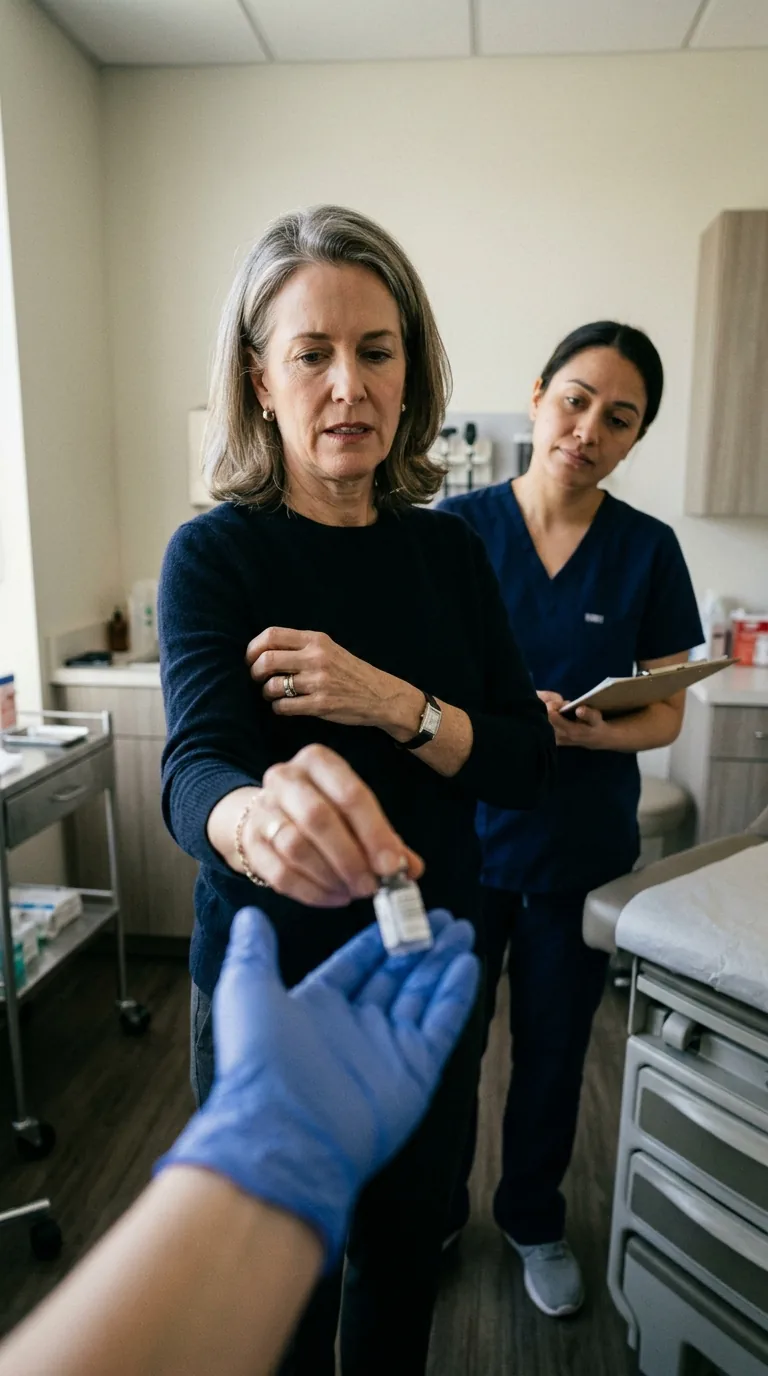
Marian set the vial down and adjusted her cuffs first, slow enough to look uncertain, then reached for it again. The trick in that room was timing. Everybody could see timing. She had spent the last several minutes making herself look like she needed directions for a simple transfer, and now the same hands that had fumbled the cap found the ridge on the vial immediately.
I kept my hands off the tray.
Dr. Sloane moved one step to the side, enough to give himself a clear view of Marian’s fingers. “Leave the label where it is,” he said. “No prompting.”
Marian nodded once. “Of course.”
She picked up the treatment vial, turned it under the light, and stopped pretending to search for the seam. The cap came off in one clean twist. Not a hard twist, not a guess, not a series of little corrections. Clean. Exact. Then she checked the contents against the line marked on the card beside the tray, and she did it faster than either of the staff members had done all morning.
The nurse at the counter looked over. So did the receptionist through the glass.
Marian’s voice stayed even. “This is the one for the infusion bay, not the storage rack.”
Dr. Sloane held out his hand without taking his eyes off the vial. “Show me the wristband match.”
She did. First the band, then the label, then the route notation, each step exact. The awkward pauses from earlier were gone. So was the little show of uncertainty. In their place was a person who knew the sequence better than the room expected.
I said, “You were doing all that on purpose.”
Marian’s gaze flicked to me, then back to the vial. “I was asking for clarity.”
“That isn’t what you were doing,” I said.
Dr. Sloane took the vial from her and checked the seal. “We all saw the handling now.”
That landed harder than anything shouted could have. Nobody in the room needed a speech. The shift was visible in the way the nurse stopped reaching for the tray, in the way Marian no longer asked for the cap to be explained, in the way Dr. Sloane said the next words like he was marking a chart entry. “Procedure is over the line now. We proceed with the correct handler and the documented sequence.”
Marian pressed her lips together and looked at the vial again. When she reached for it the second time, she did it with the same precision she had just used to undo the whole performance. She did not hesitate. She did not miss. She completed the step cleanly enough that the tray looked staged for it.
I watched Dr. Sloane note the time, then the nurse swap the labels back into place. Marian’s fingers never shook. She took the vial, set it down exactly where he indicated, and for the first time in the room, she did not ask me to repeat anything.
Dr. Sloane closed the chart. “We have what we need.”
Marian kept her eyes on the vial as if it had become the only thing in the room. Then she said, “If the sequence changes, I’ll need another appointment.”
The nurse answered before I could. “That comes with a reschedule fee and a new intake window.”
Marian looked at the fee sheet, then at the vial, then at Dr. Sloane. He did not move.
That was when I understood the room had seen the truth, but nobody had said what it would cost to keep it moving. Marian could handle the vial just fine when the blind test started. What I could not tell yet was whether she had been buying time, or buying a way to make me carry the next consequence.