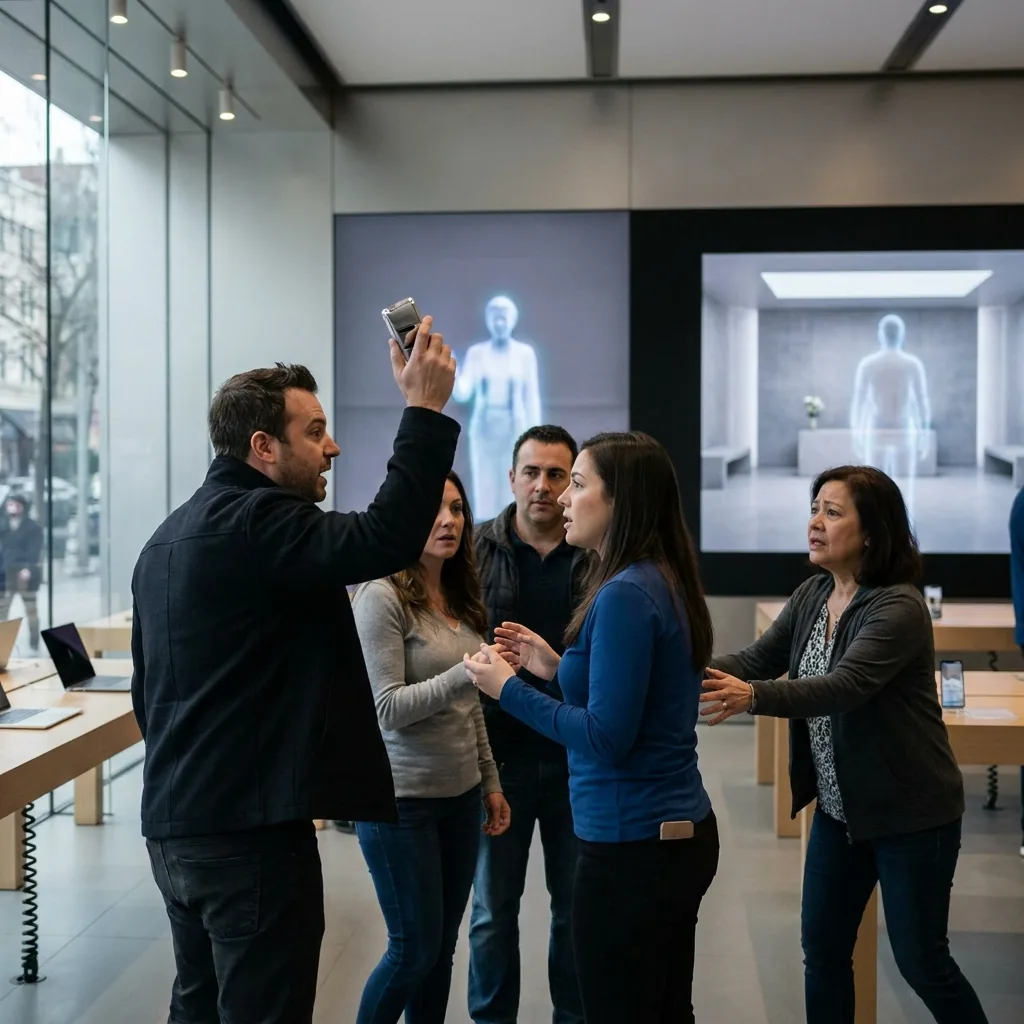
Story code: ST-000355
Part 2: The Help He Asked For
Noah Velez did not speed up when Derek said that. He kept the same pace across the showroom floor, tablet in one hand, access badge clipped to his belt, while Derek stayed at my counter with one palm near the voice-model drive like he could claim the whole station by standing there.
“You reported an active failure,” Noah said when he reached us. “I need the drive, the schedule reference, and the claimed point of failure.”
Derek gave a quick tight smile that never reached his eyes. “I said there was a problem. I didn’t say we needed to blow it up in front of everyone.”
Noah looked at the schedule screen, then at the drive beside my tablet. “Your sister’s memorial is on the active queue. That’s already public to the room because you announced it. Where is the failure presenting?”
Derek rubbed the back of his neck and glanced toward Bay Three, where a preview reel was running in silent light. “I was trying to prevent a failure.”
That was not what he’d said when he came in.
I didn’t add commentary. I didn’t need to. The woman by the urn display was still pretending to study bronze finishes while listening to every word.
Noah held out his hand. “Drive.”
Derek did not give it to him. He picked it up first and turned it over in his own fingers.
“Can you just check the live model without taking this?”
“No.”
“Why not?”
“Because you brought this as the corrective source and claimed a present-tense system problem. Those are linked. I verify both or neither.”
Derek let out a short laugh with no humor in it. “This is exactly why families stop trusting places like this. Everything has to become a process demonstration.”
Noah kept his hand out. “If you want emergency handling, this is emergency handling.”
For a second Derek looked at me, not Noah, like I was still the person he could push back into the easier lane. “Mara, all I needed was for you to load the clean voice pass so the memorial wouldn’t stutter. That’s it. Then this turns into a file note instead of a production.”
“I can’t do that,” I said.
“You could have.”
“Not without logging it. Not without him.”
His mouth flattened. He finally placed the drive in Noah’s hand, but he did it slowly, almost as if he expected the room to notice the handoff itself. Noah set it on the counter, scanned the barcode with his tablet, and looked at the result.
“This drive was previously checked into the showroom archive transfer stream,” he said.
Derek answered too quickly. “Yes, because we had to rebuild from old audio. That’s what I’m saying. It’s been unstable.”
Noah asked, “When did you remove it from archive custody?”
Derek blinked once. “I didn’t remove anything. They gave it back.”
“Who is they?”
“Your people.”
Noah tapped twice on his screen. “No release to family is logged on this identifier.”
Nobody said anything for a beat after that. I could hear the low showroom audio from Bay One switching tracks.
Derek put both hands up, palms open, and took half a step back. “Okay. Then maybe it’s a duplicate. That’s not the issue. The issue is whether Lena’s voice model is clean enough for tonight.”
He had moved from active failure to maybe-prevention to now quality concern in less than three minutes.
Noah turned the drive so the barcode faced me for a second, then back to Derek. “If your concern is quality, that is not the same as a live failure. If your concern is active failure, we proceed to a visible test now.”
“Visible?” Derek said. “No. Absolutely not. My family does not need my sister run in a demo bay because of some misunderstanding.”
Noah’s voice stayed level. “Bay Three can be privacy-screened from customer seating in under thirty seconds. You created the public urgency. The cleanest path is to verify current output against the drive you presented.”
Derek looked over his shoulder. Two people immediately looked away. One of the consultation associates on the far end stopped pretending to straighten brochures.
“This is turning into theater,” he said.
“No,” Noah said. “This is narrowing the claim.”
That line changed the air more than if he had raised his voice.
Derek leaned in again, lower now. “What if I don’t consent to a live run?”
“Then I note that the claimant reported an active memorial failure, brought an unlogged voice-model drive as a corrective source, and declined verification when operator support arrived,” Noah said. “The scheduled display remains frozen at current approved state pending review.”
Derek’s head came up fast. “Frozen? You can’t freeze her memorial over this.”
“I can freeze any active memorial asset when chain of custody is broken and emergency reporting conflicts with requested handling.”
The words landed one at a time. No lecture. No scolding. Just policy with edges.
Derek pointed at the drive. “That is her voice. I brought that here to help you.”
Noah answered, “Then let it be tested.”
Derek didn’t say yes. He looked at the floor, then at Bay Three, then at the glass partition around the operator console. His fingers flexed once against the counter. When he spoke again, his voice had lost the hard rush he came in with.
“What exactly would a live test show?”
Noah didn’t soften. “Whether the current approved model is failing as claimed. Whether this drive matches the approved asset family. Whether loading it would correct anything or alter something.”
Derek swallowed and said, “Alter what?”
Noah turned the tablet so only he and I could see the top line. The asset record on his screen had one red banner across it.
He read it aloud anyway, in the same plain voice. “Submitted source divergence detected.”