Story code: ST-000617
Part 1: The Rule at the Door
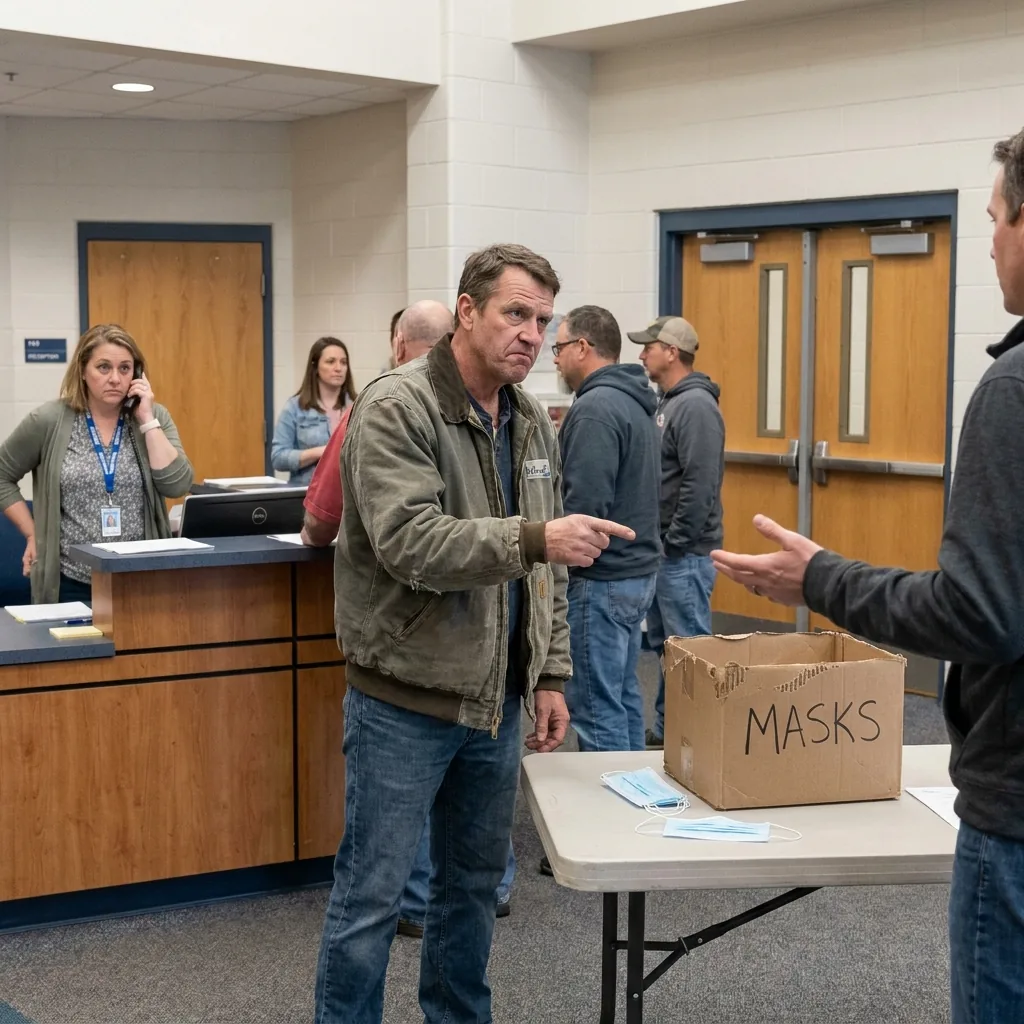
Dale Mercer stopped me at the auditorium entrance, pointed at an old cardboard box of leftover masks by the volunteer table, and said, like he was reading from district policy, that nobody was getting in without one. Behind me, parents were folding programs under their arms and inching through the tape line, but when I asked where the rule came from, nobody at that door could show me a single thing.
That was the part that caught my attention first. Not the mask itself. The way he said it.
We were at the middle school auditorium for an evening school meeting, the kind where people arrive half distracted, balancing phones, keys, and a low-level determination to find a seat before the doors really clog. Two student volunteers were straightening stacks of printed programs on a narrow table just inside the lobby. The old mask box sat on the floor beside them, bent at the top corners, with a few blue disposable masks slumped inside like leftovers from another year.
Dale planted himself beside that box as if the box made him official.
“You need to put one on before you go in,” he told me.
I asked, “Is that a school rule tonight?”
“It’s the rule for the auditorium,” he said.
He did not say who set it. He did not say the principal, the district, the event coordinator, or the front office. He just said it the way people say things when they expect the room to carry them the rest of the way.
I looked past him. People were still moving in. A woman near the aisle edge had a program in one hand and no mask on at all. A man farther up the line stepped through after a quick nod from Dale, like the standard had already changed depending on who happened to be in front of him.
“Can you show me where that’s posted?” I asked.
He tapped the side of the box with two fingers. “Masks are right here.”
That was not an answer, and we both knew it.
One of the volunteers, Tessa Nguyen, was lining up pens beside the attendance sheet. She had the careful look of somebody trying not to get drafted into an adult argument. I asked her, as plainly as I could, “Were you told everyone has to wear a mask to enter?”
She glanced at Dale, then back at me. “I was told to put the box by the table and hand out programs.”
Dale cut in before I could say anything else. “It’s been communicated. We’re not doing this at the door.”
That phrase stayed with me too. Not because it clarified anything, but because it did the opposite. Communicated by whom? To whom? When? He was using the shape of procedure without any actual procedure attached to it.
The line behind me slowed. Nobody wanted a speech. They wanted the easy version of the evening where adults at a school event acted like adults at a school event. A few people looked at the box, then at me, then at the opening into the auditorium where you could see the first row of seats and hear the hollow microphone thump from inside.
I said, “If this is the rule, there should be somebody here who can verify it.”
Dale’s answer came clipped and fast. “I’m verifying it.”
That would have landed better if he had been wearing a badge, holding a clipboard, or standing next to someone staff clearly recognized. Instead, he was an attendee with a loud voice and a good spot near a leftover supply box.
I asked for the event coordinator.
He said she was busy.
I asked for the front office contact on site.
He said entry needed to keep moving.
I asked again, “Who authorized you to block people from a public school meeting?”
He did not answer that one directly. He repeated, “You can either take a mask or step aside.”
So I stepped aside, but not in the way he meant.
I moved to the aisle edge near the door where I could watch the flow. If there really was a rule, it should have applied the same way every time. Instead, within the next few minutes, I watched three different versions of the same claim. One woman walked in after taking a mask from the box and carrying it in her hand. An older man with a coffee cup was waved through after a short exchange I couldn’t fully hear. Then a parent coming in with a little kid was told, “Just for the adult,” which narrowed the supposed policy again.
Tessa kept returning loose programs to neat stacks. She was not enforcing anything. She was not handing masks to each person as a set procedure. She was doing volunteer work at a table while Dale used her setup as cover.
The box mattered because he kept making it matter. Every time somebody questioned him, he touched it, pointed to it, or shifted it a few inches with his shoe like the box itself was proof.
I had still not seen a sign. I had still not heard a staff name attached to the order. And I had now watched the “rule” bend three different ways in less than ten minutes.
Then Marcus Hill came up the short stretch of hallway carrying his program from the outer check-in, looked straight at the same box, and got stopped for something even stranger.
Dale told him the rule applied in the lobby too, and when Marcus asked whether that meant everyone standing there had to mask before they could even wait for seats, Dale couldn’t explain why the line behind him was suddenly exempt.
Dale Mercer stopped me at the auditorium entrance, pointed at an old cardboard box of leftover masks by the volunteer table, and said, like he was reading from district policy, that nobody was getting in without one. Behind me, parents were folding programs under their arms and inching through the tape line, but when I asked where the rule came from, nobody at that door could show me a single thing.
That was the part that caught my attention first. Not the mask itself. The way he said it.
We were at the middle school auditorium for an evening school meeting, the kind where people arrive half distracted, balancing phones, keys, and a low-level determination to find a seat before the doors really clog. Two student volunteers were straightening stacks of printed programs on a narrow table just inside the lobby. The old mask box sat on the floor beside them, bent at the top corners, with a few blue disposable masks slumped inside like leftovers from another year.
Dale planted himself beside that box as if the box made him official.
“You need to put one on before you go in,” he told me.
I asked, “Is that a school rule tonight?”
“It’s the rule for the auditorium,” he said.
He did not say who set it. He did not say the principal, the district, the event coordinator, or the front office. He just said it the way people say things when they expect the room to carry them the rest of the way.
I looked past him. People were still moving in. A woman near the aisle edge had a program in one hand and no mask on at all. A man farther up the line stepped through after a quick nod from Dale, like the standard had already changed depending on who happened to be in front of him.
“Can you show me where that’s posted?” I asked.
He tapped the side of the box with two fingers. “Masks are right here.”
That was not an answer, and we both knew it.
One of the volunteers, Tessa Nguyen, was lining up pens beside the attendance sheet. She had the careful look of somebody trying not to get drafted into an adult argument. I asked her, as plainly as I could, “Were you told everyone has to wear a mask to enter?”
She glanced at Dale, then back at me. “I was told to put the box by the table and hand out programs.”
Dale cut in before I could say anything else. “It’s been communicated. We’re not doing this at the door.”
That phrase stayed with me too. Not because it clarified anything, but because it did the opposite. Communicated by whom? To whom? When? He was using the shape of procedure without any actual procedure attached to it.
The line behind me slowed. Nobody wanted a speech. They wanted the easy version of the evening where adults at a school event acted like adults at a school event. A few people looked at the box, then at me, then at the opening into the auditorium where you could see the first row of seats and hear the hollow microphone thump from inside.
I said, “If this is the rule, there should be somebody here who can verify it.”
Dale’s answer came clipped and fast. “I’m verifying it.”
That would have landed better if he had been wearing a badge, holding a clipboard, or standing next to someone staff clearly recognized. Instead, he was an attendee with a loud voice and a good spot near a leftover supply box.
I asked for the event coordinator.
He said she was busy.
I asked for the front office contact on site.
He said entry needed to keep moving.
I asked again, “Who authorized you to block people from a public school meeting?”
He did not answer that one directly. He repeated, “You can either take a mask or step aside.”
So I stepped aside, but not in the way he meant.
I moved to the aisle edge near the door where I could watch the flow. If there really was a rule, it should have applied the same way every time. Instead, within the next few minutes, I watched three different versions of the same claim. One woman walked in after taking a mask from the box and carrying it in her hand. An older man with a coffee cup was waved through after a short exchange I couldn’t fully hear. Then a parent coming in with a little kid was told, “Just for the adult,” which narrowed the supposed policy again.
Tessa kept returning loose programs to neat stacks. She was not enforcing anything. She was not handing masks to each person as a set procedure. She was doing volunteer work at a table while Dale used her setup as cover.
The box mattered because he kept making it matter. Every time somebody questioned him, he touched it, pointed to it, or shifted it a few inches with his shoe like the box itself was proof.
I had still not seen a sign. I had still not heard a staff name attached to the order. And I had now watched the “rule” bend three different ways in less than ten minutes.
Then Marcus Hill came up the short stretch of hallway carrying his program from the outer check-in, looked straight at the same box, and got stopped for something even stranger.
Dale told him the rule applied in the lobby too, and when Marcus asked whether that meant everyone standing there had to mask before they could even wait for seats, Dale couldn’t explain why the line behind him was suddenly exempt.