Story code: ST-000913
Part 4: The Record Took the Key Away
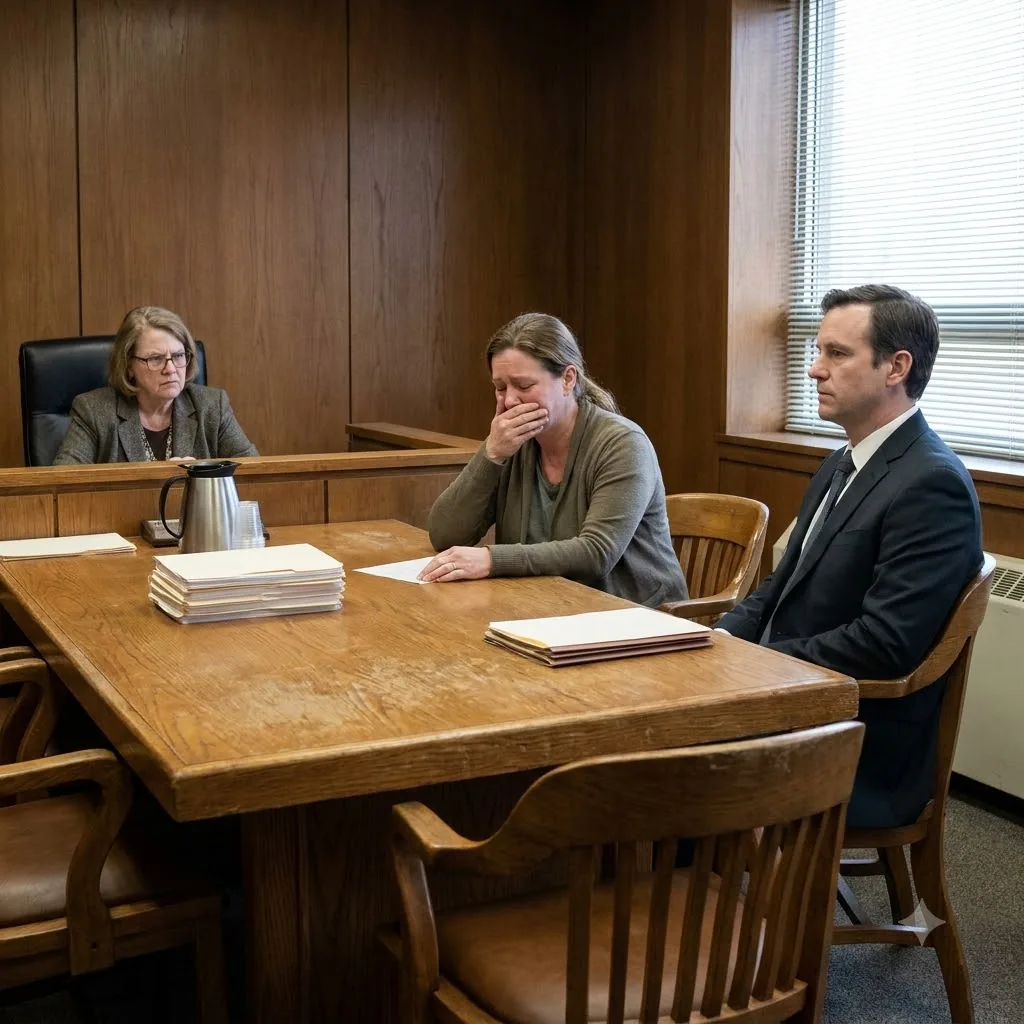
The walk back through the controlled corridor was quieter than the walk in. Noah Bell carried the chain-of-custody clipboard this time with an added notation clipped on top. Dr. Priya Nand had written in block letters that internal category labels, release conditions, and restricted authority had been observed in person. Graham Sloane walked beside no one. His shoe covers made a soft paper sound against the floor. When they returned to the Mercer Bioethics Review Center hearing room, the ordinary objects were exactly where they had been left: pitchers on the rolling cart, agenda packets spread under name placards, pens laid across margins. That sameness made the freezer language feel harsher. Noah took his side chair again. Dr. Elena Pike sat, squared the packet in front of her, and placed the added notation on top where everyone could see it. “We will stay with procedure,” she said. No one interrupted. She looked first to Nand. “For the record: are the clone-related samples stored under a restricted category separate from general repository handling?” “Yes,” Nand said. “Visible in rack placement, label format, retrieval requirements, and internal handling note.” “Does that restricted category rely on sponsor-linked release authority?” “Yes. My name and Mr. Sloane’s are on the release authority insert. The access log also reflects sponsor-linked authorization remarks.” Dr. Pike nodded once and turned to Noah. “Mr. Bell, did you witness the release confirmation, freezer opening, and notation?” “Yes,” Noah said. “And the labels on the C-4 boxes said hold for direct release and not for general repository transfer.” She marked something in the margin of her packet. Then she turned to Sloane. “Your denial did not merely challenge wording. It asserted there was never a promise or separate handling expectation of the kind this room had been relying on. The freezer category, the internal note, and the release authority structure do not support that denial.” Sloane leaned toward his microphone. “They support a limited custodial precaution. I have said repeatedly that operational caution is not the same thing as the broad assurance Ms. Vance described to affected parties.” Mara did not lunge for the opening. She only opened her legal pad and set one finger on an earlier page. Dr. Pike answered before Mara could. “You are still trying to narrow this after using the broad denial first. That is the problem. If you had said the room was dealing with a constrained operational boundary whose wording had been presented imprecisely, we would be having a different hearing. Instead you said there had never been any promise about how the samples would be handled. The storage system says otherwise.” Leah Mercer sat very still beside Mara, binder closed now. One of the hearing members at the far end reached for his packet and pulled it closer for the first time in several minutes. Dr. Pike continued. “This is an oversight setting. We do not need a dramatic admission. We need a record that matches physical practice. At present, your testimony does not.” She turned to the staff attorney seated against the back wall and said, “Draft an interim corrective note: sponsor testimony regarding clone sample handling contradicted by observed storage restrictions, internal handling language, and sponsor-linked release authority.” The attorney nodded and began writing. Then Pike faced Nand again. “Effective immediately, remove Mr. Sloane from active freezer release authority for C-4 pending formal review by this board. Convert release control to custodian-only with chair sign-off for any retrieval. Can that be done today?” Nand answered without flourish. “Yes. I can update the storage system, replace the insert, and disable his badge-linked release permission before end of day.” Sloane spoke over the last two words. “On what basis?” “On the basis that you used this board’s hearing to deny a handling boundary that your own authorization structure helps maintain,” Dr. Pike said. “You are free to submit a written clarification. You are not free to keep live release authority over the category while the contradiction remains unresolved.” Noah saw the effect of that sentence land more clearly than anything said in the freezer room. Sloane’s hand went to the table, then flattened there. Not a slam. Just a stop. The donor polish was still present in his suit, his tie, his measured posture. But the room no longer moved around it. Mara looked down at her notes once, then closed the pad. She did not ask for an apology. She did not need to repeat what she had said earlier. The board had already moved past argument into logistics. Nand unclipped her lab badge from her jacket and set it on the table beside the packet. “If the chair wants, I can call storage now and have secondary authorization removed before we adjourn.” “Do it,” Dr. Pike said. Nand used the room phone rather than her cell. She gave the storage code, the category, and Sloane’s name letter by letter. Noah heard only her side: “Yes. Effective immediately. Yes, chair instruction. Custodian-only until review notice issues.” She wrote the time in the margin when she hung up. Leah exhaled once and looked at the hearing packet instead of at Sloane. One of the other members asked for the corrective note to include the exact wording from the freezer label. Pike agreed. The attorney kept writing. Sloane did not leave. He sat through the wording of the interim restriction, the notation of observed contradictions, and the instruction that any future representation about clone sample handling had to match storage practice already in place. By the time Dr. Pike announced the next agenda item, the change had become just another line of procedure. Noah looked at the water pitchers, the placards, the stack of folders still waiting for later discussion. Nothing in the room looked broken. That was what made it final. The denial that had made Mara sound unreliable had ended as a badge permission removed, a release authority stripped from a plastic sleeve, and a written note that would stay in the.