Story code: ST-001344
Part 3: The Verification Failure
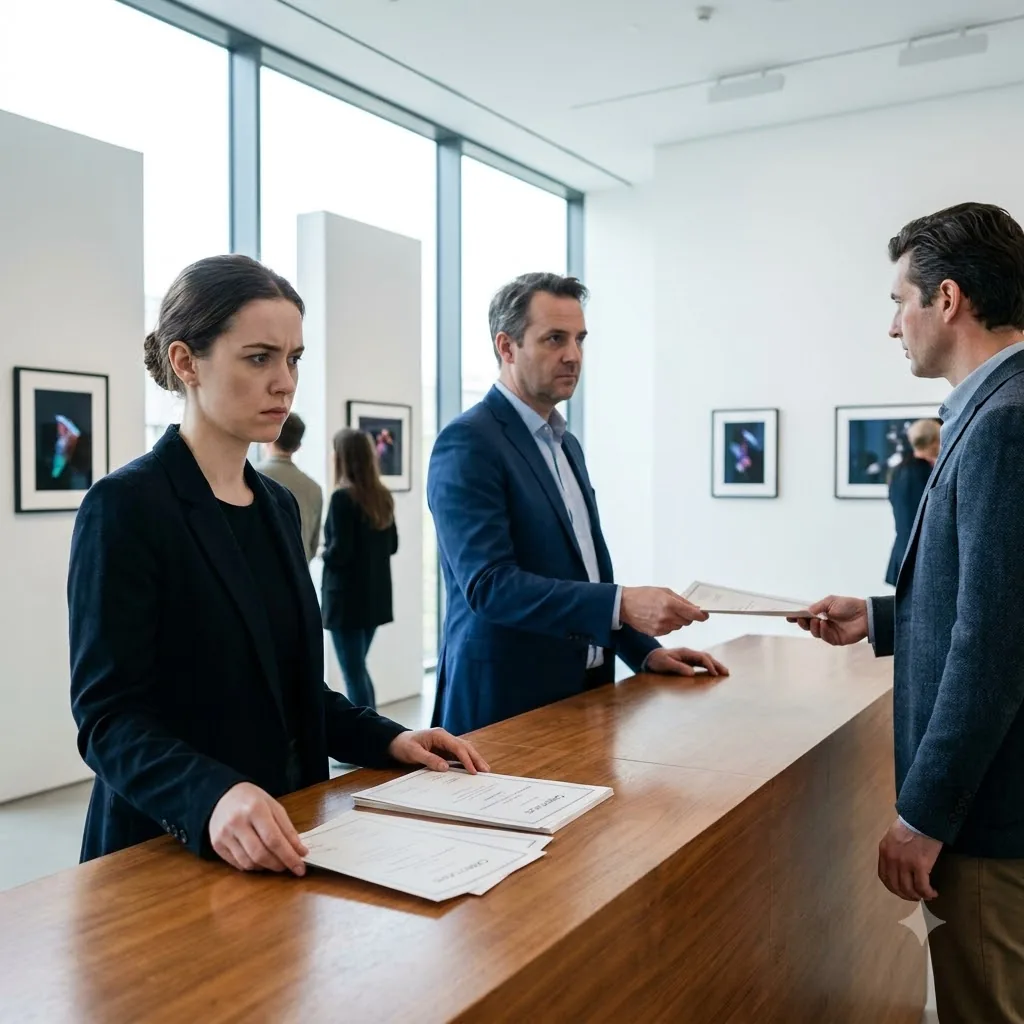
Julian slowly turned the screen, his shoulder blocking the direct path of the overhead spotlight. His fingers hovered over the glass. I adjusted a stack of catalog booklets on the counter, positioning myself where I could see the reflection on the glass wall behind him. The gallery was filled with the soft clink of champagne glasses and the low hum of wealthy patrons discussing the collection, but our corner had grown remarkably quiet.
The screen displayed the terminal command line, flashing a prompt for the primary weights directory.
“It’s just a matter of executing the base script,” Julian said, his voice rising in pitch as he turned to Marcus. “But as I mentioned, running it live without the local seed caches can cause rendering artifacts. It won’t look like the finished pieces on the wall.”
“I’m aware of how diffusion models render in real-time, Julian,” Marcus said. His voice was level, almost clinical. “I don’t mind noise. I want to see the syntax you used to balance the copper density in the second layer. Enter the base parameters.”
Julian’s fingers tapped the screen. He typed: `/generate –prompt “neon copper vortex, obsidian flow, cinematic lighting, 8k”`
Nothing happened. A yellow syntax warning appeared: `Syntax Error: Unknown command structure. Access denied to base weights.`
Julian cleared his throat, the sound dry in the quiet space. He deleted the line and typed it again, changing the hyphens to underscores. The screen flashed red: `Registry block locked. Execute authority token required.`
He turned his back to Marcus, stepping closer to Evelyn. His elbow brushed against a display stand, nearly knocking over a tray of champagne flutes. I caught the tray, my eyes remaining on his face. Beads of sweat had formed along his hairline, reflecting the neon blue light from the gallery’s centerpiece.
“Evelyn,” Julian whispered, his lips barely moving as he leaned toward her. “The local port token. The one you stored in the administrative folder. Type it in. Now.”
Evelyn did not move. Her hands remained crossed behind her back. “The token is linked to the developer’s hardware signature, Julian. Even if I typed the alphanumeric sequence, the registry checks the origin device. It knows the local node was compiled on my workstation, not yours.”
“We are in the middle of a gallery preview,” Julian said, his whisper sharp and rapid. “You signed the transfer agreement for the physical assets. The exhibition is under my curatorial license. Just input the initialization sequence. I will have the accounting desk adjust your bonus tomorrow morning. Ten percent.”
“I signed an agreement to print the physical canvases,” Evelyn said. Her voice was not a whisper. It carried across the immediate circle of collectors who had gathered around the counter. “I did not transfer the cryptographic keys to the model weights. The gallery registry requires the creator’s key to modify the source code. You told the board you wrote the code yourself. If that is true, you don’t need my administrative files.”
Marcus stepped forward, his eyes dropping to the red error screens on the tablet. He reached out, took the tablet from Julian’s hand, and turned it toward the crowd. The screen displayed the creator registration log, highlighting the locked local directory.
“Julian,” Marcus said, his tone dropping any pretense of warmth. “This model isn’t accepting your developer signature because your signature doesn’t exist on this repository. If you don’t have the creator token to run the live modifications, the entire collection’s value drops to zero for my portfolio. I buy intellectual property, not physical copies of someone else’s work.”
Julian reached for the tablet, but Marcus did not hand it back. Instead, Marcus turned his gaze to Evelyn, his face unreadable. “Who holds the master key for the ‘Digital Terrains’ repository?”