Story code: ST-000905
Part 2: His Glitch Story Started Costing Us Money
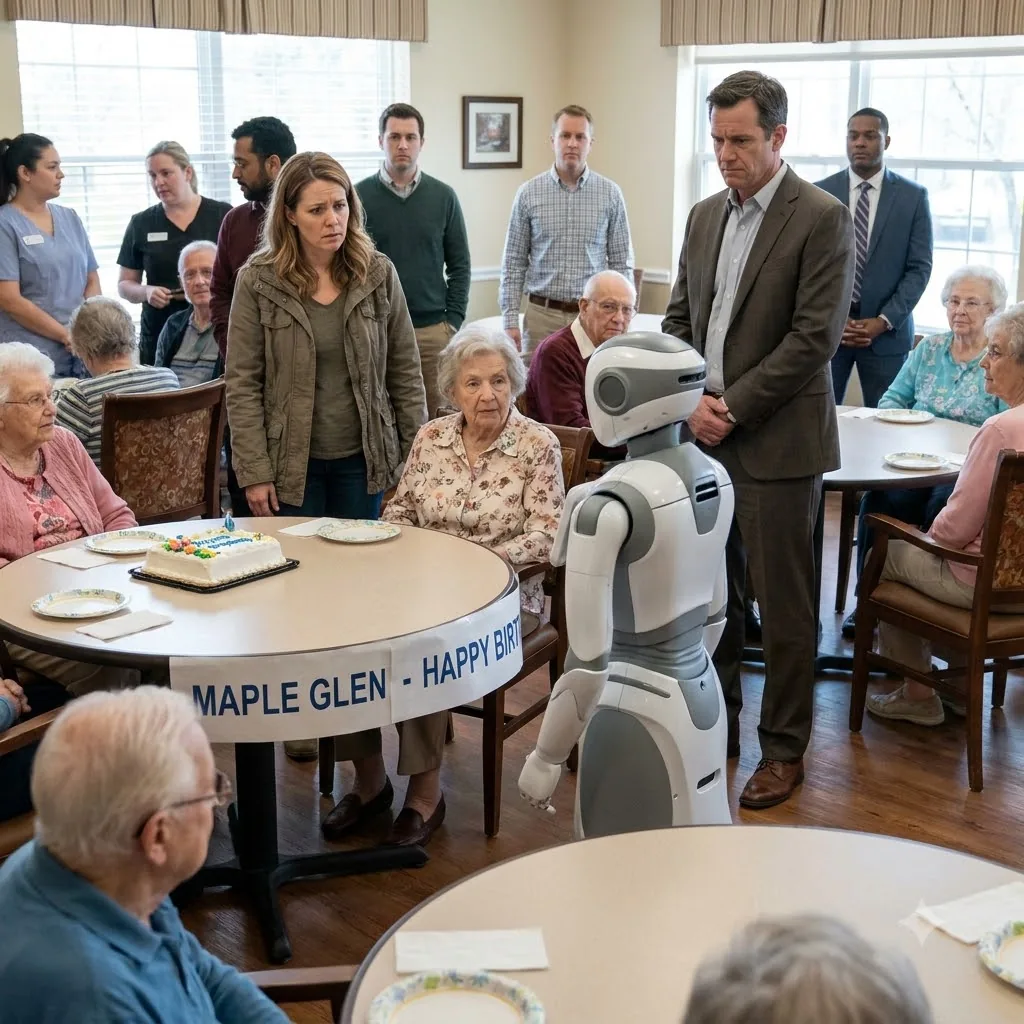
By the time the aides cleared the cake plates, Owen Pike had a new story. He said the robot had not been serving another household at all. He said the unit had been used in a vendor “simulation environment,” and certain phrases had bled into live conversation after an update. He stood beside the charging alcove saying this with his service tablet angled against his body, while my mother sat six feet away with her celebration balloon bobbing over one shoulder like a joke nobody could take down fast enough. I wrote his exact phrase: simulation environment. Then I wrote the problem with it. The robot had not spoken like a machine pulling random fragments. It had used a name, a medication trick, and a timed checklist in the same breath. It had also asked if it should tell me what happened at the Wynn house. A simulation does not explain a house it can label and a person it can find with its screen. Maya Torres must have been doing her own reconstruction beside mine. She stood at the dock with her arms folded and said, “If this is a training bleed, why has Elaine’s unit been missing regular room rounds?” Owen turned to her with that polished calm again. “There have been no missed rounds.” Maya did not raise her voice. “Last Thursday it skipped her hydration prompt until after seven. Sunday evening we had to do the bedtime reminder ourselves. Tuesday morning it wasn’t on the floor at shift handoff.” He answered too fast. “Brief maintenance windows.” She answered just as fast. “Not on my floor schedule.” That was the first clean gap I could hold up in public. Not an accusation. A timing mismatch. My mother watched both of them without interrupting. She had gone quiet in a way I knew well. She used quiet to pin people in place. I asked Owen, “If it was in maintenance, why did it know how to say six o’clock checklist to Tessa Wynn?” “It could have assembled that from generic care language.” Tessa was still near the hallway, as if she wanted the room and the exit at the same time. She had not left. She had also not denied anything. When Maya asked an aide to bring water to two residents at the back table, Tessa spoke before the aide could move. “Companion, kitchen route, then left side first,” she said. The paused robot did not move, but its screen lit with a prompt tone and displayed: ROUTINE RECOGNIZED. Nobody in the room needed technical training to understand what we had just seen. She knew a shortcut command. More importantly, the robot knew she knew it. Owen stepped toward her. “Please don’t interact with the unit.” She folded her arms and looked at the floor. “I didn’t.” “You issued a command.” “I said words out loud.” Again, not proof by itself, but a stronger line on the page. Maya asked for the activity logs one more time. “I don’t need a summary. I need timestamps.” Owen finally tilted the tablet enough for her to see, but not enough for anyone else. I moved two steps closer on purpose. He shifted the screen away from me, and that movement told me as much as the entries did. Maya read silently, then said, “These blocks say remote support. Four hours here, three hours there, all during resident service periods.” “Remote support is standard,” Owen said. “For a docked unit?” she asked. He said, “For software optimization.” My mother spoke then, still seated. “It came back warm on those mornings.” Everyone turned to her. She touched the paper napkin by her plate, flattening it with two fingers. “Not charging warm. Travel warm. Like after it had been in a car.” Owen gave a small laugh that did not spread to anyone else. “Elaine, with respect, the unit does not travel in private vehicles.” My mother looked at the robot, not at him. “Then explain the road grit in the wheel seam last Monday. Nora cleaned it with a tissue.” That was true. I had forgotten it until she said it. A thin line of tan dust had collected around one front caster, wrong for a machine that moved mostly between carpet, tile, and the little garden patio. I had wiped it off while she complained that the robot had bumped the leg of her chair. Owen changed direction. “Even if there was unauthorized testing, pulling this unit now would be disruptive. Elaine relies on it. Replacement outside contract could mean a temporary private-pay rental until corporate reviews the account.” There it was: the new cost. He was no longer just minimizing the mistake. He was putting a price tag on challenging him. “How much?” I asked. “I can’t quote in the room.” Maya said, “You can threaten interruption in the room but not quote the interruption?” He ignored her. “If the family insists on removal before diagnostics, Maple Glen may not be able to guarantee equivalent companion support this week.” My mother’s chin lifted at that. Public trust had already cracked. Now he was trying to make us pay for seeing it crack. I looked back at Tessa. “Is this why you stayed? Because you know he’s lying about where the robot’s been?” She pressed her thumb against the edge of her badge until it bent. Then she said, very quietly but clearly enough for the room, “That unit knows my father’s dinner meds because it gave them to him on Tuesday.” Owen said her name once, sharp and low. Tessa did not look at him. She looked at the charging dock. “And Tuesday,” Maya said, turning toward him, “is the same morning your log says this unit was in remote support while it missed Elaine’s floor handoff.” Nobody shouted after that. Nobody had to. The contradiction sat in the middle of the common room beside the half-cut cake, and all I could think was that if Tuesday was true,.