Story code: ST-000767
Part 4: I Kept the Protection and Lost the Room
The replacement technician came from the monitoring side, a woman in navy scrubs with a short silver pen clipped to her collar. Her badge said Lena Ortiz. She did not ask for a recap in front of us. Dr. Soren spoke to her in a low voice by the glass wall while the tablet stayed locked on the table between Tessa and me.
I could not hear every word. I heard support confirmed, supervisor note, and complete this with patient pace.
That was enough.
Lena sat down across from Tessa, unlocked the tablet with her own badge, and turned the brightness up. “We’re going one screen at a time,” she said. “If you want your support person to read with you, that’s noted. If you want a pause, we pause.”
Tessa nodded once. Her shoulders dropped a little, not in a dramatic way, just enough that I could see the difference.
We finished the consent that way. One page. Then another. I read the denser sections out loud when Tessa asked. Lena waited after every answer. Nobody grabbed for the tablet. Nobody used the word clean like the room needed me removed from it before it could count.
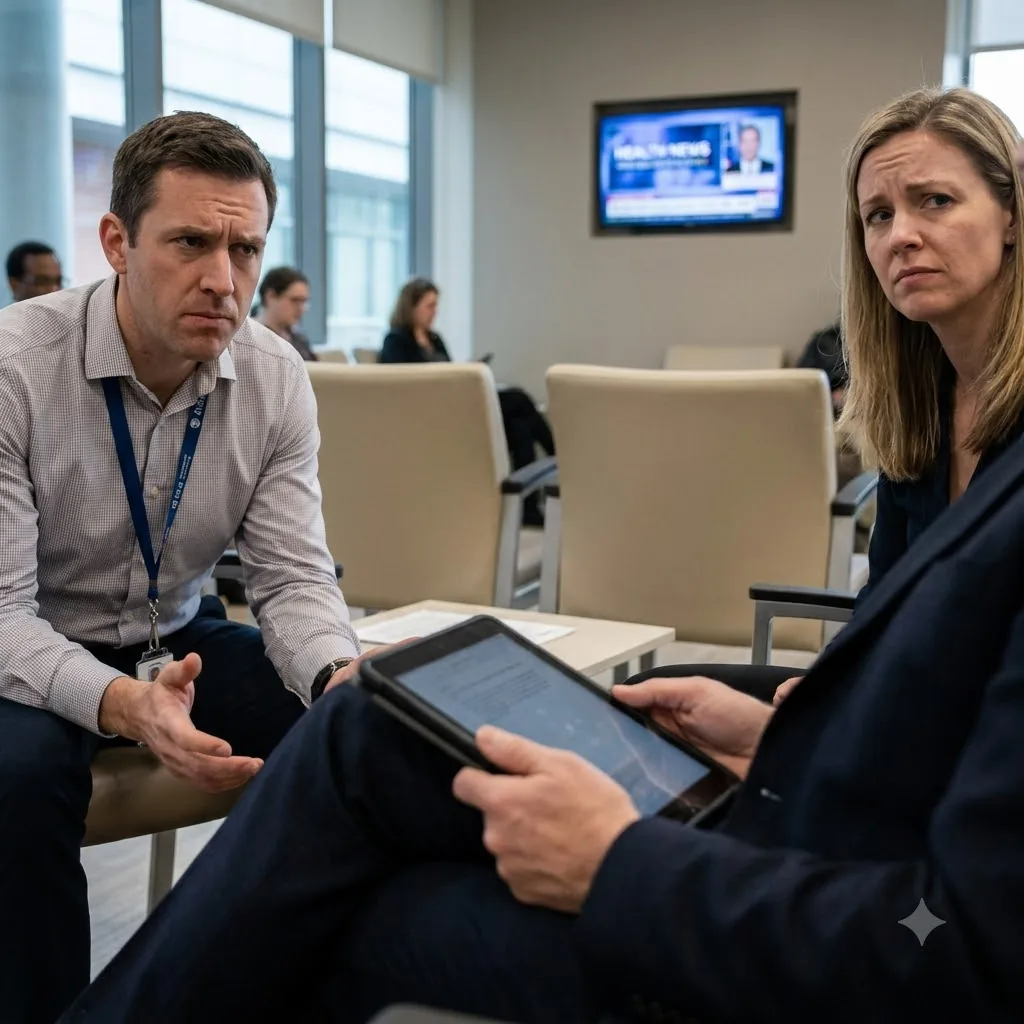
By the time the final confirmation screen came up, the health feed in the waiting area had changed to a stroke recovery segment with captions running under a smiling face. The ordinary clinic sounds kept going. Phones. Wheels. Soft shoes on vinyl flooring. The kind of noise that makes one bad hour disappear into the building unless the building decides to remember it.
This one remembered.
When Lena closed the workflow, the tablet flashed the session summary for one second before dimming. I saw Tessa’s signed consent, my support role, and Dr. Soren’s supervisor note attached to the completed record.
Protection, exactly where it should have been from the start.
Tessa reached for my wrist after Lena stepped away with the tablet. She did not squeeze hard. “Thank you,” she said.
I told her, “You don’t have to thank me for staying.”
She looked toward the hall where Evan had disappeared and then back at me. “They’ll still say stuff.”
She was right.
Not loudly. Not in some big scene. That would have been easier to answer. It came in side looks and clipped politeness and the way one of the intake women stopped talking when I walked back to the checkout alcove for Tessa’s discharge folder. Another staff member asked, “Are you the family support from earlier?” in a tone that said she had already heard a version with my name in it.
Then I saw the concrete part.
A yellow advisory banner had been added to Tessa’s printed visit packet: Care companion participation permitted by supervisor review. Use assigned staff only for consent handling.
It was meant to protect the next step. It also turned our morning into a permanent flag someone else would see before they saw us.
I held the folder a little tighter and brought it back to Tessa.
Dr. Soren met us near the exit rail where patients waited for rides. He had his chart tucked under one arm again, same as before, but his voice was more formal now, like he was already speaking for the record. “I’ve documented that Ms. Bell remained within patient-requested support and that today’s accusation was not supported by the care log or tablet sequence. Mr. Pryce is removed from this case going forward.”
I said, “Going forward on this case.”
He looked at me and gave a small nod. “On this case.”
That was the shape of the win. Narrow. Accurate. Not generous.
Tessa heard it too. Her mouth pressed flat for a second. She adjusted the folder on her lap and looked down at the advisory banner without saying anything.
A few minutes later, through the glass panel by the side station, I saw Evan at a terminal with another staff member standing beside him. He was not touching the keyboard. She was. He pointed once at the screen, and she kept typing. Then she printed something, pulled his badge access sheet from under a clip, and set it on top.
I could not hear them, but I did not need to. He had been taken out of at least one system path, and he knew I could see it.
He turned his head. Our eyes met through the glass.
He did not come over. He did not apologize. He did not need to for the cost to stay where it had landed. A few people in that clinic had already watched him call me selfish. Fewer of them had watched the tablet prove otherwise. That ratio was not going to change because one supervisor note existed.
Our ride texted that she was outside.
I helped Tessa stand, took the folder, and walked her through the automatic doors into the hot afternoon. The parking lot smelled like asphalt and cut grass. For the first time all day, there was no machine noise around us.
Tessa stopped before the curb and said, “Next time, I want a different location.”
I looked back through the glass at the clinic logo on the wall and the blur of people moving inside it. “Then that’s what we do,” I said.
It meant a longer drive, new scheduling, another morning off work for me, and starting over with a team that had never seen us before. It also meant I would not bring her back into a room where my help could be turned into a warning label and then corrected only after damage had already traveled.
When the car pulled up, I opened the door for her and tucked the flagged folder under my arm so it would not slide.
We had the note. We had the record. We had the protection.
What we did not have was the clean version where truth arrives first and everybody who heard the lie also hears the fix.
We left anyway.